
The Gap Between Theological Confidence and Christian Faithfulness
There is no question that many men today are thinking more seriously about theology than they were a generation ago. That is a good thing. The renewed interest in Reformed theology, confessional Christianity, biblical masculinity, and broader cultural questions has brought real clarity in some areas where the church had grown shallow. Recent controversies surrounding Christian Nationalism, interracial marriage, and government interference have only intensified these discussions and pushed many men to sharpen their theological positions and public convictions.
But clarity in doctrine does not automatically produce maturity in life.
That distinction matters far more than many realize.
Scripture never treats theology as an end in itself. Truth is always meant to shape worship, obedience, relationships, and daily conduct. When doctrine stops at the level of debate, identity, or online presence, something essential has been missed.
This is where a growing number of “theobros” struggle. Not because they care about truth, but because truth has not yet fully worked its way into every corner of their lives.
Definition of a “Theobro”
Before we go any further, let’s define what a “theobro” is.
The term theobro is a social media portmanteau of “theology” and “bro.” It typically refers to a specific subculture of young men—often within Reformed or Calvinist circles—who are intensely passionate about high-level Christian doctrine and church history. While the term can be used affectionately within these communities, it is more commonly used as a lighthearted (or sometimes critical) critique of a personality type that prioritizes intellectual debate and rigorous logic over pastoral sensitivity or nuance.
Often, a theobro starts as a “Cage Stage” Calvinist. This term refers to a phase some people go through after first embracing Reformed theology, where enthusiasm turns into constant arguing, correcting others, and pressing the doctrines aggressively. The issue is not wrong doctrine but right doctrine without maturity. Over time, most grow out of it as they learn that the doctrines of grace are meant to produce humility, patience, and love, not pride or combativeness.
Unfortunately, some Cage Stagers never break free into maturity and growth in Christ, and only find other like-minded believers and double down in their persistent arrogance. Others may “mellow out,” but remain functionally unchanged, having traded open hostility for quiet pride, retaining sharp theology while never allowing it to reshape their character, relationships, or daily obedience.
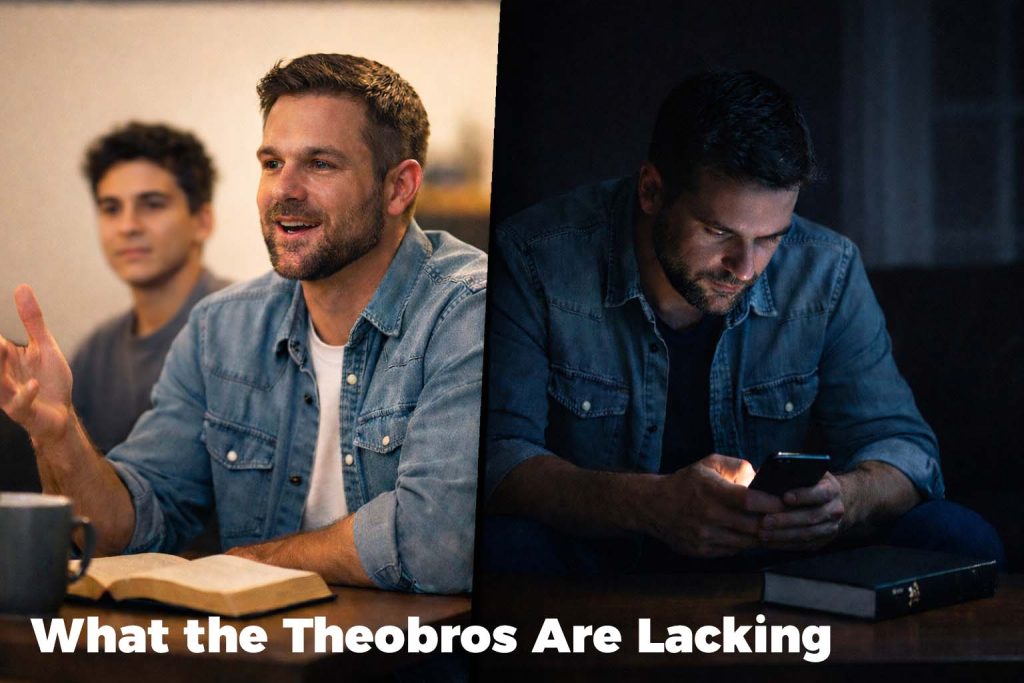
In a digital space, a theobro is easily identified by his aesthetic and habits: think coffee shop settings, leather-bound Bibles, owning stacks of reformed and Puritan books, and a penchant for quoting 16th-century theologians like John Calvin. They are known for being highly active in “Christian Twitter” or “X,” where they engage in spirited—and often pedantic—debates over complex topics like Christian Nationalism, predestination, or church governance. At its core, the theobro phenomenon represents a modern intersection of traditional masculinity and academic faith, though it often faces criticism for being overly argumentative or exclusionary toward differing viewpoints.
Please note that this term does not cover most men in the reformed/Calvinistic camp, and I include myself in that realm. This term defines only those who are very vocal and exhibit the traits listed above.
Let’s now discuss what many theobros are lacking in their walk with Christ.
Knowledge Without Corresponding Fruit
Many theobros know their soteriology. They can explain election, regeneration, effectual calling, justification, ordo salutus, and perseverance with impressive precision. They can quote the Reformers, reference confessions and catechisms, and aggressively dismantle shallow arguments with ease.
What Scripture asks, however, is not only what a man knows, but what kind of man that knowledge is producing.
Paul warns that knowledge alone can puff up, while love builds up (1 Corinthians 8:1). James reminds us that hearing without doing is self-deception, not maturity (James 1:22). Jesus Himself said that a tree is known by its fruit, not by its vocabulary (Matthew 7:16-20).
Quite honestly, what is missing from many of these men’s lives is gentleness, graciousness, humility, and meekness. Yes, we are to be bold and courageous in proclaiming the good news of Jesus Christ, but not to the point where we are arrogant, harsh, self-serving, or prideful in our ways.
The danger is not strong doctrine. The danger is doctrine that stops short of obedience.
Reformed in Soteriology, Unreformed Everywhere Else
Pastor Paul Washer once made a sobering observation. Many Calvinistic men are deeply Reformed and biblical in their understanding of salvation, but are not Reformed or biblical in their marriages, prayer lives, parenting, church involvement, or care for the poor.
That is not a minor inconsistency. It is a hefty theological problem.
Biblical doctrine was never meant to reform only how a man thinks about salvation. It was meant to reform how he loves his wife (Ephesians 5:25), how he raises his children (Ephesians 6:4), how he prays (1 Thessalonians 5:17), how he treats the church (Hebrews 13:17), and how he cares for those in need (James 1:27).
A man who is precise about justification but negligent in prayer has not fully absorbed what it means to depend on God. A man who defends headship but neglects sacrificial love has misunderstood authority. A man who champions God’s sovereignty but refuses humility has missed the point of grace altogether.
The doctrines of grace are meant to produce gracious men.
Loud About Authority, Quiet About Submission
One recurring issue among theobros is a fixation on authority without an equal emphasis on submission. There is strong rhetoric about leadership, hierarchy, and order, but far less enthusiasm for being under authority.
Scripture never separates the two.
Jesus exercised perfect authority because He lived in perfect submission to the Father (John 5:19). Paul commanded wives, children, and servants to submit, but also placed husbands, fathers, and masters under God’s judgment and accountability (Ephesians 5:21–6:9).
Men who resist church membership, dismiss pastors, or operate independently while speaking constantly about authority reveal a fundamental imbalance. Biblical masculinity does not begin with ruling. It begins with kneeling.
God gives authority to men who have learned obedience.
Argument Culture Instead of Shepherding Hearts
Another common gap is the substitution of debate for discipleship. Many theobros are far more skilled at arguing online than they are at patiently shepherding people in real life.
Paul instructs Timothy that the Lord’s servant must not be quarrelsome, but kind, patient, and gentle, even while correcting error (2 Timothy 2:24–25). Truth is never meant to be wielded like a club.
Winning arguments does not make mature believers. Walking alongside people, bearing burdens, and laboring patiently does.
The church does not primarily need more polemicists. It needs men who can teach, correct, and care without arrogance or contempt.
Cultural Vision Without Personal Faithfulness
Some theobros speak passionately about reclaiming culture, restoring Christian influence, and resisting secularism. Those concerns are not illegitimate. But Scripture consistently prioritizes faithfulness in ordinary callings over grand visions.
Paul tells believers to aspire to live quietly, work with their hands, and walk properly before outsiders (1 Thessalonians 4:11–12). Jesus teaches that those faithful in little will be faithful in much (Luke 16:10).
A man who cannot manage his time, steward his finances, keep steady employment, or serve faithfully in a local church is not prepared for broader influence. Cultural renewal does not begin with platforms. It begins with character.
God is far more concerned with who a man is becoming than how many people are listening to him.
A Thin Prayer Life
For all the talk of sovereignty, many theobros pray very little. This is one of the clearest signs of imbalance.
Scripture presents prayer as the natural response to belief in God’s absolute rule. If God truly governs all things, then dependence should increase, not diminish.
Jesus prayed constantly. Paul prayed without ceasing. The early church prayed earnestly. Men who claim deep theology but live prayerless lives are functionally self-reliant.
Prayerlessness is not a personality trait. It is a theological contradiction.
Neglect of the Poor and the Weak
Another overlooked area is concern for the poor, the marginalized, and the vulnerable. Scripture repeatedly ties true religion to caring for those who cannot repay us (Proverbs 19:17; James 1:27).
Some theobros dismiss this emphasis as social distraction or sentimentalism. Scripture does not give that option.
Care for the needy is not a substitute for the gospel, but it is a fruit of it. A man who understands grace but shows no mercy has misunderstood both.
The same God who saves sovereignly commands generosity sacrificially.
Confidence Without Humility
Strong convictions are necessary. Scripture never commends timidity about truth. But conviction must be matched by humility.
James describes wisdom from above as pure, peaceable, gentle, open to reason, and full of mercy (James 3:17). Peter commands believers to defend the faith with gentleness and respect (1 Peter 3:15).
When confidence consistently outruns character, something has gone wrong. The goal of theology is not dominance. It is transformation.
The Call to Repentance and Growth
None of this is meant to dismiss theological seriousness. The church desperately needs men who care about truth. But truth that does not reshape life is incomplete.
Scripture does not ask men to choose between doctrine and devotion; it demands both.
The answer is not less theology. It is deeper theology. Theology that reaches the marriage bed, the prayer closet, the dinner table, the church pew, and the street where the poor live.
If you see yourself in these weaknesses, the solution is not defensiveness. It is repentance. God is patient. He delights in reforming men who are willing to be reformed all the way down.
Christ did not die merely to correct our thinking. He died to claim our whole lives.
The mark of a mature Christian man is not how sharp his theology sounds, but how faithfully it governs his life when no one is watching.
That is the kind of Reformation the church still needs.
One Comment
Joshua Boron
It’s about time someone called out the “Cage Stage” warriors who can quote the Institutes in their sleep but haven’t spoken to their neighbors in years. You hit the nail on the head: having a pristine 1689 confession on your shelf doesn’t mean much if your prayer life is as dry as a stack of Puritan paperbacks.
It’s a great reminder that the “ordo salutis” should actually result in, you know, being a decent human being!
That said, I’m sure the guys you’re describing will take this feedback with their signature “gentleness and respect,” which is to say, they’re probably already drafting a 47-part X thread explaining why your definition of “meekness” is historically inaccurate. Thanks for having the guts to say what everyone else is thinking while they’re busy arguing about aesthetics