
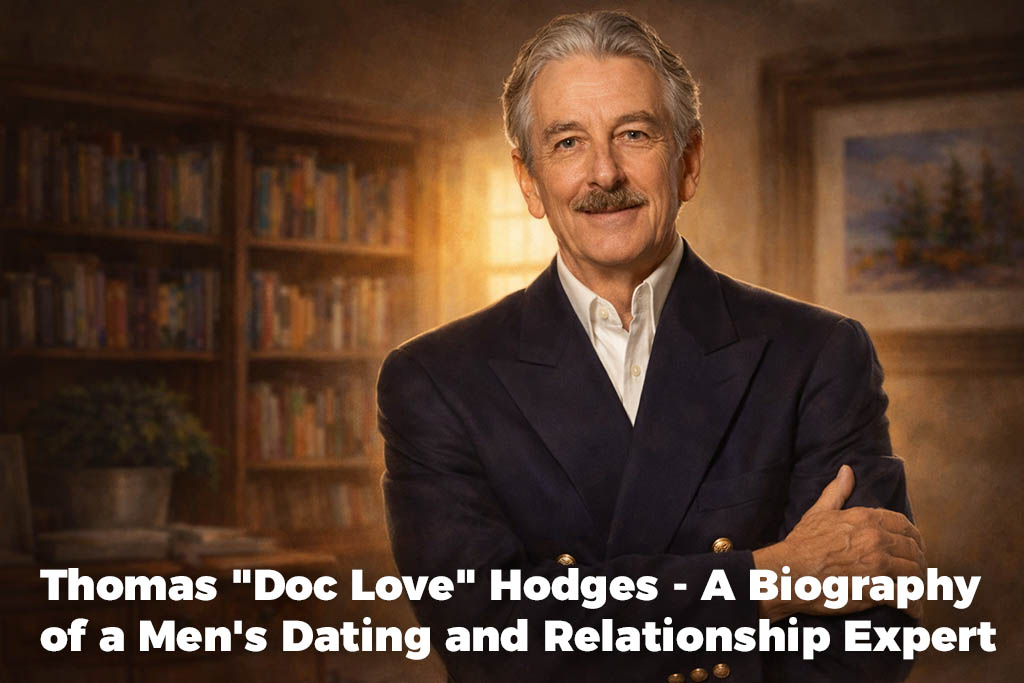
Thomas “Doc Love” Hodges (1943-2020): A Comprehensive Biography
Thomas Warren Hodges, best known under the pseudonym “Doc Love,” was an American relationship coach, advice columnist, and author whose work influenced generations of men navigating the complexities of dating and relationships. Over a four-decade career, he built a reputation for no-nonsense, research-driven coaching focused on helping men develop confidence and discernment in their romantic lives. Born March 14, 1943, and passing in August 2020 at age 77, Hodges left behind a library of writings and audio resources that continue to be circulated among men seeking relationship wisdom.
Early Life and Personal Background
Public records provide limited information on Hodges’s early life. Born in 1943, he later made Oceanside, California, his home base. Before stepping into the relationship coaching world, Hodges worked as a salesman, an experience that shaped his pragmatic, strategic outlook on social dynamics. He adopted the moniker “Doc Love” as a persona rather than a title—he was not a medical doctor, but rather a self-styled expert in love and human behavior. Hodges identified as a libertarian and an advocate for men’s issues in dating, often emphasizing the importance of male self-respect and boundaries. His personal life remained largely private, with Hodges preferring to focus his public persona on instruction and commentary rather than autobiography.
Founding “The System” and Field Research Methods
In 1965, at the age of 22, Hodges began what would become a lifelong pursuit: understanding what makes women stay with one man and not another. Instead of relying on conventional psychology or academic theories, he conducted his own field research, interviewing over 10,000 women across a span of 40 years. He believed the best way to understand women was to ask them directly—so he did. He focused not just on what women claimed they wanted, but on how they actually behaved in relationships. These firsthand insights would become the backbone of his signature program, The System [read my review].
His sales background played a role in how he taught dating: success was about process, confidence, timing, and reading responses accurately. He believed that just as a salesperson learns to read a potential buyer, a man should learn to read a woman’s level of interest. His methodology emphasized discipline, timing, and emotional control. By the early 2000s, he had codified these principles into a core curriculum known as The System: The Dating Dictionary, first self-published in 2002.
Core Teachings: Interest Level, Challenge, and Compatibility
At the heart of The System was a belief that a man’s success in dating hinged on his ability to be a Challenge. For Hodges, being a Challenge meant not giving away romantic interest too quickly and not doing the emotional “chasing.” Instead, he taught men to let women do the pursuing—if they were genuinely interested.
The cornerstone of this philosophy was the concept of Interest Level, which Hodges described as a woman’s degree of emotional and romantic investment, measured on a scale from 0% to 100%. According to The System, a woman had to start with at least a 51% Interest Level for a relationship to work. Anything less was doomed from the start, and it was up to the man to recognize that early on and walk away.
Interest Level, as Hodges taught it, was dynamic. Women’s interest could rise or fall depending on the man’s behavior. Therefore, his advice centered around monitoring a woman’s actions, not her words. If she showed up consistently, expressed affection, and responded positively, her interest was high. But if she canceled plans, pulled away, or became critical, her interest was dropping—and men were coached to respond accordingly.
In his broader framework, Hodges outlined a set of ideal male traits—Confidence, Control, and Challenge—and corresponding female traits to look for: Integrity, Flexibility, Emotional Stability, and a Giving Nature. A successful long-term relationship, in his model, required that both partners possess the right traits and that the woman’s Interest Level remained high.
Coaching Method: Strategic Masculinity
Doc Love’s coaching style was characterized by a mixture of tough love, behavioral analysis, and structured repetition. He didn’t believe in vague encouragement or flowery motivation. Instead, he emphasized behavioral feedback loops, drawing from both street-level realism and a tactical understanding of romantic psychology.
He encouraged men to treat dating like a long-term sales cycle: the goal was not to convince a woman to like them, but to evaluate whether she already had enough interest to sustain a relationship. Men were told to focus less on impressing women and more on screening them for high Interest Level and healthy long-term traits. This coaching model intentionally avoided pickup artistry techniques or seduction gimmicks, framing dating instead as a matter of self-control, reading cues, and exercising standards.
For example, his advice to delay calling a woman after getting her number—sometimes up to 5 to 9 days—wasn’t about manipulating women or playing games. It was about resisting neediness and testing the woman’s natural enthusiasm. He saw this as a counterbalance to men who typically moved too quickly and overinvested too soon. Similarly, he trained men to recognize red flags, stand firm on values, and even walk away if needed—teaching that losing a woman who isn’t right is not failure but strength.
His coaching also relied on what he called “Success Stories” and “Reality Checks”—case studies where listeners shared how The System had worked (or not) and received Hodges’ critique. This recursive, correctional style made his audience not just passive learners but active participants in developing discernment.
The Ringer Connection: Borrowing the Interest Level Framework
Hodges credited his foundational idea of Interest Level to Robert Ringer, a libertarian author known for the bestsellers Winning Through Intimidation (1973) and Looking Out for #1 (1977). In Looking Out for #1, Ringer writes that “love is not an either/or proposition; it is measured in degrees.” This framework—seeing emotional investment as something that can rise or fall—would become central to Hodges’ teaching decades later.
Ringer’s broader philosophy emphasized rational self-interest, the idea that people are motivated primarily by what benefits them. In relationships, this meant that affection, loyalty, and love had to be earned by offering value—not demanded or expected unconditionally. He also championed what would later be called the principle of least interest—that the person who is less emotionally invested has more power in the relationship.
Doc Love’s interpretation of this idea became the backbone of his Challenge doctrine. If a man showed too much interest too early, he would lower the woman’s Interest Level. Instead, he taught men to hold back—to maintain the perception of value and to ensure that any pursuing came from genuine desire on the woman’s part.
While Ringer’s work wasn’t written specifically about romantic relationships, its concepts about perception, value, and self-control deeply influenced Hodges. The System repackaged those ideas for the dating world, placing them into a structured method for men seeking long-term commitment.
Career as Author, Columnist, and Broadcaster
Hodges spent decades building out his material into multiple formats. In 2002, he published The System – The Dating Dictionary, and later expanded his teachings with a series of audio supplements and the Mastery Series (Volumes I-IV). He became a regular contributor to AskMen.com, where his weekly “Ask Doc Love” column became one of the site’s most popular features.
He also hosted a long-running radio show, The Doc Love Show: Understanding Women for Men Only, co-hosted with Jeff M. Stevens. The show featured live Q&A sessions, where Hodges answered relationship questions in real time using principles from The System. Over 300 episodes are archived, and many of them are still circulated today through his website and podcast platforms.
Hodges made media appearances on outlets such as FOX News and Time Magazine. These appearances, along with his consistent radio and blog presence, earned him recognition as one of the more serious and structured voices in the dating advice space. Unlike the flashier pickup artist (PUA) crowd that emerged during the same era, Doc Love focused on long-term relationships and marriage-oriented dating.
Reception, Critiques, and Cultural Impact
Reception to Hodges’ work ranged from devoted praise to measured criticism. Many men credit The System with helping them move on from toxic relationships or develop confidence they had never experienced before. Listeners often said they felt seen, especially those who had been “too nice” or overly accommodating in their past relationships.
However, critics have accused The System of being overly rigid, lacking flexibility for nuance or exceptions. The structure’s emphasis on rules—like call-back timelines or never discussing feelings too early—was seen by some as dogmatic. Detractors also argued that certain elements encouraged emotional distance or manipulation if taken to extremes. The mantra “watch her actions, not her words” was useful, but some felt it led to paranoia or over-analysis.
Despite this, Hodges consistently reminded his audience that his goal was long-term relationships, not short-term conquests. He condemned the casual sex ethos of the PUA scene, stating that real strength came not from sexual success, but from relational discernment and stability.
In terms of cultural influence, Doc Love helped usher in a generation of men thinking more critically about dating—not just in terms of seduction, but in values, compatibility, and emotional readiness. He predated and possibly influenced more modern dating podcasts and influencers who emphasize male self-respect, boundaries, and filtering for women who show genuine interest. While some of his views might feel dated to today’s audiences, the deeper themes—confidence, emotional self-discipline, and choosing wisely—remain relevant.
Death and Ongoing Legacy
Thomas “Doc Love” Hodges died in August 2020 at the age of 77. The cause of death was not publicly disclosed. His passing was mourned by a wide community of followers who had benefited from his teachings. His longtime friend and co-host Jeff Stevens helped ensure that Hodges’ work remained available, curating the Doc Love Club and managing the archive of articles, podcasts, and training materials.
As of 2023, the website DocLove.com continues to offer weekly advice segments and archived radio recordings. His YouTube channel and blog remain active, with past episodes and lessons still reaching new audiences. For those who knew him or learned from him, Hodges remains a singular figure—one of the few dating coaches who built his system on decades of empirical interviews, personal field work, and practical experience.
Conclusion
Thomas Hodges, or “Doc Love,” left behind more than just dating advice—he left behind a structured philosophy rooted in human behavior, confidence, and emotional intelligence. Drawing inspiration from thinkers like Robert Ringer and blending it with firsthand research, Hodges created a system that continues to shape the way many men approach relationships today. Whether one agrees with every detail of The System or not, there’s no denying that Doc Love carved out a unique and lasting legacy in the world of relationship coaching.
5 Comments
My Top 20 Favorite Books of All Time (Outside of… Pingback
[…] Doc Love‘s The System is certainly the odd duck here. Since this is admittedly a secular dating and relationship book, it may appear to be totally out of place on this list, like a headbanger wearing a Slayer t-shirt would be at a reformed church conference. Plus, with a title like The System, and its cover artwork displaying a pair of female legs, this may look like a sleazy and misogynistic “pick-up artist” guide. So, what’s the deal? […]
Day 1 - Winning Back Her Heart, God's Way… Pingback
[…] day will integrate four redeemed ideas from Doc Love: Interest Level, The System (steady, disciplined behavior), Being a Challenge (strength with […]
Interest Level: Why Relationships Change and What… Pingback
[…] term Interest Level was coined by the late Thomas “Doc Love” Hodges, a relationship researcher who spent decades observing patterns in male and female relationships. […]
The Core Reason Adultery and Divorce Happens -… Pingback
[…] late secular relationship expert Thomas Hodges, better known as Doc Love, talked constantly about “Interest Level.” Strip away the […]
Review of Doc Love’s THE SYSTEM – THE DATING… Pingback
[…] and “love coach” Doc Love claims that he does indeed understand women, and is perhaps the first in 6,000 years to do so. […]