 The Most Misinterpreted Bible Verses (And What They Actually Mean)
If you spend any time around Christian culture, you start to notice something. Certain verses get quoted a lot. They show up in sermons, on social media images and memes, even on coffee mugs. But when you slow down and actually read them in context, you realize something else. Many of these verses aren’t being used the way God intended.
This matters heavily. Because when we misunderstand Scripture, we often miss more than just a detail. We can miss the whole point. Over time, that shapes how we see God, the Gospel, and the Christian life itself.
Let us walk through some of the most commonly misinterpreted passages, one by one, and let the Bible speak for itself.
Matthew 18:20
“For where two or three are gathered in my name, there am I among them.”
I have heard this verse used countless times to describe small prayer meetings. The idea is that if only a few people show up, that is okay, because Jesus promises to be present. It sounds comforting. But that is not what Jesus is talking about.
The context is church discipline. In Matthew 18:15-20, Jesus is giving instructions on how to deal with sin in the church. If someone refuses to repent, it eventually comes before the church. And when the church acts in accordance with Christ’s authority, Jesus assures them that He is present in that process.
This is not about needing a minimum number for God to show up, as if you, when you are by yourself, the Holy Spirit disappears, and He reappears when another Christian comes along. God is present with His people always, even when they are alone. This verse is about the authority of Christ working through His church when it faithfully applies His Word. That should actually raise the weight of the passage, not reduce it to a comforting slogan.
Revelation 3:20
“Behold, I stand at the door and knock. If anyone hears my voice and opens the door, I will come in to him and eat with him, and he with me.”
This is often used as an evangelistic appeal, as if Jesus is knocking on the door of an unbeliever’s heart, waiting to be let in. You have probably seen it in tracts or heard it in altar calls.
But the verse is addressed to a church. Specifically, the church in Laodicea, to which Jesus is speaking to in Revelation 3:14-22 (don’t forget, He addressed seven specific churches in Asia Minor in chapters 2 and 3). In the Laodicean church, they were already believers in Christ. They were a church that had become self-sufficient, complacent, lackluster, and spiritually useless. Jesus is not outside the heart of an unbeliever here. He is outside His own church, calling them to repent.
That should stop us in our tracks. It is possible for a church to be so lukewarm, so content in its own comfort, that Christ is no longer central. The call is not merely “let Jesus into your life,” but “repent and return to fellowship with Him.” This is a warning passage for professing believers, not just an invitation for outsiders.
1 Timothy 6:10
“For the love of money is a root of all kinds of evils.”
People often shorten this to “money is the root of all evil,” which is not what Paul says. Those two small changes (eliminating the “love of money” and calling it “the root” as opposed to the correct “a root”) create a big misunderstanding.
Money itself is not evil. It is a tool. Scripture speaks positively about wise stewardship, generosity, and provision. The issue is the love of money. That craving, that fixation, that subtle shift where wealth becomes security and desire becomes idolatry, and the Bible warns in numerous places about how the love of riches can lead one astray.
Paul says this love leads people to wander from the faith and pierce themselves with many pains. I have seen that play out, and you probably have, too. It rarely looks dramatic at first. It starts with priorities shifting. Time, energy, and attention get redirected. And before long, Christ is no longer first.
The verse is not condemning having money. It is exposing the danger of loving it.
John 6:53
“Unless you eat the flesh of the Son of Man and drink his blood, you have no life in you.”
This is one of the most misunderstood and debated passages in the New Testament. Some take it as a literal command, pointing to the Eucharist (AKA Communion or Lord’s Supper), in that when you partake in the elements of bread and wine, they literally turn into the flesh and blood of Jesus Christ in your body (something Catholics call transubstantiation). But if you follow the flow of John 6, Jesus is explaining what it means to believe in Him.
Earlier in the chapter, He says that whoever comes to Him will not hunger, and whoever believes in Him will never thirst. Coming and believing are parallel ideas. Then He uses this graphic language about eating and drinking to emphasize the necessity of fully receiving Him by faith.
And then He clarifies in John 6:63 that the flesh is no help at all and that His words are spirit and life. That matters. Jesus is not teaching literal consumption. His context has nothing to do with Communion (a concept He did not introduce until the Last Supper). He is calling people to trust in Him completely, to rely on Him as their true source of life.
Faith is not casual agreement. It is dependence. That is what this passage is driving at.
Matthew 7:1
“Judge not, that you be not judged.”
This is perhaps the most misused verse in all the Bible.
Matthew 7:1 verse gets thrown around anytime someone calls sin what it is. It has become a shield against correction, accountability, and even basic discernment. People (especially non-believers) blurt it out whenever a Christian speaks out against any wrongdoing.
But Jesus is not forbidding all judgment. In fact, several verses later in Matthew 7:15-20, He tells us to watch out for false prophets and to recognize them by their fruits. That requires judgment.
But even the verses surrounding this “do not judge” shows what the command really means. Read the whole section in context:
Judge not, that you be not judged. For with the judgment you pronounce you will be judged, and with the measure you use it will be measured to you. Why do you see the speck that is in your brother’s eye, but do not notice the log that is in your own eye? Or how can you say to your brother, ‘Let me take the speck out of your eye,’ when there is the log in your own eye? You hypocrite, first take the log out of your own eye, and then you will see clearly to take the speck out of your brother’s eye.”
– Matthew 7:1-5″
The issue is hypocrisy. Jesus describes a man trying to remove a “speck” from his brother’s eye while a wooden “log” is in his own. That is the kind of judgment He condemns. Self-righteous, blind, and arrogant.
Right judgment, on the other hand, starts with examining ourselves. He says to remove the log (big, habitual sins) from your own life first, then you can righteously judge others. It is humble. It is careful. It is rooted in truth, not pride. We are not called to ignore sin. We are called to deal with it rightly, beginning with our own hearts.
2 Chronicles 7:14
“If my people who are called by my name humble themselves, and pray and seek my face and turn from their wicked ways, then I will hear from heaven and will forgive their sin and heal their land.”
This verse gets applied to nations all the time, especially in calls for cultural revival. You will hear it quoted in reference to modern countries, especially to America, as if it is a direct promise that God will heal the land if enough people pray.
But this verse was spoken to Israel under the Old Covenant. Israel was a specific people, in a specific land, with covenant promises tied to their obedience. Christians today, as part of the Kingdom of God, have no physical land. We are a spiritual Kingdom until the actual, literal, physical return of the Lord Jesus Christ.
That does not mean it has no application today. The basic principle is still true. God responds to humility, repentance, and prayer. But we need to be careful not to treat this as a national formula.
The Church is not a geopolitical nation. Our hope is not in cultural restoration but in the advance of the Gospel. When God’s people repent, He restores them spiritually. That is the deeper reality this points toward.
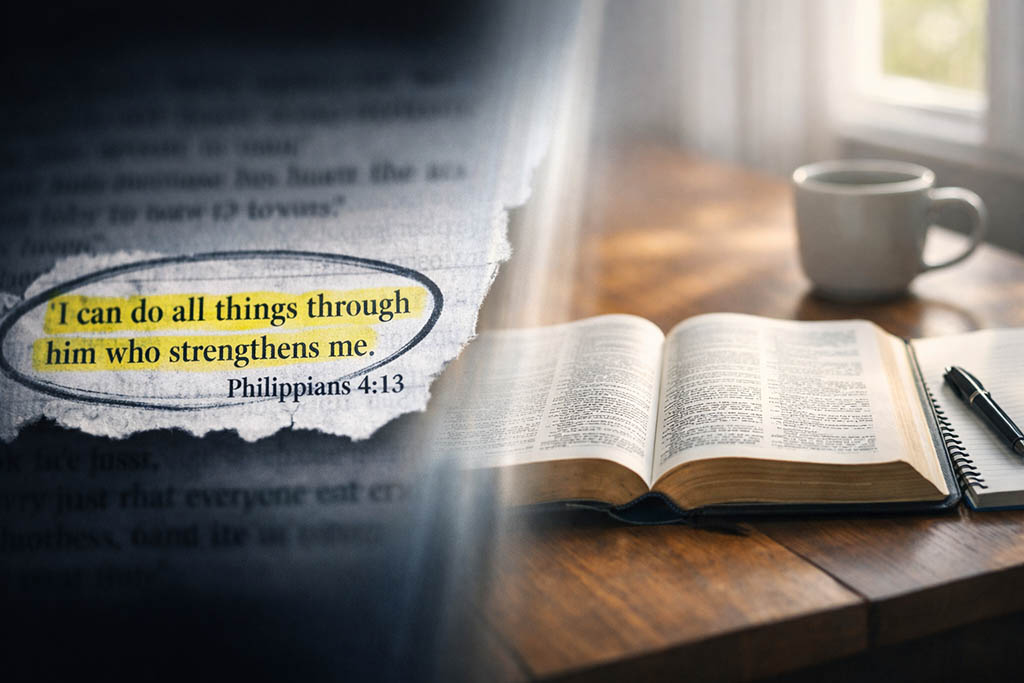
Philippians 4:13
“I can do all things through him who strengthens me.”
This has become a kind of Christian motivational slogan. Athletes quote it. People use it to talk about achieving goals or overcoming challenges.
But Paul is not talking about accomplishing anything we set our minds to. He is not talking about scoring a touchdown, dunking a basketball, winning a foot race, passing an exam, or getting a promotion at work. He is talking about contentment in all circumstances. In the verses leading up to this, he says he has learned to be content in any situation. Whether well-fed or hungry, in abundance or in need.
That changes everything. The strength Christ provides is not about success in worldly terms. It is about faithfulness in every circumstance and to endure through the power of Christ.
I have found this especially helpful in seasons that do not go the way I expected. This verse reminds me that Christ is enough, even when everything else feels uncertain.
Jeremiah 29:11
“For I know the plans I have for you, declares the Lord, plans for welfare and not for evil, to give you a future and a hope”
This is one of the most quoted verses in the Bible, often used to encourage people that God has a wonderful plan for their life filled with lots of prosperity and success.
But the original audience was in exile: God was speaking to the Jewish people in Babylon, telling them that after seventy years, He would bring them back to the lands He promised them. Seventy years. That means many of them would not live to see it.
So what is the promise? Not immediate comfort, but future restoration. Not a guarantee of ease, but assurance of God’s faithfulness.
When we read this rightly, it actually becomes more powerful. God’s plans are good, even when they unfold over time, through hardship, and beyond what we can see. Our hope is anchored in Him, not in our circumstances.
Proverbs 22:6
“Train up a child in the way he should go; even when he is old, he will not depart from it.”
Many parents read this as a promise. Raise your children right, and they will never walk away. But Proverbs as a type of Hebrew literature, are wisdom sayings, not guarantees.
They describe how life generally works, not what always happens in every single situation. Of course, faithful parenting matters deeply! It shapes, guides, and influences. But each child is still responsible before God.
This verse encourages diligence, not control. It calls parents to invest, teach, and model godliness, trusting the results to the Lord.
That can be both freeing and sobering. We are responsible for faithfulness, not outcomes.
Luke 22:36
“Let the one who has no sword sell his cloak and buy one.”
This verse is sometimes used to argue that Jesus was promoting armed defense or even violence. But the context matters.
Just a few verses later, when the disciples produce two swords, Jesus says, “It is enough.” And when one of them actually uses a sword to strike a servant, Jesus rebukes him and heals the man.
So what is going on? Jesus is preparing His disciples for a shift. They are about to face opposition and hardship. The mention of swords highlights the seriousness of what is coming, not a call to violence.
The broader teaching of Jesus consistently points toward trust in God, not reliance on force. We need to read this verse in light of the whole picture.
For more on self-defense and war for Christians, please read my in-depth article on the topic.
Isaiah 54:17
“No weapon that is formed against you shall prosper…”
This verse gets used as a blanket promise of protection from harm, as if nothing bad will ever happen to God’s people.
But the context is about ultimate vindication. Here in the Book of Isaiah, God is speaking to His people about their future restoration and the fact that their enemies will not ultimately prevail.
That does not mean believers will never suffer. The New Testament is abundantly clear that we will face trials, persecution, and hardship. But none of those things can separate us from God or thwart His purposes. The promise is not that weapons will never be formed, but that they will not ultimately succeed at defeating God in the end. God’s people are secure in Him, even in the midst of suffering.
In Summary – Read the Bible in Context
When you put all of this together, a pattern emerges. Scripture is not vague or contradictory. It is consistent, clear, and deeply rooted in context. The problem is not with the Bible. It is with how we sometimes handle it.
That is why careful reading matters. That is why context matters. And that is why we need to let the Bible interpret itself.
One of the simplest and most practical ways to guard against misinterpretation is this: stop reading isolated verses and start reading whole sections. Read the paragraph. Read the chapter. Keep going until you understand the flow of thought. Ask basic questions. Who is speaking? Who is being addressed? What is happening before and after this verse? Who is this book of the Bible about, and why was it written?
I have found that many of the so-called confusing verses in Scripture clear up quickly when you just keep reading. The Bible was not written as a collection of random one-liners or warm, inspirational quotes to put on t-shirts, bumper stickers, and coffee mugs. Scripture was written as whole letters, narratives, sermons, and prophecies that unfold over time. When we pull a single verse out of that flow, we are far more likely to twist it without realizing it.
This is also why it is so important to sit under faithful, expository preaching. Not topical messages built around a few scattered verses, but preaching that opens the text, walks through it carefully, and explains what it actually says in its context. Verse by verse. Chapter by chapter. Letting the meaning come from the passage itself rather than being imposed onto it.
There is something deeply stabilizing about that kind of preaching. It trains you to read your Bible better. It protects you from error. And over time, it shapes how you think, not just about individual verses, but about the whole counsel of God.
Because when we handle Scripture rightly, we do not just gain information; we encounter truth. We see more clearly who God is in His holiness, His justice, and His mercy. We see what He has done in Christ to save sinners who could never save themselves. And we begin to understand what it means to live in light of that reality.
The Word of God is not the problem. It is living and active. It is sharp. It is clear. And it is sufficient. The call is not to reshape it, soften it, or bend it to fit what we want it to say. The call is to read it carefully, believe it fully, and submit to it completely.