
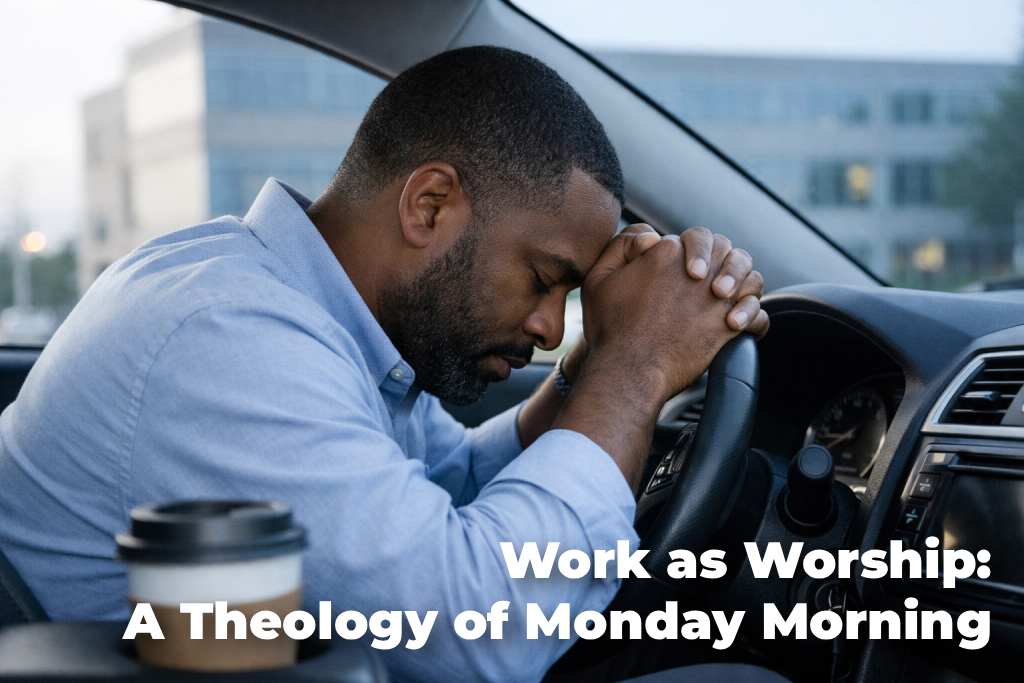
Most men do not struggle to connect Sunday to Sunday. They struggle to connect Sunday to Monday.
They can sit in church, sing, listen to preaching, and feel stirred. For a moment, everything seems clear. God is real. His Word is true. His priorities matter. Then Monday morning comes. The alarm goes off. The routine starts again. Emails, meetings, deadlines, commutes, responsibilities. And somewhere between Sunday and Monday, something disconnects.
Work begins to feel separate from worship. Many Christian men would never say that out loud, but their lives often reflect it. Sunday is for God. Monday is for the real world. Sunday is spiritual. Monday is practical. Sunday matters eternally. Monday feels temporary.
Scripture does not allow that division.
Work Was Always Part of God’s Design
The Bible presents a very different vision. It teaches that all of life belongs to God, including what happens on Monday morning. Colossians 3:23 says, “Whatever you do, work heartily, as for the Lord and not for men.” That specific word, whatever, matters. It does not carve out exceptions or limit itself to church activity. It reaches into every task, every responsibility, every form of honest labor.
This begins all the way back in Genesis. Before sin entered the world, God gave Adam work to do. Genesis 2:15 says, “The Lord God took the man and put him in the garden of Eden to work it and keep it.” Work was not a punishment. It was always part of God’s good design. Man was created to cultivate, to build, to steward, and to bring order and fruitfulness into the world.
Sin did not create work. It corrupted it. After the fall, work became difficult. Frustration entered. Thorns and thistles grew. Effort no longer guaranteed visible results. Yet the calling itself remained. Men are still called to labor, to provide, to build, and to serve.
This is why work often feels heavy, yet still necessary. The problem is not that we work. The problem is how we understand it.
Why Monday Feels So Meaningless
I remember one particular season where Monday mornings felt especially draining to me. It was a time in my life where the weekend seemed too short, the workload too high, and the motivation too low. I’m sure 100% of you know exactly what I mean. Anyway, I would sit at my desk, look at the list of tasks in front of me, trying to stay awake and chugging on coffee, and I felt like I was just grinding through another week, and the only thing that mattered was when it became 5:00 pm on a Friday. Nothing about it felt spiritual. It felt like survival.
That is where many men live. Work becomes something to endure rather than something to steward. You push through the day, look forward to the weekend, and repeat the cycle. Over time, that mindset begins to shape how you view your entire life.
It’s often worse because the world often encourages us to hate Mondays and hate our jobs.
But Scripture invites us to see something different. Something deeper. It reminds us that your ultimate boss is not your employer. It is Christ Himself. When Paul tells believers to work “as for the Lord,” he is not speaking theoretically. He is reorienting how we see reality.
You are not just working for a paycheck. You are serving the Lord Jesus Christ.
Work as Worship Changes Everything
That truth changes everything about how a man approaches his work. It means your effort matters even when no one notices. It means integrity matters when shortcuts are available. It means your attitude matters when the environment around you is frustrating.
There is a quiet dignity in this. Ordinary work is lifted out of meaninglessness and placed into purpose. The emails you answer, the meetings you attend, the problems you solve, all become opportunities to reflect the character of God. Excellence becomes an act of worship, not perfection, but a sincere desire to do your work well because it belongs to Him.
A man who understands this does not need constant recognition to stay motivated. He knows that the Lord sees. He knows that faithfulness matters. He understands that even unseen obedience is never wasted.
I have also seen the opposite in my own life. There have been seasons where my attitude toward work slipped. Complaining came easily. Small frustrations felt bigger than they should have. I would mentally check out, doing the minimum just to get through the day.
That mindset revealed something. I was viewing work as mine instead of His.
When work becomes about me, everything feels heavier. Every inconvenience becomes personal. Every unmet expectation becomes frustrating. But when I remember that my work is ultimately for the Lord, the perspective shifts. The tasks do not change, but the meaning behind them does.
Faithfulness in Imperfect Work
This does not mean every job will feel fulfilling. Some work is repetitive. Some environments are difficult. Some bosses are unreasonable. Scripture does not pretend that those realities do not exist. Yet it calls us to something higher than our circumstances.
A Christian man works faithfully because God is worthy, not because his job is perfect.
This kind of faithfulness stands out. In a culture where many people do the minimum required, a man who works with integrity and consistency becomes noticeable. Not in a self-promoting way, but in a steady and reliable way. He becomes someone others can trust. He becomes someone who reflects something different.
That difference points back to Christ.
Provision Is Part of Worship
Work also becomes worship when it is connected to provision. 1 Timothy 5:8 reminds us of the seriousness of providing for our families. When a man works to support his household, he is not just earning money. He is fulfilling a God-given responsibility. He is caring for those entrusted to him. He is reflecting, in a small way, the provision of God Himself.
That gives weight to even the most ordinary paycheck. It is not just income. It is stewardship. It is service. It is part of your calling as a man.
Yet we must be careful. Work as worship does not mean work as identity. It does not mean work is our ultimate purpose in life. Many men begin by working faithfully, but slowly allow work to take a place it was never meant to hold.
Their sense of worth rises and falls with performance. Their mood is tied to success, and their time is consumed by their career. Sadly, their family gets what is left over. That is not worship. That is idolatry.
When Work Becomes an Idol
Jesus warned about this in Matthew 6:24 when He said, “You cannot serve God and money.” The same principle applies to work itself. You cannot serve Christ while being mastered by your career. Work is meant to be a servant, not a master.
A man who understands this holds his work with open hands. He works hard. He pursues excellence. He provides faithfully. Yet he refuses to let his job define him. His identity is rooted in Christ. His worth is secured in the gospel. His purpose extends beyond his career.
I remember a conversation with a man who had just received a promotion he had worked toward for years. More responsibility, more income, more influence. He finally became a “big shot!” On the surface, everything looked like success to this guy.
But as we talked, he admitted something quietly. He felt more pressure than peace.
His time with his family had decreased. His time in the Word had become inconsistent and eventually non-existent. His mind was constantly occupied with work decisions. During late-night hours, instead of giving his wife full attention, he spent it on his phone and on his laptop. While he had gained something externally, he was losing something internally.
That is the tension many men face. Success in the world can quietly compete with faithfulness to God and our families.
The Gospel Anchors Your Work
This is why a theology of Monday morning matters. Without it, work will either become meaningless or it will become ultimate. Neither option leads to a healthy or faithful life.
The gospel anchors us in the right place. Jesus did not die to make us successful professionals. He died to reconcile us to God. Through His life, death, and resurrection, we are forgiven, adopted, and given new life.
That identity shapes everything, including how we approach work.
We no longer work to earn worth. We work from a place of worth already given. We no longer chase success as our ultimate goal. We pursue faithfulness. We no longer see Monday as disconnected from Sunday. We see it as an extension of it.
Monday Is Not Separate From Worship
Every Monday morning becomes an opportunity. An opportunity to reflect Christ in how we speak. An opportunity to show integrity when no one is watching. An opportunity to work diligently, even when it is hard. An opportunity to serve others rather than simply advancing ourselves. These are not small things. They are acts of worship.
Romans 12:1 calls believers to present their bodies as living sacrifices, holy and acceptable to God, which is our spiritual worship. That includes what we do with our hands, our minds, and our time throughout the week.
Worship is not confined to a building. It extends into the office, the job site, the truck, the classroom, and every place where work happens.
A man who understands this does not dread Monday in the same way. He may still feel the weight of responsibility. He may still face challenges. But he knows that his work matters in a deeper sense. He knows that he is not just going through the motions. He is serving the Lord in the middle of ordinary life.
Monday morning is not the interruption of worship. It is the continuation of it. So let’s be joyful and do our all to serve the Lord!