
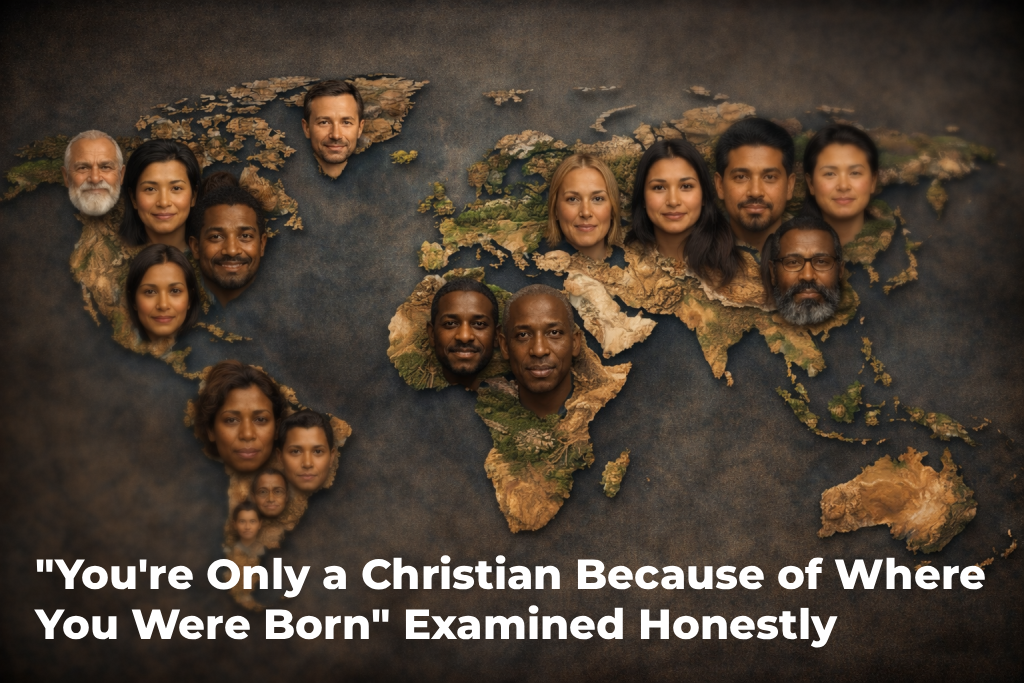
One of the most common objections to Christianity today rarely comes wrapped in anger or hostility. More often, it is delivered with a shrug, as if it settles the matter all by itself.
“You’re only a Christian because you grew up in a Christian country.”
Sometimes the phrasing changes slightly. The United States or North America may get mentioned. The West gets blamed. Occasionally, it is said with an air of psychological sophistication, as though belief has been neatly explained away by geography alone. The assumption is clear enough. Christianity is not believed because it is true or compelling or grounded in reality. It is believed because it is familiar, inherited, absorbed passively through culture like an accent or a regional habit.
I understand why this argument sounds persuasive at first. Of course where you are born shapes what you are exposed to. No serious person denies that. A child raised in Saudi Arabia will hear Islam far more than Christianity. A child raised in India will be immersed in Hindu categories from a young age. A child raised in parts of the American South will almost certainly hear about Jesus early in life.
But influence is not the same thing as explanation, and exposure is not the same thing as belief. Once you slow this claim down and actually examine what it is saying, it begins to unravel in ways that are difficult to ignore.
What This Argument Is Really Claiming
When someone says, “You’re only a Christian because of where you were born,” they are not making a neutral observation about cultural influence. They are making a dismissive claim about the nature of belief itself. The suggestion is that Christianity has not persuaded you, confronted you, or convinced you. It has simply happened to you.
In other words, the argument is not engaging Christianity’s claims at all. It is sidestepping them. Rather than asking whether Christianity is true, coherent, or historically grounded, it reframes belief as an accident of birth. Once belief is treated as social conditioning, there is no need to wrestle with resurrection claims, moral categories, or the person of Jesus Himself.
That move matters more than most people realize. It shifts the entire conversation away from truth and into psychology. Instead of asking whether Christianity corresponds to reality, the focus becomes how people came to hold the belief in the first place. And once that shift happens, the content of Christianity never actually has to be addressed.
The Argument Proves Too Much
Here is the first major problem with the geography objection. When applied consistently, it proves far too much.
Every worldview is shaped by culture, including atheism. Skepticism itself clusters geographically. Western secularism is not a neutral default position floating above culture. It thrives in particular environments, usually affluent, post-Christian societies shaped by specific assumptions about authority, autonomy, and meaning. A person raised in a highly secular academic setting is no less culturally formed than a person raised in church.
No one chooses their starting point. None of us does.
So if a Christian’s belief is dismissed because of where they were born, then the atheist must answer the same question. Why were you born into a culture that prizes skepticism? Why were you educated in systems that frame religion as irrational or regressive? Why do your doubts line up so neatly with your social environment?
Once the standard is applied evenly, it collapses. Either cultural influence invalidates all beliefs, or it invalidates none. You do not get to use geography to disqualify Christianity while quietly exempting disbelief from the same scrutiny.
Christianity Grows Where It Is Costly, Not Convenient
If Christianity were merely a cultural inheritance, we would expect it to thrive where it is rewarded and fade where it is punished. It should flourish where it carries social capital and disappear where it brings risk or loss.
That is not what we see.
Christianity is growing rapidly in places where belief is costly rather than comfortable. In China, house churches continue to multiply despite state pressure. In Iran, Christianity is spreading underground at a remarkable pace, often among people who know full well that conversion could cost them family, freedom, or worse. Across parts of Africa, believers face hostility and violence, yet churches continue to expand.
These are not environments where Christianity is socially inherited. These are environments where Christianity is chosen at real personal cost.
People do not walk away from their safety, reputation, or community because a belief is familiar. They do so because they believe it is true.
Christianity Did Not Originate in the West
Another weakness in this argument is historical forgetfulness. Christianity did not originate in Europe or North America. Jesus was a Middle Eastern Jew, and the earliest Christian communities were not Western at all.
The Gospel first spread through places like Jerusalem, Antioch, Alexandria, and Rome, crossing ethnic and linguistic boundaries long before Christianity held any political power. It moved through households, trade routes, and ordinary conversations, not through legislation or cultural dominance.
If geography were the primary explanation for belief, Christianity should have remained a small Jewish sect in Palestine. Instead, it crossed borders with remarkable speed, often flourishing in places where it was least expected and least welcomed.
Early Christians Believed Against Their Culture
The earliest Christians did not believe because their culture affirmed them. They believed in direct opposition to the surrounding culture. They were mocked for worshiping a crucified Messiah. They were accused of atheism for refusing to honor the Roman gods. They were persecuted for rejecting emperor worship and refusing to blend their faith into the existing religious marketplace.
Becoming a Christian in the first century rarely made life easier. It often made life more dangerous.
That is not how cultural inheritance works.
Conversion Is a Persistent Reality
One of the most striking problems with the geography argument is how easily it ignores living counterexamples. Many Christians did not grow up Christian at all. They were raised secular, indifferent, or openly hostile to faith. Some were committed atheists. Others followed different religions. Many spent years dismissing Christianity before eventually embracing it.
I have met countless men who did not come to faith because it was socially rewarded, but because something confronted them inescapably. A text they could not dismiss. A moral framework that explained the world more clearly than the alternatives. A historical claim that refused to stay buried.
You can wave away one testimony. You cannot wave away millions without doing serious intellectual damage.
Christianity Persists After Cultural Decline
If Christianity were merely cultural residue, it should fade as Christian culture fades. Yet in the modern West, where cultural Christianity has largely collapsed, belief persists.
Public opinion has shifted dramatically. Social pressure now often runs in the opposite direction. Open Christian conviction can carry professional, relational, and social risk. And yet, many believers remain, not because it is easy, but because it still makes sense to them.
Cultural inheritance cannot explain perseverance under pressure.
The Genetic Fallacy at Work
At its core, the geography objection commits a basic logical error known as the genetic fallacy. It evaluates a belief by its origin rather than by its truth.
Where a belief comes from does not determine whether it corresponds to reality. Mathematical truths do not change because they were learned in different countries. Scientific theories developed in particular cultures still describe universal realities. Moral insights shaped in specific societies still point beyond those societies.
Christianity makes historical claims, moral claims, and metaphysical claims. None of those are answered by pointing at a map. The resurrection of Jesus does not become less plausible because someone first heard about it in North America rather than the Middle East.
Christianity Disrupts Cultural Comfort
Christianity does something unusual. It does not simply affirm cultural identity. It challenges it. Jesus Himself warned that following Him would divide families, strain loyalties, and unsettle assumptions. The Gospel calls people out of their default identities and into something deeper.
This is why Christianity has always produced dissenters. Converts who leave behind old frameworks, old allegiances, and sometimes old communities.
A belief that consistently fractures social comfort cannot be reduced to social conformity.
Avoiding the Harder Question
I have come to believe that the geography argument functions less as an explanation and more as an avoidance tactic. It allows a skeptic to dismiss Christianity without ever asking whether it might actually be true. It reframes belief as accidental rather than reasoned and quietly closes the door on further investigation.
But the harder question remains untouched.
Is Christianity true?
Timothy Keller on Christianity’s Global Movement
The late Timothy Keller addressed this objection directly in his book The Reason for God, and his observations are especially relevant here because they cut across both history and present reality.
Keller pointed out that Christianity has never remained locked inside one culture, one ethnic group, or one geographic region. Instead, it repeatedly takes root in places where it did not originate and often where it is not socially dominant. He wrote:
Christianity is a remarkably adaptable religion. Unlike many other faiths, it is not the property of any one culture or race. It has repeatedly spread into new cultures and adapted itself to them.”
That observation alone challenges the idea that Christianity survives by cultural inheritance alone. A belief system that continually detaches from its original cultural centers and flourishes elsewhere cannot be reduced to mere familiarity or social momentum.
Keller also noted that the common Western assumption that Christianity belongs to Europe or North America is historically outdated. He wrote:
The center of gravity for Christianity has shifted decisively away from the West. Today, the majority of Christians live in Africa, Asia, and Latin America.”
This is a crucial point. If Christianity were sustained primarily by Western culture, its decline in the West should have meant its decline everywhere. Instead, the opposite has happened. As Christianity has lost cultural dominance in Europe and North America, it has exploded in parts of the world where belief often brings social cost rather than advantage.
Now we see the continent of Africa, just for example, containing more evangelical Christians than in all of North America. Therefore, Christianity can no longer be considered a “Western religion.” It’s more of a worldwide phenomenon.
Keller went on to explain why this matters for the truth question itself, not merely the sociology of religion. He argued that Christianity’s ability to cross cultures so consistently points to something deeper than inherited tradition. He wrote:
A faith that can take root in so many different cultures, among both the powerful and the powerless, suggests that it is tapping into something universal about the human condition.”
That is the part skeptics often overlook. Christianity does not merely spread where it is comfortable. It spreads where it confronts people, explains their guilt and hope, diagnoses their brokenness, and offers a coherent account of meaning, forgiveness, and redemption.
Keller’s point was not that cultural factors play no role at all. His point was that cultural explanation is insufficient. Christianity does not behave like a belief system that survives only by inheritance. It behaves like one that continually persuades new people in new places, often at great personal cost.
That reality alone forces a more serious conversation than “you were born there” will ever allow.
A More Honest Conversation
Yes, where you are born shapes what you are exposed to. No one disputes that. The real question is whether people remain where they started because belief is empty, or whether they stay because it continues to make sense under scrutiny.
Christianity does not ask for blind inheritance. It invites examination. It does not fear questions. It has endured them for nearly two thousand years.
You can explain how someone first heard the Gospel. You still have to explain why it continues to change lives across cultures, centuries, and costs.
Which brings us back to the only question that really matters…
Not where were you born, but is Christianity true?
0 Comments