
The Theology of Thomas Watson Series: Part 6
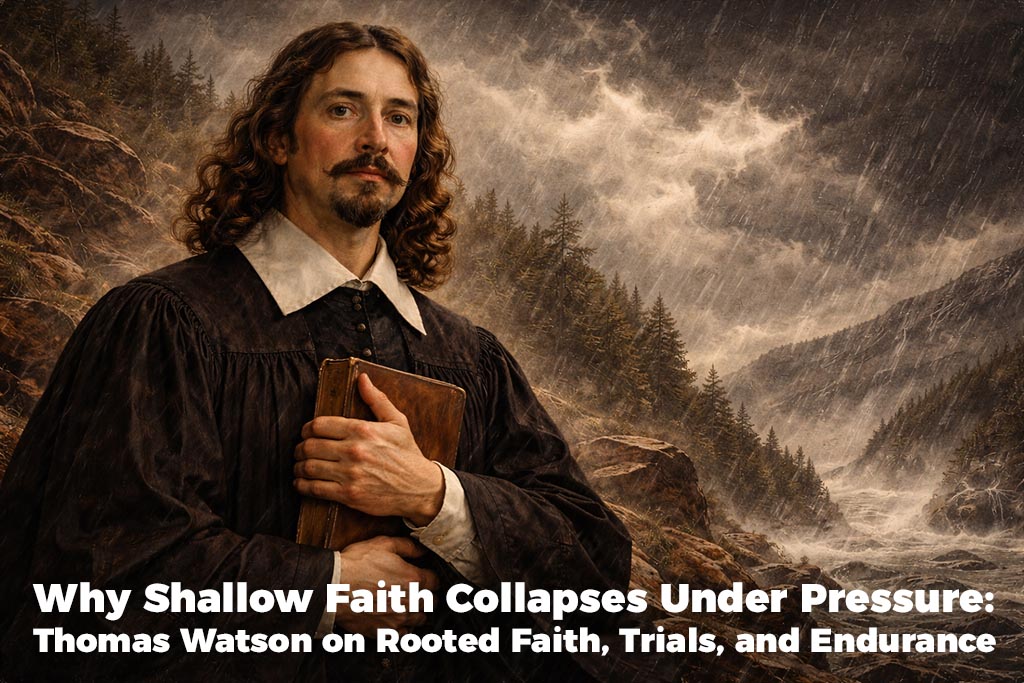
Why Shallow Faith Collapses Under Pressure: Thomas Watson on Rooted Faith, Trials, and Endurance
One of the most revealing moments in a person’s spiritual life is not success, growth, or blessing. It is pressure. Suffering, loss, temptation, disappointment, or opposition have a way of exposing what is really there. Thomas Watson understood this well, and he was deeply concerned about the kind of Christianity that looks convincing in calm seasons but collapses when life grows hard.
Watson would argue that pressure does not destroy true faith. It reveals whether faith was ever deep to begin with.
This is not a comfortable truth, but it is a necessary one. Much of modern Christianity is built for convenience, not endurance. It assumes faith should make life easier, not harder. When that expectation is shattered, many find that what they called faith was never anchored in God’s truth, character, or promises.
Shallow Faith Is Built on Comfort, Not Conviction
Watson believed that many people follow Christ as long as the road is smooth. They enjoy the benefits of Christianity without counting the cost. As long as obedience is rewarded and belief is socially acceptable, faith seems strong.
But that kind of faith is built on comfort, not conviction.
In A Body of Divinity, Watson repeatedly warns against resting in outward profession or emotional enthusiasm without deep-rooted belief. He understood that feelings can be intense and yet fleeting. Convictions, on the other hand, must be formed slowly through truth.
Hypocrites may have flashes of joy, but they lack root.”
(Thomas Watson, A Body of Divinity)
That lack of root becomes evident under pressure. When Christianity begins to cost something, shallow faith negotiates. It looks for exits. It adjusts convictions to preserve comfort.
Watson would say that a faith built on ease will never survive adversity. Only a faith grounded in truth will endure.
Trials Reveal Weakness; They Do Not Create It
One of Watson’s most important insights is that trials do not manufacture spiritual weakness. They uncover it.
This matters, because many believers blame suffering for their collapse. They assume hardship damaged their faith. Watson would gently but firmly correct that assumption.
In The Godly Man’s Picture, Watson describes trials as God’s revealing work. Pressure tests the reality of grace.
Afflictions are a touchstone to try what metal the heart is made of.”
(Thomas Watson, The Godly Man’s Picture)
When a structure collapses in a storm, the storm did not cause the weakness. It exposed it. In the same way, suffering exposes whether faith is anchored, shallow, or merely assumed.
This does not mean trials are easy or painless. Watson never minimizes suffering. But he refuses to let believers misdiagnose what suffering reveals.
Rooted Faith Is Doctrinal Faith
Watson firmly believed that endurance is inseparable from doctrine. Christians who cannot explain what they believe often cannot endure when belief is tested.
Modern Christianity often treats doctrine as optional or secondary. Watson treats it as essential for stability.
In A Body of Divinity, Watson labors to teach foundational truths precisely because truth strengthens faith. Doctrine forms roots. Without roots, faith cannot stand.
Ignorance is the mother of error, not devotion.”
(Thomas Watson, A Body of Divinity)
Watson knew that believers grounded in God’s attributes, promises, and purposes are better prepared for suffering. They know who God is, even when circumstances are confusing. They know what God has promised, even when feelings waver.
Rooted faith does not panic easily. It has something to stand on.
God Uses Pressure to Strengthen Real Faith
Watson did not view trials as evidence of God’s absence. He viewed them as tools of God’s care.
In The Godly Man’s Picture, Watson explains that God refines His people through affliction. Hardship weakens attachment to the world and strengthens reliance on God.
God’s people are often best in affliction.”
(Thomas Watson, The Godly Man’s Picture)
This is not because suffering is pleasant, but because suffering clarifies. It strips away illusions. It exposes false supports. It drives believers to rest more fully in God’s promises rather than their own strength.
Watson believed that a faith that cannot suffer is not yet prepared to endure.
Endurance Is a Mark of True Godliness
Perseverance is not optional in Watson’s theology. It is a mark of grace.
In The Godly Man’’s Picture, endurance appears alongside other evidences of godliness. A true believer may stumble, but he does not abandon Christ. He may grieve, but he does not quit.
A godly man holds on in the storm.”
(Thomas Watson, The Godly Man’s Picture)
This perseverance is not rooted in personal toughness. It is rooted in God’s preserving grace. But Watson is clear that endurance shows itself in continued faith, continued repentance, and continued obedience.
Faith that disappears under pressure reveals that something essential was missing.
What Modern Christianity Gets Wrong About Strength
Watson would challenge many modern assumptions about spiritual strength. Today, strength is often equated with confidence, positivity, or emotional resilience.
Watson defines strength differently.
Strength is faith that remains steady when circumstances are unsteady. Strength is obedience that continues when rewards disappear. Strength is trust that holds even when God’s purposes are hidden.
Emotional enthusiasm fades. Hype collapses. Platforms shift. Only rooted faith remains.
Watson would argue that much of what passes for strong faith today has simply never been tested.
Why This Teaching Matters Now
We live in a time when cultural pressure is increasing, not decreasing. Comfort is no longer guaranteed. Faithfulness may carry cost.
Watson’s warning is timely. A shallow faith cannot endure a hard season. A faith built on convenience cannot withstand sacrifice.
But a faith grounded in truth, shaped by reverence, strengthened through discipline, and refined by trials will endure.
A Final Word
Pressure does not destroy true faith. It reveals it.
Shallow faith collapses because it was never anchored. Rooted faith bends, but it does not break.
Thomas Watson knew this well. And his counsel remains clear. If faith is to endure, it must be deep. It must be doctrinal. It must be shaped by suffering rather than surprised by it.
Anything less will not last.
Transition to the Next Article
If faith is shaped under pressure, it naturally turns the believer’s eyes beyond this world.
That leads us next to Thomas Watson’s teaching on heaven, eternity, and the hope that sustains the faithful to the end.
Thomas Watson Series
If this post helped you, you may also want to read the rest of this series on Thomas Watson. Each article looks at a different aspect of his life, teaching, and lasting value for Christians today.
- Who Was Thomas Watson and Why Should Modern Christians Read Him? – Part One
- The God Who Is: Thomas Watson on the Attributes of God – Part Two
- True Repentance in an Age of Excuses: Thomas Watson on the Repentance God Requires – Part Three
- Grace That Trains Us: Thomas Watson on Holiness and Sanctification – Part Four
- The Fear of God and the Death of Casual Christianity: Thomas Watson on Reverence, Awe, and Obedient Fear – Part Five
- Why Shallow Faith Collapses Under Pressure: Thomas Watson on Rooted Faith, Trials, and Endurance – Part Six
- Thomas Watson on Prayer, Meditation, and the Disciplined Mind – Part Seven
- Heaven, Hell, and Eternity Through the Eyes of Thomas Watson – Part Eight
- Why Thomas Watson Took Sin Seriously, and So Should We – Part Nine
- Reading the Puritans Without Becoming Weird or Proud – Part Ten
- A Beginner’s Guide to Reading Thomas Watson Today – Part Eleven
- What Reading Thomas Watson Did to My Faith – Part Twelve
One Comment
Grace That Trains Us: Thomas Watson on Holiness… Pingback
[…] Why Shallow Faith Collapses Under Pressure: Thomas Watson on Rooted Faith, Trials, and Endurance … […]