
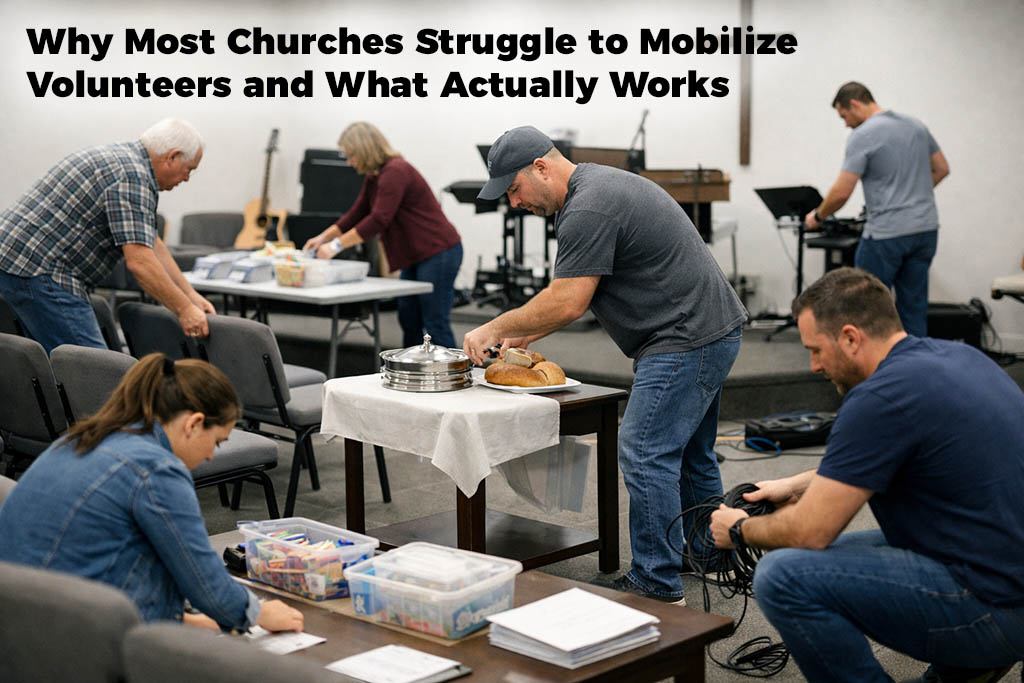
How to Actually Get People to Serve, Be Interested in Volunteering, and Lead in Various Ministries.
So, how do you get people to get involved, Scott?
How do you get people to serve? This is a subject I care deeply about, partly because I have watched churches thrive when volunteers are discipled well, and partly because I have watched good churches quietly struggle when serving is treated like an afterthought. I have lived on both sides of this. I have been the guy making the announcement. I have been the guy hoping someone, anyone, would step up. And, yes, I have also been the guy sitting in the pew thinking, “Someone else will probably handle that,” all while selfishly hoping that no one asks me to fill in the role.
Over the years, especially through men’s ministry, I have learned that mobilizing people to serve is not primarily a logistics problem. It is a discipleship problem. Scripture makes that painfully clear, and experience confirms it.
Don’t Rely On Sunday Announcements
Let me begin with something that might actually sound counterintuitive, but it needs to be said plainly. One of the worst ways to recruit volunteers is to bury the need inside a long list of Sunday morning announcements. I have seen this repeatedly. The service is already full. Someone in person on stage or a video makes updates about events, small groups, building project updates, youth activities, and potlucks. Somewhere in the middle of this ocean of noise comes a quick mention of a ministry need. By the time the last featured item is mentioned, people have already forgotten about the first four announcements (and especially the one about the dire ministry need!), or are mentally transitioning to the sermon or to after-service lunch plans.
The message may be heard, but it is not seeped into people’s brain cells. Information overload is real, and when everything is emphasized, nothing is. Ecclesiastes reminds us that wisdom involves timing and discernment, and the same applies here. When announcements are crowded, the need you are trying to communicate gets flattened into background noise.
Just Because It’s Advertised, Doesn’t Mean People Will Listen
Closely related to this is another assumption that quietly undermines volunteer engagement. Awareness does not automatically equal interest. This is a mistake churches make all the time, and I have made it myself. We think that because people heard about a need, they will naturally feel compelled to respond.
In reality, many people hear about a need and subconsciously assume that someone else is better suited, more available, or already planning to step in. This is not rebellion; it’s human nature. Paul addresses this dynamic indirectly in 1 Corinthians 12 when he emphasizes that every part of the body is necessary and that no member should assume their role is insignificant or unnecessary. Without intentional shepherding, people default to comfort and passivity, not because they do not love the church, but because they do not see themselves as personally responsible.
Get the Lead Pastor To Speak About It
That is why the role of the lead pastor cannot be overstated. The lead or senior pastor stands as the primary spiritual voice of the church. Whether we like it or not, people listen differently when he speaks. They may love the other ministry leaders, think that worship leaders are cool, respect the elders (who, unbeknownst to much of the congregation, are themselves pastors), and appreciate volunteers, but the pulpit carries unique weight. Hebrews 13 speaks of leaders who watch over souls, and congregations instinctively recognize that authority. When a lead pastor speaks clearly, biblically, and personally about a genuine ministry need, especially from the pulpit, it lands with far greater force than other avenues of communication.
I have watched entire ministries change direction because the pastor spoke with conviction and clarity about why the work mattered, not merely that help was needed. People respond when they sense that serving is connected to obedience, faithfulness, and the mission of God, not just filling slots.
I do have to give two caveats: One, make sure that if the pastor speaks of a volunteer role that needs to be filled, or a ministry that the church is trying to drum up interest for, please try not to do it on a Sunday morning setting that is not overloaded with announcements. As mentioned before, even frank words from the pastors can get drowned out in the sea of information noise.
Two, have the news about the ministry need fit neatly within the sermon. The primary job of the teaching pastor is to exegete the Word of God and feed the sheep. Don’t try to artificially “shoehorn” the info in if it doesn’t fit the passage being preached about. If you are the one in the pulpit, work it in naturally if you can. For instance, if the passage is about discipleship, it’s quite appropriate to mention what discipling is in the context of joining your discipleship/small groups, or if you are looking for more people to step up into discipleship group leader roles.
Personally Invite People One-on-One
Beyond those foundational realities, there are several other factors that consistently move people from passive awareness to active service. The first is by personal invitation. I cannot emphasize this enough. Jesus did not issue generic announcements when He called the twelve. He looked men in the eye and said, “Follow Me.”
That model still works. In my own experience leading men’s ministry, the most faithful men almost always came through direct conversations. I asked them personally. I told them why I thought they would be great if they came out and attended a men’s ministry function. Many guys might normally just brush it off as “just another church event,” but I explained how the ministry could stretch and grow them spiritually. That personal appeal communicates value and trust. When someone realizes they were not randomly recruited but intentionally chosen, it changes how they view the opportunity.
Let Them Clearly Know What’s At Stake and What’s Involved
Another crucial factor in how to get people to serve in church is clarity of purpose. People hesitate to volunteer when they do not understand what they are signing up for or why it matters. Vagueness breeds anxiety. Clarity builds confidence. In Ephesians 4, Paul connects ministry service to maturity in Christ and the building up of the body. That theological grounding matters. When I explain a role, I try to connect the task to the larger mission of making disciples, loving people, and glorifying God. I also explain expectations clearly. Time commitment, responsibilities, support structures, and leadership oversight should all be transparent. People are far more willing to serve when they know what faithfulness looks like in practical terms.
Share a Story
Another element is testimony. Stories shape culture. When people hear how serving has strengthened someone’s faith, built relationships, or helped them grow in obedience, it reframes service from obligation to opportunity. In men’s ministry, I have watched skeptical men soften when another man shares how stepping into leadership exposed his weaknesses and drove him deeper into prayer and dependence on Christ. Revelation speaks of overcoming by the word of testimony, and that principle applies here as well. Testimony helps people imagine themselves in the role and see fruit beyond the immediate inconvenience.
Don’t Just Fill a Ministry Void; Train Them to Be Leaders
Another often overlooked factor is leadership development rather than mere task delegation. Many churches recruit volunteers but fail to disciple leaders. There is a difference. When people sense that serving is a dead end with no growth, no feedback, and no shepherding, enthusiasm fades quickly. Paul invested deeply in Timothy and Titus, not merely assigning them duties but shaping their character and theology. Churches that retain volunteers tend to invest in them spiritually. Training, encouragement, correction, and prayer communicate that service is part of a larger journey of sanctification. This is especially important with men, who often need to see a clear path from participation to responsibility to leadership.
Go to God in Prayer
Finally, and this must never be treated as an afterthought, we must pray. Prayer is not a formality. It is an admission of dependence. Jesus told His disciples to pray earnestly to the Lord of the harvest to send out laborers. He did not say to design a better system first. He said to pray. When we pray about volunteer needs, we are acknowledging that hearts are moved by God, not by clever strategies. In my own life, I have seen God prompt men to serve who I never would have recruited on my own. Prayer aligns our desires with God’s will and prepares us to recognize His answers when they come.
At the end of the day, mobilizing volunteers is about discipleship, obedience, and trust in God’s design for the church. The Bible is remarkably consistent on this point. The body grows when every member does its part. Leaders equip the saints for the work of ministry. Christ Himself supplies the growth. When churches rely solely on announcements, they shrink the vision. When they shepherd hearts, speak with conviction, invite personally, clarify purpose, share testimony, develop leaders, and pray earnestly, something deeper happens. Serving stops being about filling gaps and starts becoming a visible expression of a living, active faith. That is when the church moves forward, not by human strength, but by God working through willing, obedient people.
0 Comments