
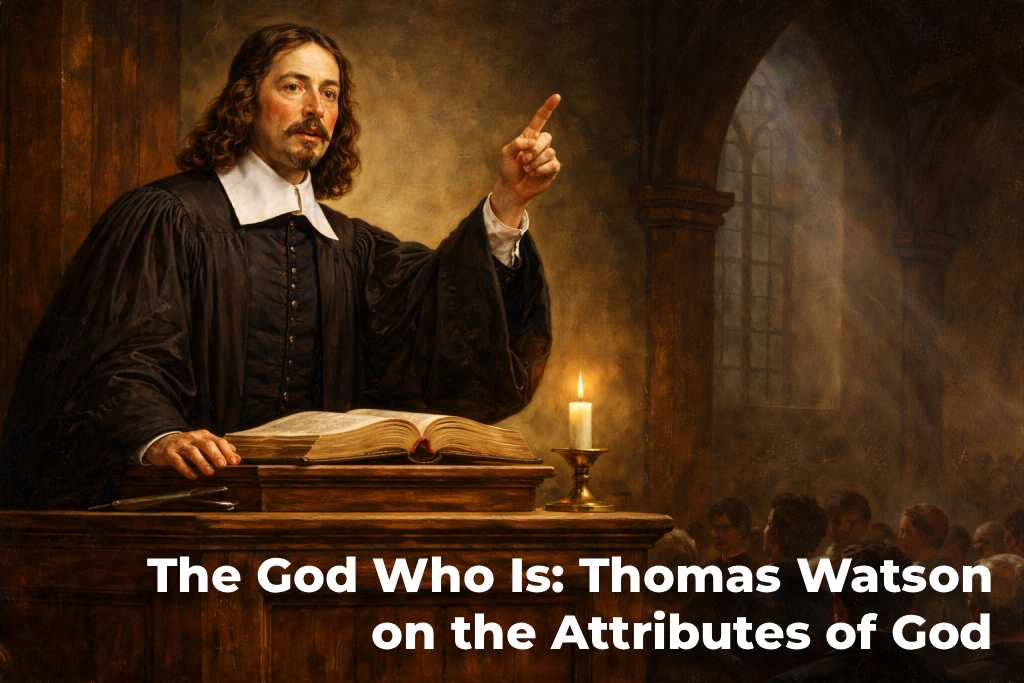
The Theology of Thomas Watson Series: Part 2
This second part of my Thomas Watson Series is about his view on the Attributes of God.
One of the reasons Puritan Thomas Watson still feels so relevant is that he never starts where modern Christianity often starts. He does not begin with our problems, our pain, our questions, or our felt needs. He begins with God.
That decision alone explains much of the power of his writing.
Watson believed that nearly every weakness in the Christian life can be traced back to small, distorted, or sentimental thoughts about God. If God is seen as light, sin becomes heavy. If God is seen as casual, sin becomes trivial. If God is reduced to a helper or a mascot, worship collapses into routine.
So Watson begins where Scripture begins. With the God who is.
Theology That Kneels Before It Speaks
Watson’s arguably most well-known theological work, A Body of Divinity, is structured around the Westminster Shorter Catechism. On paper, that may sound dry. In practice, though, it becomes one of the most devotional treatments of God’s character ever written.
Watson does not approach theology as a puzzle to solve, but as a reality to bow before. He believed doctrine should always lead to worship, humility, obedience, and reverence of the Almighty. Knowledge that stops short of those things, in his view, was not true knowledge at all.
Early in A Body of Divinity, Watson writes plainly about God’s nature:
God is a Spirit, that is, He is of a pure, spiritual, and invisible nature.”
(A Body of Divinity, on the being of God)
This matters more than we often realize. Watson insists that God cannot be reduced to an image, a feeling, or a projection of human personality. God is not an enhanced version of us. He is completely different and set apart. He is holy. He is self-existent.
That alone confronts much of modern spirituality, which often treats God as emotionally reactive, needy for our attention, or dependent on our participation.
Watson refuses all of that.
God’s Self-Existence and Sovereignty
One of the first attributes Watson emphasizes is God’s self-existence. God depends on nothing outside Himself. He is not sustained by creation. Creation is sustained by Him.
Watson writes:
God has His being of Himself; He is self-existent.”
(A Body of Divinity)
That may sound abstract, but Watson presses it into daily faith. A self-existent God is not fragile. He is not threatened by chaos. He is not scrambling to fix mistakes. He rules without anxiety.
From that flows God’s sovereignty. Watson never treats sovereignty as a philosophical debate. He treats it as a comfort to suffering believers and a warning to the proud.
He writes:
God’s providence is His ordering all things according to the counsel of His will, to His own glory.”
(A Body of Divinity, on providence)
Notice the direction of the sentence. All things. God’s will. God’s glory. Watson does not apologize for that order. He believes it is the only order that gives meaning to history, suffering, and obedience.
A God who is not sovereign cannot be trusted. A God who reacts rather than rules inspires anxiety, not faith.
The Holiness of God as the Centerpiece
If there is one attribute Watson returns to again and again, it is God’s absolute holiness. He does not treat holiness as one trait among many. He treats it as the beauty and harmony of all God’s attributes.
Watson famously writes:
Holiness is the beauty of all God’s attributes.”
(A Body of Divinity, on God’s holiness)
That line alone has corrected generations and centuries of sloppy theology.
God’s love is holy love.
God’s mercy is holy mercy.
God’s justice is holy justice.
Remove holiness, and everything else collapses into sentimentality.
Watson is unflinching here. He reminds readers that God’s holiness means He hates sin, not merely its consequences. God does not tolerate evil. He opposes it.
This is why Watson insists that repentance is not optional or peripheral. It is the only sane response to a holy God. Without holiness, grace becomes cheap, and forgiveness becomes meaningless.
The Wisdom of God and the End of Complaining
Watson’s treatment of God’s wisdom is especially pastoral. He knew that believers often struggle less with whether God exists and more with whether God knows what He is doing.
Watson answers that concern directly:
God is infinitely wise. He knows the best ends and the best means to bring them about.”
(A Body of Divinity, on God’s wisdom)
That statement dismantles much of our complaining. If God knows the best ends and the best means, then our frustrations often reveal not insight, but impatience.
Watson believed wisdom meant God never acts randomly, wastes nothing, and never miscalculates. Even affliction has purpose. Even delay (or what we may perceive as “delay”) has design.
This does not minimize pain. It gives pain meaning.
God’s Power and the Death of Fear
Watson’s view of God’s power leaves little room for the kind of low-grade anxiety many Christians carry.
He writes:
God’s power is His ability to do whatever He wills.”
(A Body of Divinity, on God’s power)
This is so simple, clear, and absolute.
Watson believed fear often grows when God’s power shrinks in our imagination. If God is powerful only in theory but limited in practice, then worry becomes rational. But if God truly does whatever He wills, then fear loses its footing.
This attribute is not meant to puff up believers. It is meant to steady them.
God’s Justice and the Weight of Sin
Watson’s emphasis on justice keeps his theology from drifting into softness. God is not merely loving. He is just.
Watson writes:
Justice is that attribute of God whereby He gives every one his due.”
(A Body of Divinity, on God’s justice)
That sentence alone explains why Watson takes sin so seriously. Justice means sin must be addressed, not ignored. Forgiveness is not God pretending evil did not happen. It is God dealing with evil fully through Christ.
This is why Watson never separates the attributes of God from the cross of Christ. God’s mercy does not cancel His justice. It satisfies it.
Mercy That Magnifies Grace
Watson’s treatment of mercy is careful and joyful. He refuses to sentimentalize it, but he also refuses to minimize it.
He writes:
God is more willing to pardon than to punish.”
(A Body of Divinity, on God’s mercy)
That line has comforted countless wounded consciences. Watson does not portray God as reluctant to forgive. He portrays Him as delighting in mercy, while never compromising holiness.
Mercy, for Watson, magnifies grace because it flows from God’s character, not human deserving.
Why This Matters Right Now
Watson understood something we have largely forgotten. You cannot sustain a serious Christian life with a casual view of God.
A small God produces shallow repentance.
A manageable God produces selective obedience.
A tame God produces fragile faith.
Thomas Watson’s theology restores weight. It presses God back to the center, where He belongs.
Modern Christianity often asks, “What does this mean for me?” Watson first asks, “What does this reveal about God?” Only then does he apply it to the believer’s life.
That order changes everything.
Theology That Leads Somewhere
Watson never intended his readers to stop at admiration. He intended transformation.
Knowing God’s holiness should lead to hatred of sin.
Knowing God’s wisdom should lead to trust.
Knowing God’s sovereignty should lead to humility.
Knowing God’s mercy should lead to repentance and gratitude.
Anything less, in Watson’s view, was knowledge falsely so called.
Why Watson Still Cuts Through the Noise
In an age of shallow content, endless opinions, and emotional Christianity untethered from truth, Thomas Watson feels like a corrective gift.
He slows us down.
He deepens our thinking.
He enlarges our view of God.
Most importantly, he reminds us that the Christian life begins and ends with God Himself.
In the next article, we will move from God’s character to our response by looking at what Watson taught about repentance. And he will not allow us to treat it lightly.
That, too, is a mercy.
Thomas Watson Series
If this post helped you, you may also want to read the rest of this series on Thomas Watson. Each article looks at a different aspect of his life, teaching, and lasting value for Christians today.
- Who Was Thomas Watson and Why Should Modern Christians Read Him? – Part One
- The God Who Is: Thomas Watson on the Attributes of God – Part Two
- True Repentance in an Age of Excuses: Thomas Watson on the Repentance God Requires – Part Three
- Grace That Trains Us: Thomas Watson on Holiness and Sanctification – Part Four
- The Fear of God and the Death of Casual Christianity: Thomas Watson on Reverence, Awe, and Obedient Fear – Part Five
- Why Shallow Faith Collapses Under Pressure: Thomas Watson on Rooted Faith, Trials, and Endurance – Part Six
- Thomas Watson on Prayer, Meditation, and the Disciplined Mind – Part Seven
- Heaven, Hell, and Eternity Through the Eyes of Thomas Watson – Part Eight
- Why Thomas Watson Took Sin Seriously, and So Should We – Part Nine
- Reading the Puritans Without Becoming Weird or Proud – Part Ten
- A Beginner’s Guide to Reading Thomas Watson Today – Part Eleven
- What Reading Thomas Watson Did to My Faith – Part Twelve
3 Comments
True Repentance in an Age of Excuses: Thomas… Pingback
[…] Read Part 2 of my Thomas Watson series, The God Who Is: Thomas Watson on the Attributes of God […]
The Fear of God and the Death of Casual… Pingback
[…] Read Part 2 of my Thomas Watson series, The God Who Is: Thomas Watson on the Attributes of God […]
Who Was Thomas Watson and Why Should Modern… Pingback
[…] The God Who Is: Thomas Watson on the Attributes of God – Part Two […]