
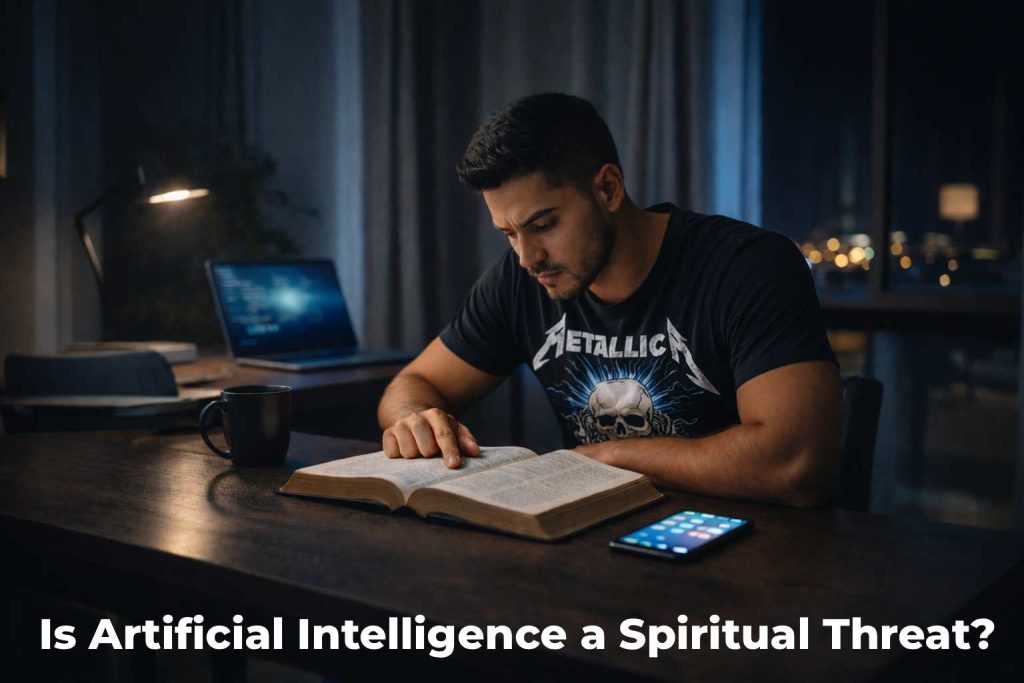
A few years ago, most people thought AI was a nerdy productivity tool. Now it writes essays, imitates voices, generates realistic video, offers “therapy,” and can persuade and trick people with frightening accuracy. The speed of change is the point. We are being trained to accept a new normal without asking the deeper questions.
One such query is: Is artificial intelligence a spiritual threat?
Here is my short answer: no one knows for sure how far this goes, and that is exactly why Christians should be unusually cautious. The devil does not need AI to destroy souls. He has been lying since Eden. But AI can amplify the same old temptations at a scale and speed the world has never seen.
And if you are a Christian man, you especially need to hear this. Men are already prone to distraction, passivity, and hidden sin. AI can become a force multiplier for all three.
Before I go further, I wrote a piece last year that asks a narrower question: whether AI could be part of the infrastructure that Revelation describes in the rise of the Antichrist. That post is intentionally framed as a speculative hypothesis, not a definitive doctrine. If you have not read it, start there and then come back here: https://scottroberts.org/could-ai-be-linked-to-the-rise-of-the-antichrist
This article I’m writing now is different. I am not trying to map AI onto Revelation. I am asking a more practical question: How could AI shape the soul, distort reality, and tempt people away from truth?
1. AI supercharges deception, and deception is always spiritual
The Bible treats deception as a moral category, not a quirky mistake. Satan is “the father of lies” in John 8:44. So when a technology makes lying easier, cheaper, and more believable, Christians should not shrug or turn a deaf ear.
Governments and security agencies are already warning that generative AI is enabling more convincing impersonation and social engineering, including deepfakes that imitate trusted people to manipulate targets.
This is not abstract. It is practical: fake audio of your pastor, fake video of a public figure, fake screenshots, fake “evidence,” fake scandal, and fake miracles. The more the world trains itself to believe what it sees on a screen, the more vulnerable it becomes.
The spiritual danger is not only that people get tricked. The greater danger is that trust itself collapses. When you cannot tell what is real, cynicism grows. People then cling to whatever voice feels safe, familiar, and powerful. That is a recipe for manipulation.
Even policymakers are treating AI-enabled deception as a growing threat to democratic trust and public confidence.
If deception can destabilize nations, it can absolutely destabilize households, churches, and individual consciences.
2. AI can become a false shepherd
A shepherd guides, corrects, comforts, and instructs. God has given shepherds to the church. He has given parents to children. He has given older men to train younger men. That is discipleship.
But what happens when a man quietly replaces those relationships with an AI voice that is always available, always agreeable, always “helpful,” and never confronts him with the cost of obedience?
That is not neutral. That is formation.
We are already watching AI chatbots and “digital companions” become emotional fixtures in people’s lives. Psychologists are raising concerns that these tools can reinforce unhealthy patterns of thinking and can blur relational boundaries for users who are vulnerable.
There are also policy researchers warning specifically about “bonding chatbots” and the risk of emotional manipulation and interference with a person’s freedom of thought.
Christian, hear me: a tool that can shape your thoughts, soothe your guilt, and keep you from real repentance is not harmless. It can become a counterfeit pastor.
3. AI offers counterfeit intimacy
Men are starving for brotherhood, respect, and clarity. If that hunger is not met in Christ and in the local church, men will look for substitutes.
AI companionship is one of those substitutes. Some analyses of AI companion systems have documented patterns that can include sexual content, boundary violations, and harmful reinforcement.
Even if you avoid the extremes, the core issue remains: AI can simulate being known without the cost of being accountable. It can simulate comfort without the call to holiness. It can simulate friendship while leaving you more isolated.
And isolation is gasoline for sin.
4. AI can inflate pride and make men spiritually soft
One of the strangest temptations of AI is how quickly it makes a man feel smart. Ask the right prompts, get polished answers, and suddenly you feel like a theologian, a strategist, a leader. But knowledge without wisdom produces pride.
If AI makes you talk like you have convictions while your life remains undisciplined, you have not grown. You have only upgraded your vocabulary. And that is a common way men deceive themselves.
A sober question every Christian man should ask is this: Am I using AI to avoid the hard work of becoming a godly man?
Because the traits of godliness are developed in the real world: prayer, Scripture, repentance, obedience, self-control, faithful church life, honest relationships, and suffering endured with hope. No machine can do that for you.
5. AI makes temptation more tailored, more private, and more constant
Temptation has always been personal, but AI can make it personalized.
Cybersecurity assessments already note that criminals use large language models to improve social engineering and manipulation, making scams and persuasion more effective.
Now widen that beyond criminal fraud into spiritual warfare: persuasion at scale, nudges that work, content that hooks you, feeds that study you, and synthetic media that targets your weaknesses.
The devil loves hiddenness. AI can help men keep everything hidden.
6. Christians should reject panic, but they must also reject naivete
Some Christians will treat every AI development like the final sign of the end. Others will treat AI like a shiny tool with no moral weight. But both responses are childish.
You do not need to fear. Instead, you need discernment. And discernment begins with admitting what you do not know.
There are major, ongoing conversations in AI safety circles about deepfakes, manipulation, and the broad social impacts of generative systems, including harms to trust and information integrity.
That should tell you something: even experts who love the technology are not shrugging.
So Christians should not shrug either.
7. A cautious, biblical posture for men
Here is what caution looks like, practically. Not legalism. Not paranoia. Just wisdom.
1) Keep AI in the category of tool, not guide.
Use it for drafts, summaries, brainstorming, and organization. Do not use it as your confessor, counselor, pastor, or moral compass.
2) Put hard limits on private use.
A man alone with a powerful, always-on system is not automatically sinful, but it is automatically risky. Sin loves privacy. If you have struggled with lust, deceit, escapism, or addictions, you do not get to be casual here.
3) Test everything you consume.
Assume screenshots can be fake. Assume audio can be cloned. Assume video can be manipulated. Slow down before you share, accuse, or react. The book of Proverbs would have a field day with how quickly people spread nonsense online.
4) Anchor your mind in Scripture daily.
If AI is shaping your thinking more than the Word, you are being discipled by a machine. That is not a small problem.
5) Stay close to the local church.
AI pulls men into individualized, customized “faith.” Jesus builds His church. He does not build independent spiritual freelancers.
6) Teach your family and your men about deception.
If you lead men, do not avoid the topic. Train them. Warn them. Ground them. The sheep get slaughtered when shepherds refuse to address wolves.
Closing thoughts
No one knows the full shape of what AI will become in the next few years. Christians should be honest about that. But we do know the human heart. We know temptation. We know idolatry. We know deception. We know how quickly men drift when comfort is easy and accountability is costly.
AI may prove to be a neutral tool in many contexts. It may also become a serious accelerant for spiritual deception and moral collapse. Both can be true in different settings.
So do not panic. But do not play games either.
Stay awake. Stay humble. Stay rooted in the Word. Stay close to Christ. And remember: the real battle has never been about machines. It has always been about worship.
Further Reading:
Could AI Be Linked to the Rise of the Antichrist?
The Future of Christianity in the West: Why Persecution Is Rising and How Believers Must Stand Firm
0 Comments