

Christian movies sure take a beating online.
You don’t have to scroll far before you see the same criticisms repeated over and over again. They’re too preachy. The acting isn’t great. The stories feel forced. The gospel is shoved down your throat. Even many Christians echo these same complaints, almost embarrassed by the genre.
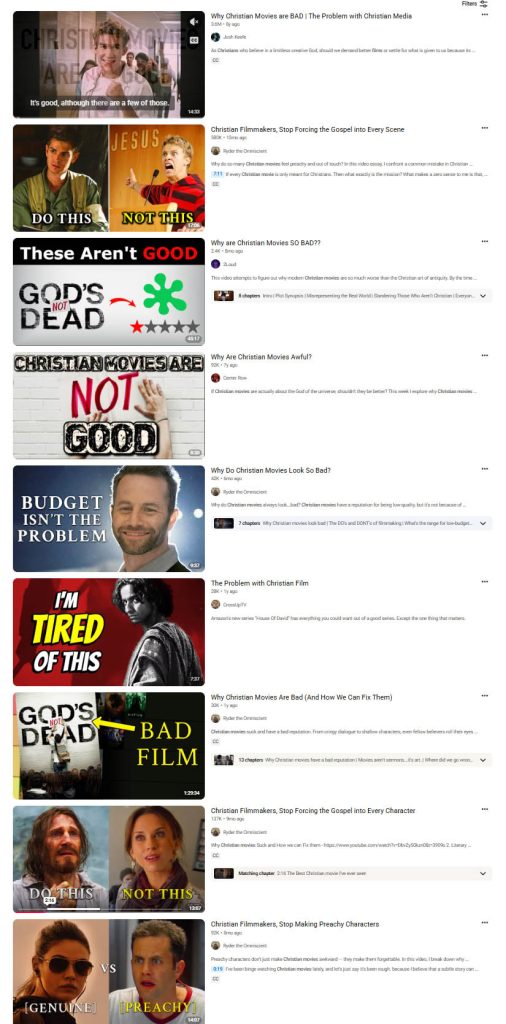
And I understand where some of that is coming from. There are Christian films that fall short. Smaller budgets can limit production quality. Some scripts are thin. Characters can feel one-dimensional. I actually think 2016’s God’s Not Dead 2 is a decent film overall, but the antagonist, prosecutor Pete Kane, is written in such a flat, almost caricature-like way that it weakens the story; he’s almost literally a mustache-swirling villain (save for the fact that he is clean-shaven). A more nuanced character could have elevated the entire film.
So yes, Christian filmmakers should strive to do better. They should sharpen their writing, develop richer characters (yes, even the bad guys!), and aim for excellence in every area.
But that is only part of the story.
What often gets ignored is that the same problems exist across the entire film industry. Most secular movies are not masterpieces. They rely on recycled storylines, predictable character arcs, and familiar emotional beats. The difference is that they usually have larger budgets, better production polish, and stronger marketing behind them.
We tend to remember the great films and forget the countless forgettable ones. That skews our perception. It makes it feel like secular films are consistently better when, in reality, we are comparing the best of one category to the average of another.
Personally, I enjoy a lot of Christian films. I think many of them are far better than critics give them credit for. One of the standout examples over the years has been the entire output from writers/producers/directors, the Kendrick Brothers. Their films are not perfect, but they consistently center on meaningful, biblical themes: Integrity in business. Faithfulness in marriage. The responsibility of fatherhood. The power of prayer. The sanctity of life. The call to discipleship and mentorship.
Those are not shallow ideas. Those are the kinds of truths that shape lives.
Too Preachy?
Which brings us to one of the most common complaints: Christian movies are “too preachy.”
Well, there may be some truth to that. Many Christian films are direct. They do not hide their message. They present the gospel clearly and unapologetically.
But here is the question I keep coming back to: Why does that bother us if we are Christians?
If we really believe what the Bible teaches, then there is no more important message in the world than the gospel of Jesus Christ. Without it, people are lost. Without it, they remain separated from God. We are not talking about a minor philosophical idea or a lifestyle preference. We are talking about eternal life and eternal judgment. So why would clarity about that message be treated as a flaw?
I have spoken with many people who say they prefer stories where Christian themes are more subtle, more woven into the background of an otherwise secular narrative. They’ll watch the Lord of the Rings films and say they appreciate Tolkien’s subtle biblical themes and morals, or see redeemer/messiah figures in other movies. Hey, I understand the appeal of good storytelling with good lessons that can remind us of God’s redemptive story in the Bible. I appreciate nuance.
But I still find myself asking the same question. Why does the truth need to be hidden, be subtle, and (God forbid) on the nose?
Jesus did not hide the truth. The apostles did not veil the gospel. They proclaimed it openly, even when it cost them everything. There is something in us that wants the message to be softened, made more palatable, less direct. But that instinct does not come from Scripture.
At the same time, there is another issue that deserves attention, and it goes in the opposite direction.
Some Christian films can even pull back too much.
Take the recent sequel to I Can Only Imagine, titled (not surprisingly) I Can Only Imagine 2, which my wife and I caught at the movie theater several weeks ago.
The film continues the autobiographical story of Bart Millard and the band Mercy Me as he navigates the pressures of life, family, and personal identity. It explores his struggles as a husband and father while dealing with the weight of expectations that come with success. The emotional tension is real, and the story leans into themes of brokenness, doubt, and the desire to hold everything together as he deals with the strained relationship with his own son, who is now a teenager and doing out on tour with him.
As the film unfolds, Bart is eventually brought back to a place of surrender, influenced by the message behind songs like the Tim Timmons-penned “Even If” and the enduring hymn “It Is Well with My Soul.” The story points him toward the reality that God is still in control, even when life feels chaotic and unresolved.
And to be clear, I actually liked the movie. It is well-acted, engaging, and carries an encouraging message by the end.
But something felt off to me the entire time.
In all of Bart’s struggles, there are no visible times of prayer for any of the characters. There is no scene of anyone ever opening a Bible or reading a verse (the only books seen in the entire film are The Origin of Hymns by Robert J. Morgan, and a newly published biography of Mercy Me’s manager, Scotty Brickell, used for comic relief). There is no moment when Bart or his wife seeks pastoral counsel regarding their son. Bart’s wife does not pray or talk about God with him. His bandmates, who are present throughout the film, never offer distinctly biblical wisdom, and as a matter of fact, they come across as (sigh) more gonzo comic relief rather than as brothers in Christ who could speak truth into Bart’s life.
(The only explicitly spiritual element that carries weight is the aforementioned hymn and Timmons song. It took the actual character of Tim Timmons – who, in the movie, toured with the band as their opening act – having a cancer diagnosis to be any kind of catalyst for Bart Millard’s spiritual growth.)
Virtually All Movies Don’t Show the Realities of Life
So the lack of spiritual seeking or guidance in I Can Only Imagine 2 stood out to me because it does not reflect real Christian life and what believers in Christ see as their worldview.
If a believer is struggling, especially in the ways portrayed in that film, prayer is not optional. Scripture is not absent. The church is not irrelevant. These are not add-ons to the Christian life. They are central to it.
It left me with the impression that the filmmakers were trying to avoid being “too religious.” It’s as if instead of saying, “let’s find a Christian way of solving these problems,” they chose to write the movie by resolving the story conflicts with secular solutions instead.
And that gets to the heart of the issue of some Christian media. There seems to be an underlying assumption that if a film leans too heavily into overt Christian practice, it will turn people away. So the solution is to dial it back, to keep the language vague, let the characters go through the motions with worldly solutions to their problems, and just let the message sit just beneath the surface.
But that does not reflect reality as seen by Christians.
You see, the Christian life is not just about getting a ticket into heaven. Salvation through believing in Christ is only the beginning, not the end. After conversion, a believer enters into a life of ongoing growth. We learn to deny ourselves. We learn to trust God instead of our own instincts. We wrestle with sin. We pursue holiness. We pray. We open the Word. We seek counsel. We depend on Christ daily.
Scripture is clear about this.
“Trust in the Lord with all your heart, and do not lean on your own understanding” (Proverbs 3:5).
“The heart is deceitful above all things, and desperately sick; who can understand it?” (Jeremiah 17:9).
“All our righteous deeds are like a polluted garment” (Isaiah 64:6).
“Apart from me you can do nothing” (John 15:5).
That is the biblical worldview. It runs completely counter to the dominant message of most films.
Take Back to the Future, which is one of my all-time favorites, if not the very favorite film of all-time of mine. It is an incredibly well-crafted classic with all kinds of elements I love – comedy, suspense, sci-fi, great practical and optical effects, fantastic dialogue, stellar acting, and even guitar playing by Eddie Van Halen. In many ways, it is the perfect movie.
But at the heart of the story is a familiar idea. After his son, Marty McFly, travels back to 1955 to meet him as a teenager and intervenes in his life, George McFly learns to believe in himself. He gains confidence. He stands up for himself against the bully, Buff Tannen. And he wins the heart of his future wife, Lorraine Baines, instead of her losing interest in him later.
At the end of the movie, after Marty goes back to the future, we see that middle-aged George’s life is transformed. His marriage has vastly improved. His financial situation shines. He’s become the science fiction writer he’s always wanted to be. Everything gets better.
This is the dominant “growth” story arc of the movie.
It all builds toward that memorable line that Marty told him earlier in the story, “If you put your mind to it, you can accomplish anything.” That is a powerful message.
Yet, it is also completely at odds with what Scripture teaches about the human condition.
The Bible does not tell us to trust ourselves and use our own abilities. It tells us to distrust ourselves and to rely on God. It does not present human strength as the solution. It exposes human weakness and inability, and instead points us to Christ.
That kind of message is almost nonexistent in mainstream storytelling!
Which is why Christian films matter.
They are not just another genre. They are one of the few places where stories attempt, however imperfectly, to reflect a world where God is real, where sin is serious, where redemption is possible, and then where transformation comes not from self-belief but from surrender.
Could Christian films as a whole improve? Absolutely. Should they aim higher in terms of writing, acting, and production quality? Yes, without question.
But the instinct to dismiss them entirely, or to demand that they mask the very truths they exist to proclaim, misses the point.
The Gospel is not a side theme. And the way problems are presented and solved should not be brushed off for more “human” solutions. We trust in God to fix things. It is the center of reality. This is our Christian worldview.
And any film that is willing to say that plainly, even if it stumbles along the way, is doing something far more significant than most of what Hollywood produces.
Instead of mocking Christian movies, we would do better to support them, refine them, and encourage them to grow. Not by making them less Christian, but by helping them become more faithful, more thoughtful, and more grounded in the truth they are trying to tell.
0 Comments