
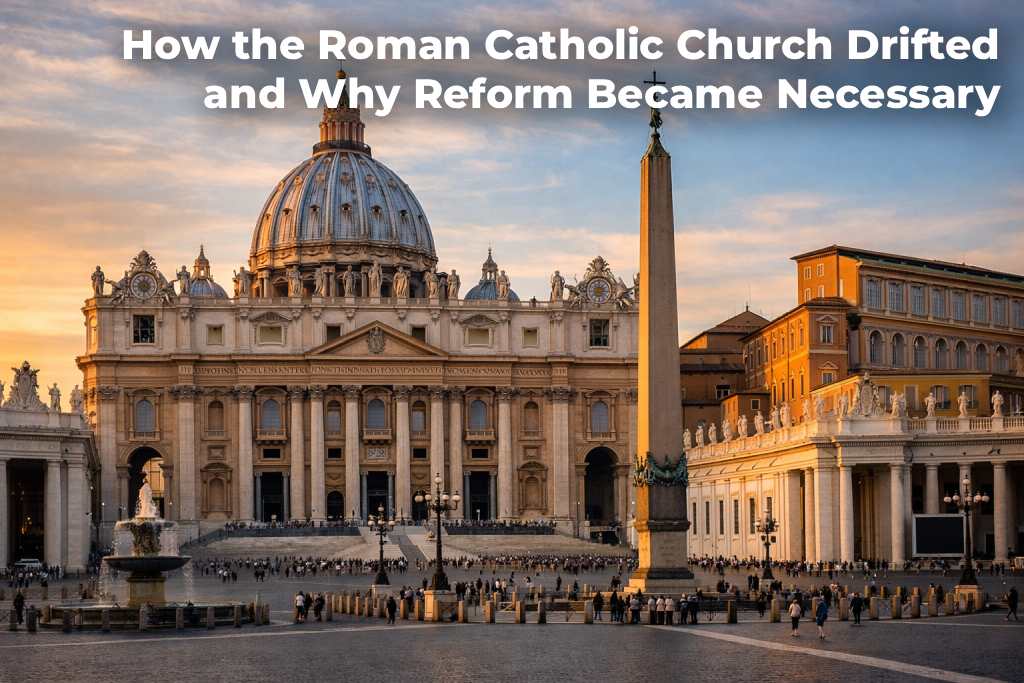
Of all the questions I have heard asked over the years, one is rarely addressed with care: “So, what exactly happened within the one historical, universal, catholic Church that led it from a Christ-centered body of believers to an institution that eventually required reform?” This is not a question asked in accusation, but in honesty, and it is one worth answering carefully.
Introduction: One Church, Many Failures, One Lord
Historic Christianity has always confessed belief in “one holy, catholic, and apostolic Church.” That confession predates Roman Catholicism as an institution, predates Protestant denominations, and predates the modern fragmentation of Western Christianity. It refers not to a single administrative structure, but to a redeemed people united to Christ by faith and scattered across time, geography, culture, and circumstance.
This matters because any serious discussion of the Protestant Reformation must begin by rejecting the idea that the Church ever ceased to exist or required reconstruction from scratch. Claims of total apostasy, followed by a new prophet or restored authority, are foreign to historic Christianity and contradict Christ’s promise that His Church would endure. The question is not whether the Church survived, but whether its institutional expressions remained faithful to the Gospel entrusted to it.
This article, therefore, asks a narrow but significant historical and theological question: What happened to the Roman Catholic Church that made the Protestant Reformation necessary? How did it slowly veer off course? When did it go from the “reliable” entity that existed as Christ’s “body,” to that of severe error and heresy?
I can provide a shorter explanation in that Rome did not suddenly abandon Christianity, the Church did not disappear altogether, and that Protestants invented a new faith.
The longer answer is more complex and more historically grounded. Over centuries, the Roman Catholic Church gradually accumulated doctrines, practices, and authoritative claims that increasingly obscured the biblical teaching of justification by faith and burdened the conscience in ways the apostles and the early church fathers never intended.
The Protestant Reformers were not claiming to restore a lost church. They were calling an existing church to repentance, clarity, and fidelity to Scripture.
The Early Church: Authority, Scripture, and the Gospel
The earliest centuries of Christianity were marked by persecution, doctrinal clarification, and theological struggle. The Church did not invent its message. It was received directly from eyewitness accounts of Jesus’ Apostles. The Apostles proclaimed Christ crucified and risen, reconciliation with God grounded in grace, and justification apart from works of the law. These points were all clearly laid-out in the pages of inspired Scripture.
The New Testament presents justification as a declarative act of God, not a gradual process of moral transformation. Paul’s letters, particularly Romans and Galatians, consistently frame justification as God’s legal verdict upon the sinner who puts their trust in Christ and the grace He freely provides. Faith is the instrument of justification, not the achievement. Works follow as fruit, not as a contributing cause.
The early church fathers, though not always precise in later theological categories, broadly reflect this framework. Clement of Rome speaks of justification by faith rather than wisdom or works. Augustine of Hippo, often claimed by both sides (as in Roman Catholics and Protestants) in later debates, repeatedly emphasizes the primacy of grace and humanity’s inability to merit salvation. Even where sacramental language appears in Augustine’s writings, it does not yet function as a replacement for faith or as a mechanism for earning righteousness.
Authority in the early church was understood as ministerial rather than magisterial. Bishops guarded doctrine. Councils clarified heresy. Scripture functioned as the highest authority, interpreted within the Church but not subordinated to it. The Church understood itself to stand under the Word of God, not over it.
This balance, however, would not remain intact indefinitely. What followed was not betrayal, but development. And it is precisely here that the story becomes complicated.
Gradual Drift, Not Sudden Collapse
How Centuries of Development Reshaped the Roman Church
One of the most persistent misunderstandings surrounding the Protestant Reformation is the belief that the Roman Catholic Church experienced a sudden theological collapse. History does not support that claim. The transformation of medieval Catholic theology was slow, incremental, and often unintentional. The Church did not abandon the Gospel in a single moment. Instead, layers were added, emphases shifted, and pastoral practices hardened into doctrinal necessity over time.
Understanding this gradual drift is essential. Without it, the Reformation appears reactionary. With it, however, the Reformation appears inevitable.
The Post-Apostolic Era (2nd-4th Centuries): Faithfulness with Growing Structure
In its first three centuries, the Christian Church existed largely under persecution. Its theology was forged through martyrdom, apologetics, and defense against heresy. Authority remained local and pastoral. Bishops guarded doctrine. Councils clarified disputes. Scripture remained central.
Even in this early period, however, seeds of later development were planted. Growing emphasis on episcopal authority, particularly in major urban centers such as Rome, Antioch, and Alexandria, began to elevate certain sees above others. This was not papal supremacy, but it marked the beginning of hierarchical differentiation.
After Constantine’s Edict of Milan in 313 AD, Christianity moved from a persecuted minority to an imperially favored religion. This shift profoundly altered the Church’s social role. Bishops increasingly functioned as administrators. Theology began to serve imperial unity as well as pastoral instruction. The Church gained stability, but also entanglement with political power.
None of this constituted doctrinal error. But it did alter incentives. Institutional cohesion began to matter in ways it had not before.
The Rise of Sacramental Centrality (4th-7th Centuries)
During this period, sacramental theology became more pronounced. Baptism, the Eucharist (AKA Lord’s Supper, or Communion), and penance were increasingly viewed not only as signs of grace, but as necessary channels through which grace was received.
By the late fourth century, post-baptismal sin was treated with increasing seriousness. Public penance developed as a means of restoration. Over time, penance shifted from a communal discipline to a private, repeatable act administered by clergy.
This development had pastoral motivations. The Church sought to address ongoing sin and provide assurance. Yet it also introduced a subtle theological shift. Grace increasingly appeared as something mediated, managed, and restored through ecclesiastical means rather than something grounded definitively in Christ’s completed work.
The doctrine of justification remained present, but its clarity began to fade.
The Early Medieval Period (8th-10th Centuries): Institutional Consolidation
By the early Middle Ages, Western Christianity had become increasingly centralized. The Bishop of Rome gained prominence as both a spiritual and political figure, especially following the collapse of the Western Roman Empire.
The Donation of Constantine, later exposed as a forgery but widely believed for centuries, reinforced papal claims to temporal authority. Likely composed in the eighth century, the document portrayed the pope as possessing imperial authority granted by Constantine himself.
At the same time, theological reflection increasingly emphasized moral transformation as the core of salvation. Justification and sanctification were not clearly distinguished. Righteousness was understood primarily as something one became rather than something one received.
This period did not deny grace. It redefined how grace functioned.
The High Medieval Period (11th-13th Centuries): Scholastic Precision and Soteriological Shift
The eleventh through the thirteenth centuries marked a decisive turning point. Scholastic theology, exemplified by figures such as Anselm and Thomas Aquinas, sought to systematize Christian doctrine using Aristotelian categories. This brought intellectual rigor, but it also reframed salvation in more philosophical and moral terms.
Grace came to be understood as an infused habit that enabled the believer to cooperate with God toward righteousness. Faith remained necessary, but no longer sufficient. It had to be formed by love and completed through obedience.
Several institutional developments reinforced this direction:
1054: The East–West Schism formally divided Christianity, weakening universal accountability.
1079: Transubstantiation began to be formally articulated, increasing sacerdotal authority.
1215: The Fourth Lateran Council mandated annual confession and communion, making priestly mediation central to Christian life.
These developments intensified the Church’s role as gatekeeper of grace. Salvation increasingly passed through ecclesiastical structures.
The Treasury of Merit and Indulgences (12th-15th Centuries)
Few developments illustrate the gradual drift more clearly than the doctrine of merit. By the late Middle Ages, the Church taught that Christ and the saints had accumulated surplus merit stored in a heavenly treasury. This merit could be applied to believers to reduce temporal punishment for sin.
Indulgences emerged from this framework. Initially connected to acts of devotion or repentance, they eventually became transactional. By the fifteenth century, indulgences were sometimes sold to fund church projects, including the rebuilding of St. Peter’s Basilica.
Christ was not replaced; He was supplemented. And that distinction mattered, as the believer’s assurance no longer rested solely on Christ’s righteousness, but on participation in an economy of grace administered by the Church.
16th Century and Beyond: Anxiety, Not Confidence
By the time Martin Luther entered the monastery in the late fifteenth century, the system was fully formed. Salvation was understood as a lifelong process of accumulating righteousness, avoiding mortal sin, performing penance, and depending on sacramental mediation.
Few expected immediate salvation. Most hoped to endure purgatory long enough to be purified.
This environment produced fear rather than joy, uncertainty rather than assurance. Luther did not invent this problem. He inherited it.
Why does this matter?
Because the Roman Catholic Church did not cease to preach Christ. It did not reject grace or deny Scripture altogether. Yet over centuries, it gradually redefined how salvation worked, how authority functioned, and how assurance was obtained.
By the early sixteenth century, the Gospel had not vanished, but it had been very much obscured.
Nowhere was this cumulative drift felt more acutely than in the Church’s doctrine of justification.
Justification Becomes a Process
While Martin Luther’s public protest began with the sale of indulgences, this specific grievance quickly revealed a more fundamental disagreement over authority. This led to the doctrine of Sola Scriptura, the conviction that the Bible is the sole infallible rule of faith and practice for the church.
Guided by Scripture, Luther and the Reformers recovered the doctrine of Sola Fide: that justification is by grace alone, through faith alone, because of Christ alone. Therefore, while Sola Scriptura provided the foundation, the central heartbeat of the Reformation was the doctrine of justification—the “article upon which the church stands or falls”—from which all other reforms flowed.
In the medieval Roman Catholic system, justification was increasingly understood as a process of becoming righteous through infused grace. Grace was given, lost, restored, increased, and mediated through sacramental participation. Faith remained essential, but no longer sufficient enough to take care of a person’s salvation on its own. It had to be completed by cooperation, penance, and obedience.
The pastoral consequences were profound. If justification is a process, assurance becomes impossible. The believer can never know whether he has repented sufficiently or cooperated adequately with grace. The conscience remains restless. Fear replaces confidence. Christ’s finished work becomes a starting point rather than a completed redemption.
Luther’s crisis arose not from rebellion, but from taking the Church’s teaching seriously. If salvation depends, even partially, on human progress in righteousness, despair becomes the only honest response for anyone who understands their sin.
The medieval penitential system attempted to address this anxiety, but it intensified it. Rather than directing sinners outward to Christ, it turned them inward to performance.
This was not apostolic Christianity.
Authority Shifts: Scripture and the Magisterium
Once justification was redefined, the question of authority could not remain secondary.
The early Church treated Scripture as the final norm. Tradition served as witness and guide, not as an independent source of revelation. Over time, Rome increasingly claimed that Scripture and tradition were equal authorities, both interpreted definitively by the Church’s teaching office.
This shift carried enormous implications. Once the Church became the final arbiter of meaning, correction became impossible. Appeals to Scripture against Church teaching could be dismissed as private judgment.
The Reformers rejected this not because they opposed authority, but because they believed the Church itself was accountable to the Word of God. Councils can err. Popes can err. Scripture cannot.
This conviction did not originate in the sixteenth century. Augustine himself insisted that Scripture stands above every human authority, even while affirming the Church’s role as witness.
The Great Schism: Unity Already Fractured
The East–West Schism of 1054 is often overlooked in Protestant–Catholic debates, yet it is essential for historical clarity. Long before Luther, the visible unity of Christendom had already fractured.
The Eastern Orthodox Church rejected Roman claims of universal jurisdiction, and longstanding cultural, linguistic, theological, and political tensions gradually intensified. One of the most visible theological flashpoints was the filioque clause. In the late first millennium, the Western Church added the phrase “and the Son” to the Nicene Creed’s description of the Holy Spirit’s procession, largely to combat Arianism. Eastern Christians objected not only because they believed this addition altered the biblical and patristic teaching that the Spirit proceeds from the Father, but also because it was made unilaterally. No single church, they argued, possessed the authority to modify an ecumenical creed without the consent of the whole Church.
What might have remained a theological dispute instead became a symbol of deeper disagreements over doctrine and authority, culminating in mutual excommunications in 1054.
This schism demonstrates that the idea of a single, uninterrupted Roman authority was already contested centuries before the Reformation. Protestantism did not invent fragmentation. It emerged within an already divided ecclesial landscape.
The Reformers and Their Intentions
It is historically inaccurate to claim that the Reformers set out to create a new church. Luther remained a Catholic priest for years. His early protests were academic and pastoral. John Calvin sought reform within the Church. Ulrich Zwingli worked through existing ecclesial and civic structures.
Their appeal was consistent: Scripture, the early church fathers, and the Gospel itself.
Only after Rome formally condemned justification by faith alone at the Council of Trent did separation become unavoidable. At that point, remaining within the Roman system required denying what the Reformers believed Scripture plainly taught.
This was not a power grab. It was a matter of conscience.
The Council of Trent and the Closing of the Door
The Council of Trent, sadly, had the Roman Catholics “doubling down” on their un-Scriptural heresies. As a “response” to Martin Luther and the burgeoning Protestant Reformation, the Roman Catholic Church, instead of making a major course correction and returning to its biblical roots, planted its flag on its tarnished stance on justification and salvation.
This council convened intermittently between 1545 and 1563, marked a decisive turning point in the history of Western Christianity. Called in response to the Protestant Reformation, Trent did not merely address abuses or clarify misunderstandings. It formally defined and codified doctrinal positions that placed the Roman Catholic Church in explicit opposition to the central claims of the Reformers.
In its Sixth Session (1547), Trent issued its Decree on Justification, which directly addressed the question that lay at the heart of the Reformation. While the council affirmed the necessity of divine grace and rejected Pelagianism, it also declared that justification was not received by faith alone. Instead, justification was defined as a process involving the infusion of righteousness, cooperation with grace, and perseverance in sacramental obedience. Those who taught that sinners are justified by faith alone, apart from inherent righteousness or cooperation with grace, were formally anathematized.
This move drew a clear and irreversible line. The issue was no longer one of emphasis, language, or pastoral practice. It was a matter of formal doctrinal condemnation. Grace was not denied, but it was declared insufficient apart from ecclesiastical mediation and human cooperation. Justification was no longer grounded solely in Christ’s imputed righteousness, but in a righteousness that must be internally possessed and maintained.
Trent also reinforced the Church’s authority structure. Scripture and tradition were affirmed as equal sources of revelation, both interpreted authoritatively by the Church’s magisterium. This effectively closed the door to reform on the Reformers’ terms. Any appeal to Scripture against conciliar teaching was rendered illegitimate by definition.
In response, the Reformers did not claim new revelation or ecclesiastical authority. They reaffirmed what they believed the apostles had taught and the early Church had confessed: that sinners are justified by grace alone, through faith alone, in Christ alone, apart from works of the law. Their confessions, catechisms, and theological treatises consistently framed justification as a declarative act of God, not a gradual process of moral transformation.
From Rome’s perspective, this teaching was dangerous and destabilizing. From the Reformers’ perspective, it was the heart of the Gospel.
What emerged from Trent was not reconciliation, but final separation. The possibility of reform within the Roman Catholic Church, at least on the question of justification, had effectively ended. What had begun as a call for correction concluded with mutual exclusion.
This was not innovation on the part of the Reformers. It was recovery.
Protestantism and the Question of the “Real Church”
Here, Protestantism differs fundamentally from restorationist movements. For instance, Joseph Smith and the Latter-day Saints claimed that ALL other denominations and branches of Christianity had fallen into total apostasy and lost authority, so the need for brand-new revelation was needed. Therefore, according to them, an all-new church (the Mormons) had to be established.
The Reformers made no such claim. They believed the true Church existed, but required reform. They affirmed that Rome retained many true doctrines, but it had succumbed to other forms of authority outside of the Bible, and that it had obscured the heart of the Gospel. They did not deny that genuine believers existed within Roman Catholicism. They denied that Rome’s official doctrinal system faithfully represented apostolic teaching.
The Protestant Reformers were not claiming to restore a lost church. They were calling an existing church to repentance, clarity, and fidelity to Scripture.”
Protestantism does not claim exclusive identity as the Church. It claims fidelity to the Gospel as the defining mark of the Church.
Matthew 16 and the Gates of Hell
Jesus’ promise that “the gates of hell will not prevail” against His Church is often misunderstood. Gates are defensive structures. They do not advance.
The image is not of a fragile Church barely surviving an attack, but of a victorious Church advancing with the Gospel into enemy territory. The Church is on the offense. Institutional corruption does not negate this promise. In many cases, reform is the means by which Christ fulfills it.
The Reformation, understood this way, is not evidence of collapse. It is evidence of Christ’s ongoing work.
Conclusion: Reform Was Not Optional
The Protestant Reformation was not a rejection of the Church. It was a refusal of the reformers to abandon the Gospel.
The Roman Catholic Church did not keep its “eyes on the Prize,” to put it crudely. It gradually drifted in ways that required correction. When correction was rejected, separation followed.
What remains is a splinter group in Rome, which is, ironically, larger in size than the group that adheres more to the Bible.
This is not a story of triumphalism, but a warning. Every single church on the face of the earth – Protestant denominations included – is capable of drift. The Reformation does not belong only to the past. Its call remains, and the Church must always be reformed according to the Word of God, anchored in Christ, and humbled by grace.
That is not sectarianism. It is faithfulness.
And it is why reform was not only justified, but necessary.
Executive Summary
This article argues that the Protestant Reformation did not arise from a sudden collapse or total apostasy within the Roman Catholic Church, but from a long, gradual process of theological and institutional drift that unfolded over centuries. While Rome never abandoned Christ, grace, or Scripture outright, it increasingly redefined how salvation functioned, how authority operated, and how assurance was obtained, particularly through a developing sacramental system, a process-based view of justification, and expanding ecclesiastical authority. The Reformers did not seek to create a new church or claim exclusive legitimacy, but to call an existing one back to the Gospel as taught in Scripture and reflected in the early Church. When that call was formally rejected, especially at the Council of Trent, separation became unavoidable. Understood this way, the Reformation represents not the failure of Christ’s promise to preserve His Church, but one of the means by which He has continued to do so.
2 Comments
Gabriel Little
Very interesting take on this, Scott. I was expecting a little more on the heresy of the papacy. But still, a very good piece. Thanks, mate.
Leonard M. Williams
Gabriel above has a good point. Aren’t popes unbiblical? Didn’t the fact that they existed long before the Middle Ages and the Great Schism show that the church as a whole had drifted massively?
Thanks, Scott.