
I’ve always loved astronomy. Inspired by the original Star Wars movie (now called Star Wars: Episode IV – A New Hope) as a little kid, I could stare up at the night sky and feel two things at the same time: incredibly small and strangely steady. For a short while, I even wanted to be an astronomer when I grew up.
That said, I haven’t always kept up on astronomical news over the decades like I probably should. I just ran across this yesterday (Wednesday, December 17, 2025), and it sent me down a rabbit trail.
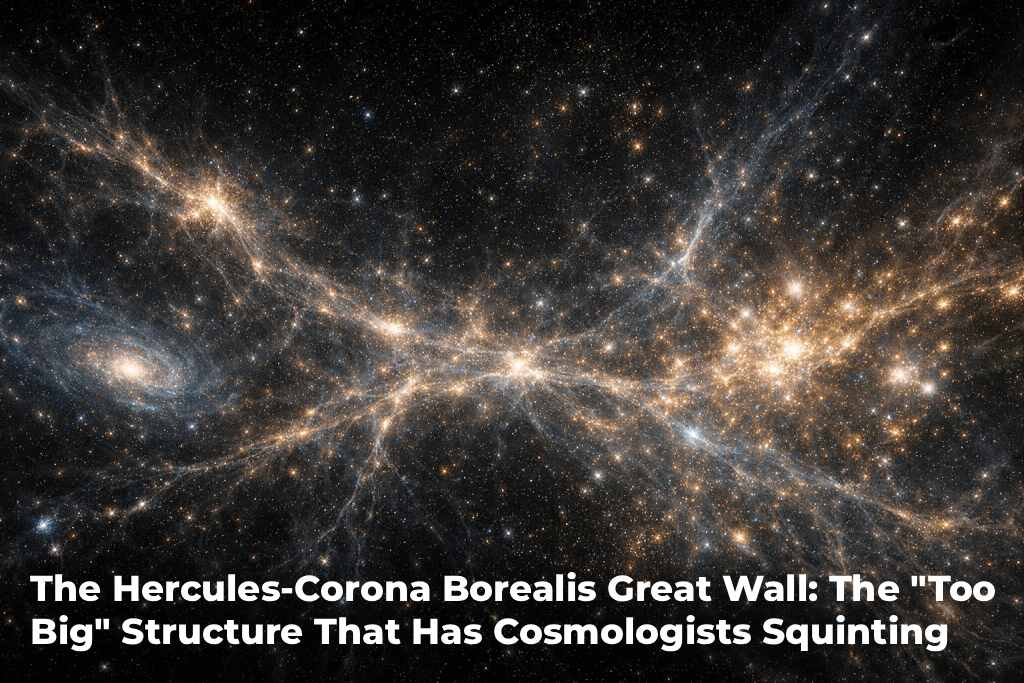
It’s called the Hercules-Corona Borealis Great Wall, and if the findings hold up, it may be the largest known structure ever identified in the observable universe.
What On Earth is the Hercules-Corona Borealis Great Wall?
The Hercules–Corona Borealis Great Wall (often shortened to “HCB Great Wall”) is a proposed superstructure in the universe, identified not by taking a single “photo” of a wall in space, but by noticing a large-scale clustering pattern in gamma-ray bursts (GRBs).
GRBs are brief, extremely energetic explosions associated with distant galaxies and star formation activity. When astronomers mapped where many GRBs appear in the sky, they found an unusual concentration of GRBs at similar distances (redshifts) in a large region of the sky. That clustering is what sparked the Great Wall proposal.
Some estimates put this structure at roughly 10 billion light-years in its longest dimension, with the clustering often discussed around redshift z ≈ 2 (commonly described as a range like 1.6 to 2.1 in early analyses).
Why this structure makes scientists uneasy
This is where it gets interesting. The issue is not simply, “Wow, that’s huge.” The issue is that the Great Wall’s proposed scale appears to strain a basic expectation in cosmology: that the universe becomes statistically smooth and uniform when you zoom out far enough.
1) It seems far too large for the “expected” cosmic smoothness
A common working assumption in cosmology is the Cosmological Principle, the idea that the universe is homogeneous and isotropic on sufficiently large scales. In plain language, you can have lots of clumping locally, but if you zoom way out, things should average out.
Some analyses in standard cosmological frameworks point to homogeneity emerging on scales on the order of a few hundred megaparsecs (often referenced around ~300 Mpc, and sometimes discussed with thresholds like ~260/h Mpc in the literature). When people propose a coherent structure far larger than that, it creates tension with those expectations.
2) It relies on an indirect tracer: gamma-ray bursts
Another reason this is debated is the method itself. The Great Wall is inferred from the sky distribution of GRBs, which are an unusual “tracer” compared to galaxy surveys. GRBs are not evenly sampled across the sky and across time. Different satellites, observing strategies, sky exposure, and the difficulty of measuring redshifts can all introduce selection effects.
So some researchers argue the clustering could be exaggerated by observational bias or statistical methods. Others argue that even after testing for sampling bias, the clustering signal still shows up strongly enough that it is hard to dismiss.
3) It adds to a growing list of “too big” structures
This is not happening in a vacuum. Over the last couple of decades, astronomers have found multiple very large structures and patterns in the cosmic web that already press on what we intuitively expect. The Hercules–Corona Borealis Great Wall is just the most extreme example that people love to talk about because the claimed size is so staggering.
There is another tension here that often goes unspoken outside of technical discussions. If the universe began as a single explosive event (such as the Big Bang), then matter would have had to spread outward and later assemble into large-scale structures through gravity. But when structures reach the scale proposed for the Hercules–Corona Borealis Great Wall, critics have pointed out that the galaxies involved appear to be separated by distances that would require an unrealistically rapid redistribution of matter.
In simple terms, if those stars and galaxies formed elsewhere and later moved into their present configuration, the implied motion would exceed what light-speed constraints and conventional structure-formation timelines comfortably allow. Cosmologists will rightly note that cosmic expansion is not the same thing as objects “traveling” through space, but the tension remains: gravity-driven assembly alone struggles to explain how such an immense, coherent structure could emerge so quickly and at such scale.
From a design perspective, the structure makes far more sense if those galaxies were not scrambling to get into place after an explosion, but were formed where they are. The appearance is not one of debris settling chaotically, but of order already present. The more massive and organized these structures become, the harder it is to see them as accidental byproducts of a cosmic blast, and the easier it becomes to see intentional placement (by design) written into the fabric of the universe.
So is it real?
The honest answer: the jury is still out.
There are peer-reviewed papers arguing that the evidence supports the existence of a significant clustering feature consistent with the Great Wall, and there are also papers pushing back, questioning whether the result is fully accounted for by observational biases and statistical pitfalls.
Even if future work concludes that the Great Wall is “less wall-like” than the headlines suggest, the broader point still stands: large-scale structure research keeps running into surprises, and those surprises force refinements in how scientists interpret the data and test assumptions about the universe.
A Quiet Philosophical Takeaway
I’m not reading this as “science is collapsing.” Not at all. I read it as a reminder that our models are exactly that: models. They are useful and often powerful, but the universe was not built to fit neatly inside our expectations.
And from where I stand, the more we learn, the more creation continues to look engineered. When you stare at a structure on a scale like this, it does not feel like randomness. It feels like order. It feels like architecture. It screams intelligent design.
Christians have always believed the heavens are declaring something, as Psalm 19:1 proclaims, “The heavens declare the glory of God, and the sky above proclaims his handiwork.” Discoveries like this do not threaten my faith, but actually quite the opposite. They strengthen the sense that we are studying a universe that is both rational and overwhelming because it comes from a rational and overwhelming Creator who has made this nearly incomprehensible universe to show His immense glory.
There is also a deeper tension beneath the surface of discussions like this. If the universe truly began as a massive explosion, then matter would have needed to spread outward and later gather itself into structures like the Hercules–Corona Borealis Great Wall. Yet when the distances involved are considered, the implied rearrangement of stars and galaxies presses hard against physical limits. If these objects formed elsewhere and migrated into their current positions, the required motion would outpace what light-speed constraints and standard structure-formation timelines comfortably allow.
Cosmologists rightly point out that the expansion of space is not the same thing as objects traveling through space, but even granting that distinction, the picture remains strained. The scale and coherence of the structure feel less like debris racing to organize itself after an explosion and more like something that was formed where it is.
In other words, this looks less like chaos settling down and more like intention already in place. The more massive and ordered the universe appears, the harder it becomes to attribute everything to chance motion, and the more reasonable it becomes to see design written into the cosmos from the very beginning, as opposed to chaotic chance. Like I said, the jury is still out. But if there is truth to this discovery, it is far more plausible that an intelligent being like God put these billions of galaxies into place, as opposed to advocating breaking the laws of physics in order to deal with the concept of a Creator.
References and further reading
- Horváth et al. (Astronomy & Astrophysics, 2015): “New data support the existence of the Hercules-Corona Borealis Great Wall”
- arXiv preprint (Horváth et al.): “New data support the existence of the Hercules-Corona Borealis Great Wall”
- arXiv preprint (S. Christian, 2020): “Re-Examining the Evidence of the Hercules-Corona Borealis Great Wall”
- Oxford Academic (MNRAS, 2024): “Mapping the Universe with gamma-ray bursts”
- Space.com (2025): Summary of the debate and what new GRB analyses may imply
- BBC Sky at Night Magazine (2024): Overview of the Hercules–Corona Borealis Great Wall
- Wikipedia: Hercules–Corona Borealis Great Wall (helpful for quick orientation and references)
- Teach Astronomy: The Cosmological Principle (plain-language explanation)
0 Comments