
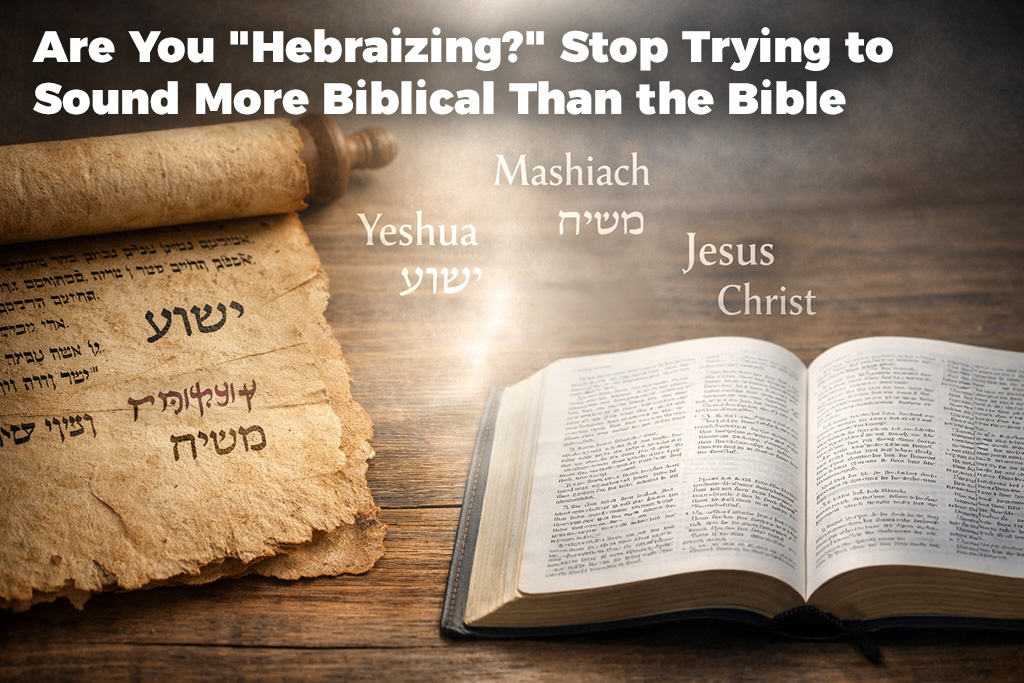
There’s a trend that keeps popping up in Christian circles, especially online. You’ve probably seen it. Someone insists on saying “Yeshua” or “Yashua” or “Yehoshua” instead of Jesus. It could be the Hebrew term “Mashiach” instead of “Messiah” or “Christ.” Someone else corrects “God” to “Yahweh” mid-conversation. Another person starts talking about feasts, keeping the Sabbath, dietary laws, or “returning to our Hebrew roots” as if the average believer is missing something essential. They’ll talk about recognizing Jewish holidays and celebrations, and some even are sticklers for requiring all Christians to observe the Sabbath day exactly as God commanded in the Old Testament.
At first glance, it can sound serious. Even reverent. Like someone is just trying to get closer to the original context of Scripture.
But if you listen closely, something else often creeps in…
A subtle tone that says, “I’m a little closer than you.”
A quiet implication that “ordinary” Christianity (especially if you live in the English-speaking world) is missing something.
A shift from Christ alone to Christ plus cultural reconstruction.
Now, let’s be clear right out of the gate.
The Old Testament Matters
The Old Testament matters. Deeply.
It is not a relic. It is not a discarded covenant that we ignore. It is the very Word of God, just as inspired, just as true, just as relevant, and just as authoritative as the New Testament. The Bible is one unified story, unfolding the plan of redemption from Genesis to Revelation fulfilled in Jesus Christ. We should not, as popular pastor Andy Stanley says, “unhitch ourselves from the Old Testament.”
You cannot fully understand the New Testament without the Old. You cannot grasp the depth of the Cross of Christ without the sacrificial system. You cannot appreciate Christ as our High Priest without Leviticus. You cannot understand the promises of God without Abraham, Moses, and David.
There are thousands of references back to the Old Testament all throughout the New Testament, and knowing what the older Scriptures say will give you insight into the newer ones.
So yes, studying the Old Testament is absolutely essential.
But here’s where things go sideways.
You don’t have to live in the Old Covenant to understand it.
You don’t have to speak Hebrew to be faithful.
You don’t have to adopt Jewish customs or have a special connection to the modern nation of Israel to be spiritual.
The New Testament never commands that. Not once.
And when people begin to imply otherwise, we need to slow down and think carefully.
What Do You Call This Trend?
There are a few different ways people describe this movement or mindset, depending on how far it goes.
1. “Hebraizing” or the Hebraic Roots idea
This is probably the most neutral way to describe it. It refers to an effort to recover what people believe are the “Jewish roots” of Christianity.
That can include things like using names such as “Yeshua” or “Yahweh,” observing Old Testament festivals like Passover or Tabernacles, or following dietary practices found in the Mosaic Law.
Now, on the surface, some of this can be helpful. Understanding Jewish culture, language, and background can absolutely enrich your reading of Scripture. It can open your eyes to connections you might have missed.
But there’s a line.
And people cross it when these practices move from being helpful context to becoming spiritual expectations.
When it shifts from “this is interesting and informative, and it shows us how Christ has fulfilled these things” to “this is what faithful Christians should be doing here and now,” something has gone wrong.
Because the moment you start binding consciences where Scripture does not, you are no longer just studying the Bible. You are adding to it what is required in the New Covenant.
2. The Hebrew Roots Movement
This is where things become more defined. This movement teaches, in varying degrees, that Christians should return to aspects of the Mosaic Law. That might include Sabbath observance on Saturday, keeping Old Testament festivals, or following dietary restrictions.
Some within this movement go even further and suggest that the church has lost its way by becoming too “Greek” or “Roman,” and that true Christianity requires reconnecting with its Jewish identity. That may sound compelling at first, especially if you already love the Old Testament. But it raises serious theological concerns. Why?
Because it begins to blur and even erase the line between the Old Covenant and the New.
Scripture is clear that Christ has fulfilled the Law. Not abolished it, not ignored it, but fulfilled it completely. The ceremonial and civil aspects of the Old Covenant pointed forward to Him. They were shadows. They were types of the Messiah to come. He is the substance. When those shadows are reintroduced as ongoing obligations, even subtly, it begins to undermine the finished work of Christ.
And that is not a small issue.
3. “Judaizing”
This is the biblical term, and it’s the one we need to take most seriously.
The issue you’re seeing today is not new. It showed up in the first century, almost immediately after the Gospel began spreading. There were people who said, “Yes, believe in Christ.” But they didn’t stop there. They added to it. They taught that Gentile believers also needed to be circumcised, to keep the Old Covenant Law, and to adopt Jewish practices in order to be fully accepted by God.
In other words, faith in Christ was not enough.
The Apostle Paul confronts this directly in Galatians, and he does not treat it as a minor disagreement. He treats it as a distortion of the Gospel itself. Look at how strong his words are in Galatians 2:21: “If righteousness were through the law, then Christ died for no purpose.” That is as clear as it gets.
If you add anything to Christ as a requirement for righteousness, you are no longer preaching the Gospel. You are replacing it.
And again in Galatians 5:2, Paul warns that if you accept circumcision as necessary, “Christ will be of no advantage to you.” My friends, that is not a soft correction. That is a line in the sand.
So when someone today begins to suggest that using Hebrew names, observing feasts, or adopting Old Testament practices makes you more authentic, more spiritual, or more aligned with God’s will, that is not just a preference.
That is drifting into the same error Paul confronted in the church in Galatia.
4. Informal and Critical Descriptions
Because of how common this has become, people often use more casual language to describe it. You’ll hear phrases like:
“Hebrew-izing Christianity”
“Torah-obsessed Christianity”
“Pseudo-Jewish Christianity”
These are not technical theological terms, but they capture the concern. They reflect the sense that something is being layered onto the Gospel that does not belong there.
Where the Line Gets Crossed
Let’s bring this down to a practical level.
There is nothing wrong with knowing that “Jesus” comes from the Hebrew name “Yeshua,” which means “YHWH saves.” (We also derive the name “Joshua” from it.) That can be very helpful. It can deepen your understanding of the text.
There is nothing wrong with learning about the name “YHWH/Yahweh” and how God revealed Himself to Israel. It is referred to as the Tetragrammaton, which is the eternally-existant, divine name of God of “I AM,” as revealed to Moses at the burning bush. It’s beneficial to study that. So yes, that matters.
And there’s nothing wrong with studying the feasts or understanding dietary laws in their historical and theological context.
All of that can strengthen your grasp of Scripture.
But the moment it turns into this:
- Saying the English name “Jesus” is somehow less accurate or less reverent
- Insisting that “Yeshua” is the only proper way to refer to Him
- Treating the use of “Yahweh” as a sign of deeper spirituality
- Implying that observing Old Testament practices brings you closer to God
…that is where the shift happens. That is no longer about understanding the Bible. That is about constructing a new standard of spirituality. And it is a standard that the New Testament never gives.
What the New Testament Actually Emphasizes
The New Testament moves in a very different direction. It does not call believers to become culturally Jewish. It does not instruct Gentiles to adopt the Hebrew language or customs. It does not elevate pronunciation or ritual as markers of maturity.
Instead, it levels the ground completely.
Galatians 3:28 says, “There is neither Jew nor Greek… for you are all one in Christ Jesus.”
That does not erase history or ethnicity, but it removes them as spiritual qualifiers (read Ephesians 2:11-22 to go deeper on this).
Your standing before God is not determined by your background, your language, or your cultural alignment. It is determined by Christ. Alone.
And when Paul addresses food laws and special days in Colossians 2:16-17, he says, “Therefore let no one pass judgment on you in questions of food and drink, or with regard to a festival or a new moon or a Sabbath. These are a shadow of the things to come, but the substance belongs to Christ.” That is the key.
These foreshadowings served their purpose. They pointed forward. But now that Christ has come, we cling to Him, not the shadows.
Even the New Testament Was Written in Greek
There’s another point that often gets overlooked in this whole discussion: the New Testament itself was written in Koine Greek.
That means Matthew the Apostle, John the Apostle, Paul the Apostle, Peter the Apostle, and the others were not going around insisting on Hebrew forms when they wrote Scripture under the inspiration of the Holy Spirit. They used Greek.
They wrote “Iesous” (Ἰησοῦς), which is where we get “Jesus.” They wrote “Theos” (Θεός) for God. They wrote “Kyrios” (Κύριος) for Lord.
And that was not a compromise. That was not a dilution of truth. That was God’s design.
The Gospel was going out to the nations, and it was communicated in the common language of the time, so people could understand it clearly. That matters because it shows us that the power of the Gospel is not tied to preserving Hebrew pronunciation. If it were, the New Testament itself would have been written differently. Instead, God chose to preserve His Word in a form that made Christ known to the world and that would have widespread distribution throughout the Roman Empire.
So again, learning Hebrew terms can be helpful. But insisting on them as necessary misses the very pattern God established in Scripture itself.
Don’t Trade Clarity for Complexity
There’s something else going on beneath the surface of this trend. For many people, adding layers like Hebrew terminology or Old Testament practices makes their faith feel deeper, more serious, and more rooted. But there’s a danger there.
Because sometimes what feels deeper is actually just more complicated. The Gospel is not complicated.
It is profound, yes. It is deep beyond measure. But it is also clear.
Christ lived the life we could not live.
Christ died the death we deserved.
Christ rose again, securing our salvation.
And we are justified by faith in Him.
Not by language. Not by rituals. Not by reconstructing ancient practices. But by faith.
When we start adding to that, even with good intentions, we begin to obscure the simplicity and power of the Gospel.
A Quick Word on Bible Translations and “Yahweh”
It’s also worth saying a quick word about Bible translations that use the name “Yahweh” for the name of God in the Old Testament, like the Legacy Standard Bible (LSB) or the World English Bible (WEB).
I actually appreciate these translations. I wholeheartedly recommend them (especially the LSB) to all Christians to read and use.
They are careful, thoughtful, and in many ways helpful. Using “Yahweh” instead of “LORD” can bring clarity to passages where God’s covenant name is being emphasized. It can help readers see distinctions in the text that might otherwise be missed. That’s a good thing.
But even here, we need to keep perspective.
The translators are not saying that you must use the word “Yahweh” in your personal speech to be more faithful. They are making a translation decision to reflect the original text more transparently. That’s very different from turning the use of “Yahweh” into a spiritual badge.
So if you read the LSB or NET (or others) and benefit from seeing “Yahweh” in the text, that’s great. Use it. Learn from it. Let it deepen your understanding. Just don’t let it become a measuring stick for spiritual maturity.
Because once again, your standing before God is not tied to whether you use the direct translation of “I AM” in Hebrew (even the Old Testament Jews feared using the name “YHWH/Yahweh,” so they replaced it with “Adonai,” which is their term for “Supreme Lord.)
It is tied to Christ.
Hold the Line
So where does that leave us?
Study the Old Testament. Dive into it. Learn the context. Understand the language where you can. Pray that God will grow you to love the rich history of His plan of redemption in it. Let it shape how you read the New Testament.
But don’t feel pressure to adopt a version of Christianity that Scripture itself does not require.
You don’t need to say “Yeshua” or “Mashiach” to be heard by God. There is no special treatment or access God provides if you use these names instead of the English (or any other language) versions.
You don’t need to say “Yahweh” to be more reverent. You can revere God Almighty as the holy, holy, holy Sovereign Creator and King of the Universe by using “LORD.”
You don’t need to live like you’re under the Old Covenant to be faithful under the New.
You need Jesus Christ. And if you have Him, you have everything.
That’s the line you want to keep clear.
0 Comments