
There is a strange kind of silence that can destroy a home.
It is not the peaceful quiet of a man who is resting in God. It is not the thoughtful silence of someone who is listening carefully. It is the silence of withdrawal. The silence of fear. The silence of a man who should speak, but does not.
Genesis 3 gives us one of the clearest and most sobering pictures of this kind of silence in all of Scripture.
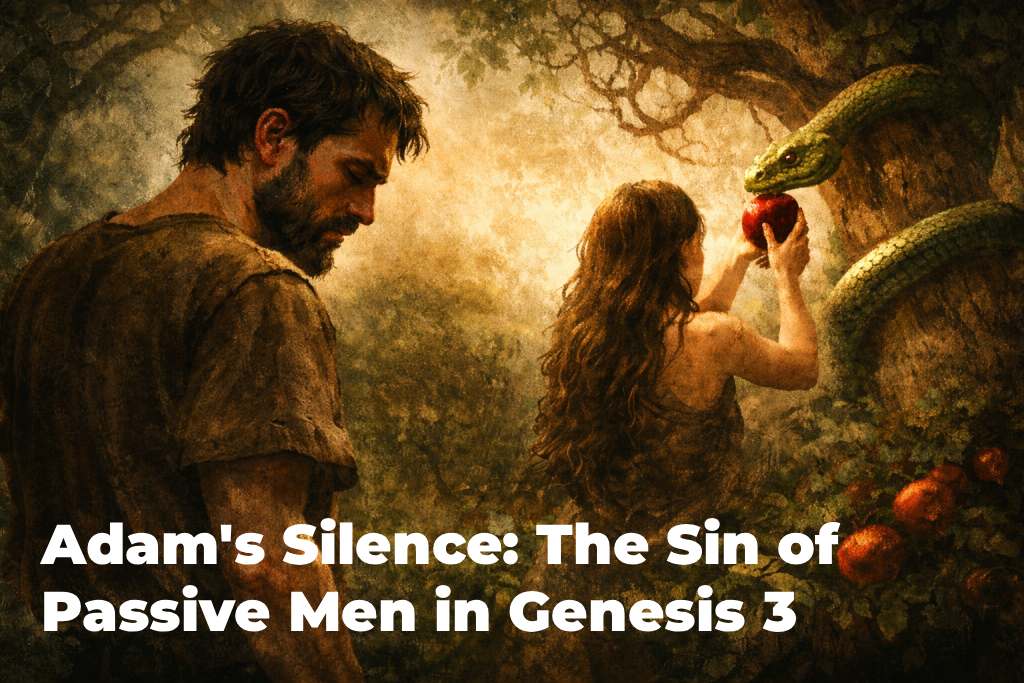
Most men know the story. The serpent comes to Eve. He questions God’s Word. He twists the truth. He promises enlightenment and freedom. Eve listens. She reasons. She looks. She takes. She eats.
But there is a detail that often gets overlooked.
Adam was there.
Genesis 3:6 says that Eve “also gave some to her husband who was with her, and he ate.”
He was not across the garden working. He was not unaware of what was happening. He was not misinformed after the fact. He was present. He saw the conversation unfold. He heard the serpent challenge God. He watched his wife reach for the forbidden fruit.
And he said nothing.
This is the first great failure of manhood in human history.
Before Adam ever ate the fruit, he failed in his calling. His silence was not neutral. It was sinful. God had given Adam the command directly. In Genesis 2:16-17, the Lord told him not to eat from the tree of the knowledge of good and evil. Adam was responsible for guarding the garden. He was responsible for leading his wife. He was responsible for upholding the Word of God in the face of temptation.
Instead, he stood there like a spectator.
Passive men often imagine that they are avoiding conflict. They think they are being kind, patient, or easygoing. In reality, they are abandoning their post. Adam did not throw the fruit away. He did not rebuke the serpent. He did not remind Eve of what God had clearly said.
He watched. He did nothing.
In fact, he willfully ate the fruit right along with Eve after she gave him some. (Genesis 3:6)
There is something in the fallen male heart that wants to step back when it should step forward. Many men are comfortable providing money, fixing things, or working long hours. Those are good responsibilities. But spiritual leadership requires courage of a different kind. It requires a willingness to speak the truth. It requires a readiness to protect. It requires the strength to say, “No. We will not go that direction.”
Adam failed at precisely that moment.
The serpent was not merely tempting Eve. He was challenging God’s authority. He was questioning the goodness of the Creator. He was planting seeds of distrust. When Adam stayed silent, he allowed those seeds to grow unchecked.
This is still happening today.
Homes drift spiritually because men drift spiritually. Churches weaken because men disengage. Children grow up confused because fathers refuse to lead. The pattern that began in Eden continues in living rooms, workplaces, and congregations all over the world.
Passivity is not harmless.
Some men imagine that being quiet keeps the peace. Scripture shows us that sinful silence often prepares the ground for disaster. Proverbs 24:11-12 calls God’s people to rescue those who are being taken away to death. That principle applies broadly. There are moments when a man must act. Moments when he must speak. Moments when he must stand firm, even if it feels uncomfortable.
Adam chose comfort over obedience.
After the fall, the consequences came quickly. Shame entered the human experience. Fear replaced fellowship with God. Blame replaced unity between husband and wife. When the Lord confronted Adam, his response revealed how deeply passivity had shaped him. In Genesis 3:12, he said, “The woman whom you gave to be with me, she gave me fruit of the tree, and I ate.”
Instead of taking responsibility, Adam shifted the blame. He pointed at Eve. He even implied that God Himself was somehow at fault. This is what passive leadership produces. When a man refuses to lead early, he often refuses to own his failures later.
Biblical Manhood Looks Very Different
A godly man is not domineering or harsh. He is not loud for the sake of being loud. He is not controlling. But he is present. He is watchful. He takes responsibility for the spiritual direction of his life and his household.
He knows that silence can be sinful.
In Ephesians 5:23, Paul says that the husband is the head of the wife as Christ is the head of the church. That is not a license for selfish authority. It is a call to sacrificial leadership. Christ leads by loving, teaching, correcting, protecting, and giving Himself for His people. A Christian man is called to reflect that pattern in his own context.
Leadership Begins with Devotion
Many men want influence without intimacy with God. They want respect without repentance. They want authority without submission to Scripture. Adam’s silence flowed from a deeper problem. He was not clinging tightly to the Word the Lord had spoken. He allowed doubt and distraction to weaken his resolve.
If a man is not regularly hearing God’s voice in Scripture, he will struggle to speak God’s truth in moments of testing.
Passivity also thrives where men fear man more than they fear God. Adam may have been hesitant to confront Eve. He may have wanted to avoid tension. He may have thought it was not his place to intervene. Whatever the internal reasoning, the result was the same. He honored human comfort over divine command.
The fear of God produces a different kind of man.
When a man takes God seriously, he becomes steady. He becomes willing to stand alone if necessary. He becomes less concerned about being liked and more concerned about being faithful. This does not make him harsh. It makes him reliable. His wife knows where he stands. His children know what he believes. His church can count on his presence and service.
The Better Adam
Genesis 3 is not only a story of failure. It also prepares us to see the hope that comes through Christ.
Where Adam was silent, Jesus spoke. Where Adam disobeyed in a garden, Jesus obeyed in a garden. In Gethsemane, facing unimaginable suffering, Christ did not retreat into passivity. He prayed, “Not my will, but yours, be done” (Luke 22:42). He moved forward in perfect submission to the Father.
Romans 5:19 says that by the one man’s disobedience the many were made sinners, but by the one man’s obedience the many will be made righteous.
This means that Christian men are not left with the example of Adam alone. We are given a new pattern. A new Head. A new source of strength. Through union with Christ, we are empowered to reject passivity and pursue faithful leadership.
What This Looks Like in Real Life
This will look very practical.
It may mean initiating family prayer even if it feels awkward at first. It may mean opening the Bible at the dinner table. It may mean confronting sin in a gentle but clear way. It may mean stepping into church service rather than remaining a spectator. It may mean confessing your own failures and asking forgiveness when you fall short.
Strong leadership is rarely dramatic. It is usually consistent.
The tragedy of Adam’s silence should sober us. The obedience of Christ should encourage us. Every day presents new opportunities to speak truth, to guard what God has entrusted to us, and to walk in humble dependence on His grace.
A man does not become passive overnight. He drifts into it. He stops paying attention. He postpones difficult conversations. He numbs himself with distractions. Over time, silence becomes his default response.
But by God’s mercy, the opposite can also be true. A man can grow in courage. He can learn to lead. He can become a steady voice in his home and church. Not because he is naturally bold, but because he is anchored in the Word of God and strengthened by the Spirit.
Genesis 3 asks every man a searching question.
When the moment comes, will you stand and speak, or will you stand and watch?
By the grace of Christ, we can choose differently than Adam.