
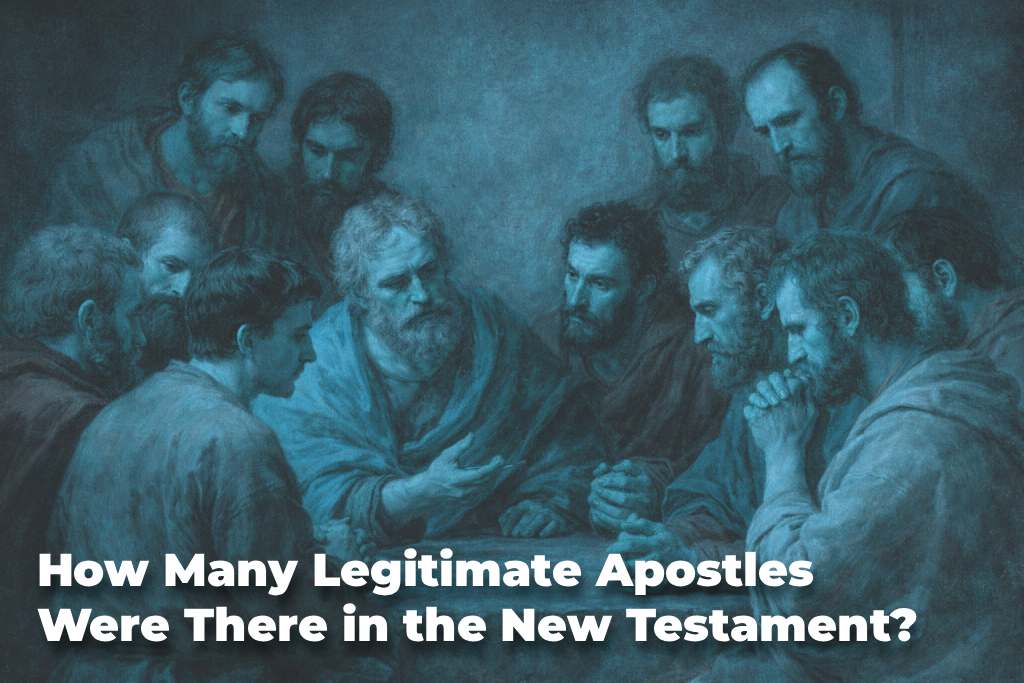
Exactly How Many Apostles Did the New Testament Recognize?
How many official, legitimate apostles have there been? Are apostles still around?
I’ve seen this bantered about with all kinds of varying answers. Some swear that the number is only 12, as going by the first Twelve chosen by Jesus (and ignoring people like Saul/Paul), while others count in upwards of twenty or more, speculating (often erroneously) that certain individuals mentioned in Acts and Paul’s letters must be apostles, despite no clear indication otherwise.
So Scott, you may be asking, what is the point of all of this?
Well, words matter. If we are going to use a biblical word like “apostle,” we need to let Scripture define it, and we need to distinguish between (1) the general meaning of a word and (2) a unique, foundational office that Christ established in the first generation of the Church.
That difference matters because the New Testament treats the apostles as the foundation stones of the Church’s earliest era, authorized by the risen Christ to bear witness, proclaim the Gospel, and deliver teaching that the churches received as binding. When you read the New Testament carefully, you can feel the historical weight of it. These are not floating religious ideas. These are eyewitness claims, public events, named people, real places, and accountable leadership. Christianity lands in history on purpose. God did not give us a vague spirituality. He gave us a crucified and risen Christ, preached by commissioned witnesses.
So how many legitimate apostles were there?
Let’s build the definition first, then count.
The Scriptural Definition of an Apostle
The Greek word apostolos (ἀπόστολος) means “one who is sent.” That matters because sometimes the New Testament uses the word in a broad, non-office sense, meaning a messenger or delegate.
But the question you are asking is about the official apostolic office, the men recognized as Christ’s commissioned representatives and foundational witnesses.
Acts 1 is the clearest place where Scripture itself defines the qualifications for replacing Judas. Peter lays out requirements for the candidate:
- He had to have accompanied Jesus during the span of His earthly ministry, from John’s baptism onward (Acts 1:21-22).
- He had to be a witness of the resurrection (Acts 1:22).
- He had to be appointed into that witness role with the apostolic group (Acts 1:22-26).
That gets us very close to a working definition.
Then the New Testament adds further confirmation through Paul. Paul repeatedly defends his apostleship by pointing to having seen the risen Christ (1 Corinthians 9:1; 15:8). He also appeals to the “signs of a true apostle” as validation (2 Corinthians 12:12). And he insists his commission is directly from Christ, not derived merely from human appointment (Galatians 1:1).
Finally, there is the foundational aspect. Ephesians 2:20 describes the church as “built on the foundation of the apostles and prophets, Christ Jesus himself being the cornerstone.” Foundations are laid once. The apostles were not simply gifted leaders. They were foundational witnesses and authoritative representatives of Christ in the once-for-all establishment era of the Church.
So, if we define the office of Apostle strictly from Scripture, we end up with something like this:
A New Testament apostle (in the official sense) is a man commissioned by Christ as an authoritative representative and foundational witness, who has seen the risen Jesus, and who is recognized as an apostle by the church and by other apostles, with divine authentication accompanying that ministry.
We see three criteria, and they are solid. I would frame them this way:
- Called and commissioned (directly by Jesus, or with Christ’s authority clearly governing the appointment).
- Witness of the risen Christ.
- Recognized in Scripture as an apostle.
Now, with that office defined, we can count.
The Count Begins With the Twelve
Jesus deliberately chose twelve (Luke 6:13). That number is not random. It echoes the twelve tribes of Israel and signals something foundational about the people of God being reconstituted around the Messiah. The New Testament repeatedly treats “the Twelve” as a distinct group.
The lists are given in Matthew 10:2-4, Mark 3:16-19, and Luke 6:13-16.
Judas Iscariot: Was Judas a Legitimate Apostle?
Yes, Judas was legitimately appointed to the office by Jesus. Luke explicitly says Jesus chose “the apostles” and names Judas among them (Luke 6:13-16). The fact that Judas was unregenerate and became the betrayer does not erase the historical reality of his appointment.
John 6:70 is chilling precisely because of this. Jesus says He chose the Twelve, yet one was a devil. That tells us something important: holding an office and having a heart transformed by grace are not identical. An office can be real, while the person holding it can be false.
So Judas was a legitimate apostle by appointment, but he was a false disciple by character.
Matthias: Replacing Judas
After Judas’ death, Acts 1 records a deliberate process to fill the office left vacant. Two candidates are presented, Joseph called Barsabbas (Justus) and Matthias (Acts 1:23). The qualifications follow Acts 1:21-22, and the conclusion is clear: “Matthias… was numbered with the eleven apostles” (Acts 1:26).
Some modern readers wonder if the apostles acted too soon and should have waited for Paul. Acts does not hint that this was a mistake. Luke presents it as a faithful obedience to Scripture and a legitimate restoration of the Twelve.
So at this stage, the official count is:
- The Twelve apostles, now including Matthias (and no longer including Judas as a living member of the group).
The count at this point is up to 12.
Paul: An Apostle “Born Out of Due Time”
Saul of Tarsus/Paul is unquestionably an apostle. He calls himself an apostle repeatedly (Romans 1:1; 1 Corinthians 1:1; Galatians 1:1). He grounds that apostleship in a resurrection appearance of Christ to him (Acts 9; 1 Corinthians 15:8). He also describes his commission as directly from Christ (Galatians 1:1), and he is recognized by the Jerusalem leadership as having a genuine apostolic ministry (Galatians 2:7-9).
Paul is not part of the Twelve, but he is an apostle in the official sense.
Add Paul, and the count becomes 13.
James, the Lord’s Brother
James, the half-brother of Jesus, is not part of the Twelve either, but the New Testament treats him as a major leader in the Jerusalem church (Acts 15). More importantly for our purposes, Paul uses language in Galatians 1:19 that strongly indicates James was regarded as an apostle: “I saw none of the other apostles except James the Lord’s brother.”
James also appears in the resurrection appearances list in 1 Corinthians 15:7, which supports the “witness of the risen Christ” criterion.
Add James, and the count becomes 14.
Barnabas: Called an Apostle in Acts 14:14
Now we come to Barnabas. Acts 14:14 explicitly refers to “the apostles Barnabas and Paul.”
That is direct Scriptural labeling, and you asked to include Barnabas for that reason, which is reasonable. Some interpreters note that apostolos can occasionally be used more broadly, but the text in Acts does not hesitate to call Barnabas an apostle alongside Paul in the context of missionary authority and public ministry.
Add Barnabas, and we reach 15.
So our working, biblically anchored count becomes:
- The Twelve (with Matthias)
- Paul
- James (the Lord’s brother)
- Barnabas
Total: 15.
Why Do We Not Add Timothy, Silas, Apollos, Luke, Mark, or Others?
This is where many people get sloppy, usually because they assume “apostle” is just a synonym for “important Christian leader.”
Believe it or not, Timothy is never called an apostle. He is a faithful coworker, a delegate, and a elder/pastor-like figure in the Pastoral Epistles.
Silas (Silvanus) is called a prophet in Acts 15:32 and appears as a missionary companion, but not as an apostle in the official sense.
It is possible that Apollos was an apostle. 1 Corinthians 4:6-9 says this: “Now these things, brothers, I have applied to myself and Apollos for your sakes, so that in us you may learn not to go beyond what is written, so that no one of you will become puffed up on behalf of one against the other. For who regards you as superior? What do you have that you did not receive? And if you did receive it, why do you boast as if you had not received it? You are already filled, you have already become rich, you have ruled without us—and how I wish that you had ruled indeed so that we also might rule with you. For, I think that God has exhibited us apostles last of all, as men condemned to death, because we have become a spectacle to the world, and to angels, and to men.” [LSB] Paul mentions Apollos in verse 6, and in verse 9 he states, “For, I think that God has exhibited us apostles…” Upon inspection, you could read it carefully and make the connection between his name and the title, but it is too vague to be 100% sure. Apollos is definitely portrayed as a gifted teacher (Acts 18:24-28), but he is not specifically called an apostle.
What about Epaphroditus? Yes, Philippians 2:25 does use the Greek word apostolos for Epaphroditus, but the context makes clear that it is being used in the broader sense of “messenger” or “delegate,” not in the technical, foundational sense of the apostolic office. Paul calls him “your apostolos,” meaning he was sent by the Philippian church to minister to Paul’s needs. He was a commissioned representative of a local church, not a resurrection witness personally appointed by the risen Christ as part of the foundational layer of the Church. The New Testament uses apostolos both broadly for sent ones and narrowly for the authoritative, Christ-commissioned apostles who laid the doctrinal foundation of the Church. Epaphroditus clearly belongs to the first category, not the second, and therefore should not be added to the official count of fifteen.
Taking this same linguistic reasoning as the Philippians 2:25 example up above, we see in 2 Corinthians 8:23 that representatives of the Corinthian church are also called apostolos, but that does not mean they were Christ-commissioned Apostles in the former sense.
Luke and Mark are crucial figures in the spread of the Gospel and the writing and transmission of Scripture, but neither is called an apostle. Of course, we should remember that even if they weren’t specifically called “apostles,” they had special “apostolic authority” given to them to write inspired Scripture as recognized by their peers.
The office is not “everyone who did major ministry.” The office has specific qualifications and a particular foundational role.
Sure, it may be possible that Timothy, Epaphroditus, Silas, Apollos, Luke, Mark, Jude, or others were genuine apostles. But since the New Testament is not cear that they were, none of them should be counted toward the official apostolic office.
Andronicus and Junia: Why Romans 16:7 Should Not Add to the Number
Romans 16:7 is often pulled into these discussions, so we should handle it carefully and with a straight face.
Paul speaks warmly of Andronicus and Junia, and many English translations have wording that can be read in more than one way. But even if we take the phrasing that they were in the Greek “hostis eimi episēmos en ho apostolos,” or in English, “well known to the apostles,” that does not mean they were apostles.
Being known by the apostles, respected by the apostles, or notable in the eyes of the apostles is not the same as holding the office of apostle. The grammar in Romans 16:7 is not a solid foundation for creating new apostles beyond the ones Scripture clearly identifies. The conservative and textually responsible conclusion is this: we should not include them in the count.
So we keep the number at 15.
A Clean Summary of the Fifteen
Here is the count in one place.
The Twelve (original office established by Jesus, now filled out by Matthias):
- Peter
- Andrew
- James (son of Zebedee)
- John
- Philip
- Bartholomew
- Matthew
- Thomas
- James (son of Alphaeus)
- Thaddaeus (also called Judas, not Iscariot)
- Simon the Zealot
- Matthias
Additional apostles recognized in Scripture:
- Paul
- James, the Lord’s brother
- Barnabas
And for clarity: Judas Iscariot was legitimately appointed as one of the Twelve, but he fell and was replaced by Matthias.
The Point of This: The Apostolic Office Was Foundational and Non-Repeatable
I have to stress that this is not a mere trivia question. The New Testament itself pushes us to see that the apostles were a foundational layer in redemptive history. Jesus builds His church through eyewitness testimony of His resurrection, carried by commissioned men whose teaching laid down the doctrinal rails for the churches.
Once that foundation is laid, the church does not need new apostles to add to it. The church needs faithful pastors, elders, teachers, evangelists, and missionaries who proclaim what the apostles already delivered.
That is why the Bible has the shape it has. The Four Gospels are rooted in eyewitness testimony and early proclamation. The Book of Acts gives historical expansion. Paul’s Epistles and the General Epistles lay down doctrine and church order. And Revelation closes the canon with Christ’s final prophetic word to His churches.
When people today claim the apostolic office in the foundational sense, they are not just claiming a title. They are implicitly claiming a kind of authority the New Testament reserves for the first-generation witnesses of the risen Christ. These people are wrong.
And that is one more quiet reason Christianity is true. The New Testament does not read like a mythical fog. It reads like accountable history, anchored in named witnesses, tested leadership, public events, and a risen Christ who commissions men to testify in the face of real persecution. Liars do not build a movement like that, and cowards do not die for what they know is false. The apostles preached a resurrection they insisted they saw, and the Christian faith stands or falls on that public claim (1 Corinthians 15).