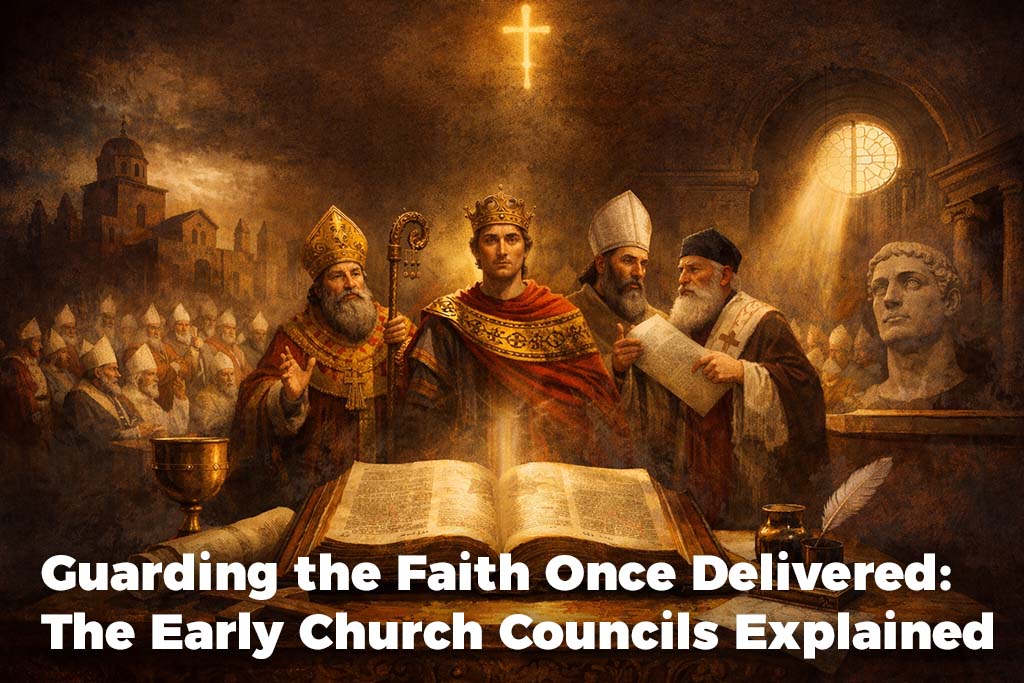
The Early Church Councils – How Christ, Scripture, and the Gospel Were Defended in the First Centuries
Introduction
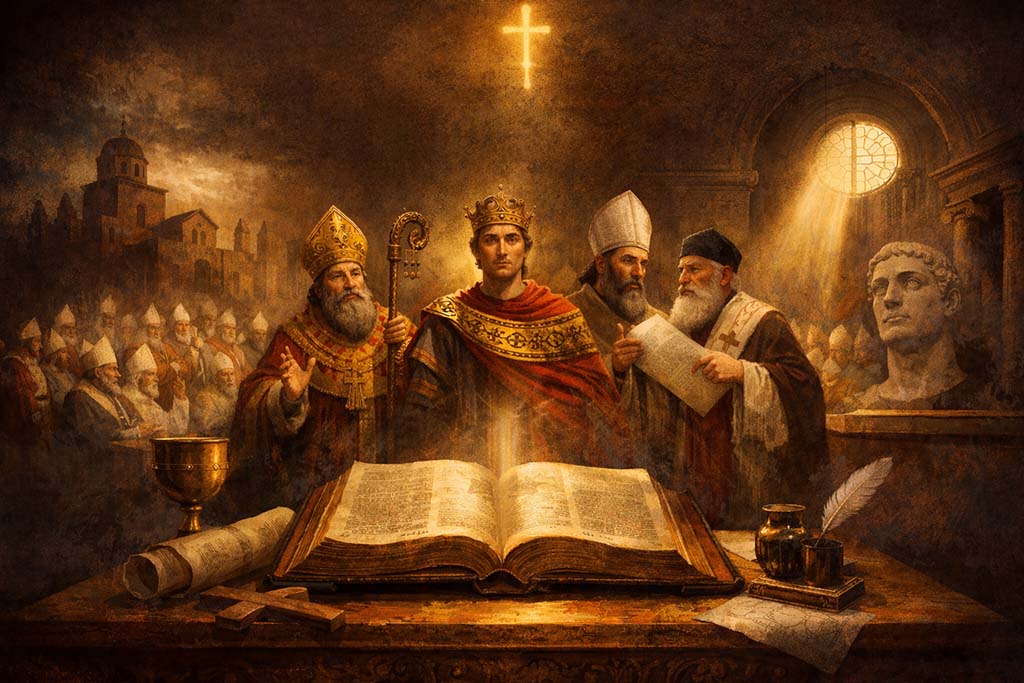
Christian doctrine did not drift into place through accident or ambition. From the earliest days, the church understood that what it had received was not its own to revise, soften, or reinvent. The Gospel was a trust, handed down through eyewitness testimony, preached publicly, and guarded with care. When disputes arose, they did not force the church to create something new, but to defend what had already been given. The early councils exist because the faith was precious. After all, error threatened clarity, and because leaders believed they would answer to God for how faithfully they protected the truth. What follows is not a story of institutional power consolidating itself, but of a church struggling, sometimes imperfectly, to preserve the message it believed had come from Christ Himself.
The Apostolic Pattern
Council of Jerusalem (c. AD 49), Jerusalem
If you want to understand why councils mattered in the early church, this is where the story begins, as told in Acts chapter 15. The idea of a churchwide council was not a later Roman Catholic development, nor was it a political maneuver. It was the universal Christian Church responding to a real and pressing crisis. The question on the table was whether Gentile believers had to become Jews through circumcision and full Torah observance in order to belong to the people of God. This was not a secondary dispute or a matter of preference. It struck at the heart of the Gospel and the very nature of the church.
The key figures were the apostles and elders, with James offering the concluding judgment and Peter and Paul bearing witness to what God had already done among the Gentiles. The decision affirmed salvation by grace and refused to place burdens on believers that God Himself had not required. That pattern is foundational. Later councils would operate the same way, not by inventing new truths, but by clarifying what had already been received when controversy threatened to distort it.
Regional Councils Before Nicaea
Early Councils of Carthage (especially mid-3rd century), Carthage, North Africa
Long before the famous ecumenical councils, African Christianity was already holding frequent synods. Carthage became a theological powerhouse, and the controversies there were not abstract. They were pastoral crises shaped by persecution, betrayal, repentance, and the stubborn question of what a holy church looks like in an unholy world. Cyprian of Carthage is one of the main voices here, pushing the church to take both repentance and discipline seriously in the aftermath of believers collapsing under pressure.
These early African councils show that church history is not mainly a parade of philosophers, but instead shepherds trying to guard the flock. That background matters later when the canon question comes to the front, because the same churches that cared about holiness and public worship also cared deeply about what could be read aloud as the authoritative Word of God.
Council of Elvira (c. AD 306), Elvira (near Granada, Spain)
Elvira is often overlooked because it is not “ecumenical,’ but it is a revealing snapshot of an early church stepping into a new era. The council’s canons show a community trying to establish moral and ecclesial order, especially regarding clergy conduct, sexual ethics, and church discipline, in a post-persecution environment. This was a church that expected obedience to matter, not as a replacement for grace, but as the fruit of a real faith.
Elvira quietly undercuts modern claims that early Christianity was loose, undefined, and endlessly malleable. Even before Nicaea, the church had a clear sense that the Gospel produces a distinct kind of life, and that public leadership in the church required credibility.
The Deity of Christ and the Trinity
First Council of Nicaea (AD 325), Nicaea (Bithynia, modern İznik, Turkey)
Nicaea did not happen because Christians were bored and wanted to invent metaphysics. It happened because Arius, a presbyter from Alexandria, taught that the Son was not eternal in the way the Father is eternal. In other words, the Son was a supreme creature, exalted above all others, yet still not truly God. That teaching threatened the entire logic of salvation. If Christ is not truly God, then His worship is idolatry, His mediation is weakened, and the Gospel becomes something less than God Himself rescuing sinners. Britannica summarizes the council’s basic outcome accurately: Arius was condemned for refusing to affirm the Son’s full divine nature and unity with the Father.
The major “players” include Arius, Alexander of Alexandria (Arius’s bishop), and the young Athanasius who would become the most famous defender of Nicene Christology for decades. The council’s confession used the language of “one essence” (homoousios) to say, as clearly as possible, that the Son is not a created thing standing somewhere between God and the world. The Son is truly God. Nicaea did not end the controversy overnight, but it drew a bright boundary and gave the church a confession sturdy enough to survive the next fifty years of turbulence.
First Council of Constantinople (AD 381), Constantinople
Constantinople is where the Nicene faith was reaffirmed and strengthened, especially regarding the Holy Spirit. The dispute here was not only the lingering aftershock of Arianism but also the question of whether the Spirit should be confessed as fully divine. Some groups treated the Spirit as a lesser power, a kind of divine agent rather than God Himself. The council, called under Emperor Theodosius I, gathered primarily Eastern bishops and sought to secure Nicene orthodoxy across the empire.
In terms of key figures, Gregory of Nazianzus is central, along with bishops connected to the wider Cappadocian theological project (Basil the Great and Gregory of Nyssa are often linked to this period’s Trinitarian clarification). The lasting effect is the form of the creed many churches recite today, often called the Nicene-Constantinopolitan Creed. Constantinople did not create the Trinity as an idea. It pressed the church to speak faithfully about what Scripture reveals: Father, Son, and Spirit are not three gods, and the Spirit is not a creature, but the living God who gives life, sanctifies, and is worshiped with the Father and the Son.
The Person of Christ
Council of Ephesus (AD 431), Ephesus (near modern Selçuk, Turkey)
Ephesus was sparked by the Nestorian controversy. Nestorius, Patriarch of Constantinople, objected to calling Mary Theotokos (“God-bearer””), preferring language that, in practice, could separate Christ’s humanity from His divinity too sharply. The church was not trying to make Mary the center. The church was trying to protect the unity of Christ Himself. If you divide Christ into two subjects, one divine and one human, you risk turning the incarnation into a partnership rather than God the Son truly becoming man for us.
Cyril of Alexandria emerged as the chief theological force on the opposing side. The council was messy, the politics were real, and the timing disputes were ugly, but the doctrinal aim was straightforward: Jesus Christ is one Person, not two. The council condemned Nestorius and insisted that the incarnation means the eternal Word truly took on human nature, so we can speak (carefully) of God the Son being born and suffering in the flesh without implying that the divine nature changes or dies. The council proceedings and summary decisions are well preserved in historical collections.
Council of Chalcedon (AD 451), Chalcedon (across from Constantinople)
If Ephesus guarded the unity of Christ’s person, Chalcedon guarded the integrity of His two natures. The background includes confusion and overcorrection in the wake of earlier debates, with some drifting toward language that effectively collapsed Christ’s humanity into His divinity. Chalcedon’s defining contribution is its careful boundary-setting: Christ is one person “in two natures,” truly God and truly man, with the natures united without being mixed, changed, divided, or separated. That is the famous fourfold fence that has shaped orthodox Christology ever since.
Major figures include Leo I of Rome, whose “Tome” influenced the council’s articulation, and Dioscorus of Alexandria, who represents the opposing pressure in the controversy. The council’s language is not philosophical fluff. It is pastoral protection. If Jesus is not fully man, He cannot stand in our place and obey where Adam failed. If He is not fully God, He cannot save. Chalcedon is the church saying, with trembling hands, “We will not lose either truth.”
The Canon of Scripture Comes Into Focus
Council of Rome (AD 382), Rome
Rome (382) is important as an early witness to canon discussions in the West. By this point, a core New Testament collection had been functioning across the churches for a long time, but questions still existed at the edges, especially about a handful of books. Councils in this era are not best understood as “creating the Bible” but as publicly listing what churches were already treating as apostolic Scripture.
The canon was not dropped “out of the sky” in one meeting, but neither was it a free-for-all. The churches recognized apostolic authority, guarded public reading, and slowly moved toward formal lists that reflected that lived consensus.
Council of Hippo (AD 393), Hippo Regius (North Africa)
Hippo matters because it stands right on the doorstep of Carthage. Saint Augustine is the major name you will recognize here, and the council is often summarized as affirming the same New Testament books Christians universally recognize today. Even when the detailed acts are not fully preserved in the same way as some later collections, the historical memory and later reaffirmations tie Hippo’s canon work closely to Carthage’s.
It’s important to know that Hippo did not “give the church a Bible,” as though nobody knew what Scripture was until a vote was taken. Most inspired books were already recognized by this time.
The point of the council’s discussion was that public worship required boundaries. In a world where many writings circulated under apostolic names, the church had to say, “These are the texts that may be read as the voice of God in the assembly.”
Council of Carthage (AD 397), Carthage, North Africa
The Canon of Scripture in the Public Life of the Church
The Council of Carthage in AD 397 is not famous because it invented authority, but because it is a clear, public, pastoral act of recognition. Carthage reaffirmed what Hippo had already laid down and issued its own canons, and Augustine was present in this North African synod world.
Carthage’s canon decision is often treated like a group of men sat in a room and decided, arbitrarily, what God was allowed to say. That is a modern myth. The canon lists in these councils functioned as an administrative restriction for church reading, aimed at guarding the pulpit and the public liturgy from texts that lacked apostolic authority. In other words, the council was saying, “In the worship of the church, only these books are to be read as canonical Scripture.” That is a very different claim than “We are granting authority to these books.”
Carthage’s significance is also geographical and practical. North Africa is not Rome, not Constantinople, not Antioch. Yet the New Testament list being affirmed is not a quirky regional invention. It reflects the broad, already-established usage of the churches, especially the four Gospels and the Pauline corpus that had been read, copied, preached, and died for since the earliest generations. Carthage stands as a historical signpost of recognition: the church, under the providence of God, publicly identifies the set of writings that had already proven themselves apostolic, orthodox, and spiritually authoritative across the life of the church.
Later Clarifications After Chalcedon
Second Council of Constantinople (AD 553), Constantinople
This council is best explained as a cleanup effort after Chalcedon, addressing disputes about how to read earlier theological writings and how to prevent Chalcedon from being misrepresented. Here is the basic idea: councils often had to clarify what earlier councils meant, because people kept trying to hijack definitions for their own agendas.
Doctrinal precision is not the enemy of unity. It is often the only way unity survives.
Third Council of Constantinople (AD 680–681), Constantinople
Here the controversy centered on whether Christ had one will or two. The council affirmed that Christ possesses a divine will and a human will, corresponding to His two natures, without turning Him into two persons. This is not a nerdy tangent. If Christ is truly man, His human obedience must be real. He does not redeem us with a costume. He redeems us by becoming what we are, yet without sin, and obeying in our place.
This council protects the full humanity of Christ again, but now at the level of human willing and moral action.
Second Council of Nicaea (AD 787), Nicaea
Nicaea II is where the icon controversy comes to the front. The debate was about images in Christian devotion and worship, and the council drew distinctions between reverence and worship. This is also where Christians today disagree sharply, especially across Catholic, Orthodox, and Protestant lines.
Church history includes real disagreements among professing Christians, and knowing that history helps you argue with more humility and less heat.
The Dan Brown Myths
Dan Brown‘s bestselling book The Da Vinci Code did not become influential because it was well-researched (in fact, it was absolutely atrocious when it came to actual historicity!). It became influential because it told modern people what they already wanted to believe: juicy-sounding (but ultimately dishonest) material that historic Christianity is a cover story, that doctrine is a political invention, and that the “real” Jesus was buried by powerful men. It is the perfect conspiracy narrative for an age that distrusts institutions and confuses cynicism with insight.
Brown’s most repeated historical error is the claim that the Council of Nicaea turned Jesus into God by a vote, as though Christians had previously viewed Him as a mere teacher and only later upgraded Him into deity. That collapses under even a basic reading of the New Testament. Paul is writing within living memory of the resurrection, and he treats Jesus as worthy of honor that belongs to God alone. The earliest Christians prayed to Christ, worshiped Christ, and confessed Him as Lord in a way that echoed Old Testament worship language applied to Yahweh. Nicaea was not inventing a new Jesus. It was defending the apostolic Jesus against a clever theological downgrade. Britannica’s summary of Nicaea’s purpose and condemnation of Arius captures the real issue: the council was about the Son’s relationship to the Father, not about whether Jesus should be considered divine in the first place.
Brown also encourages the idea that the Bible’s canon was decided at Nicaea as part of a political power grab, with alternative gospels suppressed because they threatened the ruling narrative. Historically, that is simply wrong. Nicaea did not settle the New Testament canon question. The councils most associated with formal canon lists in the late fourth century are places like Hippo (393) and Carthage (397), and even there, the best way to understand their action is recognition and regulation of public church reading, not invention of Scripture. Carthage explicitly sits in that North African stream of reaffirming what was already received and used in worship.
Finally, Brown overemphasizes “suppressed gospels” as though Gnostic texts were early, apostolic, and unfairly buried by orthodoxy. The deeper problem here is theological, not only historical. Gnosticism did not merely offer an alternative Christian flavor. It changed Christianity into something else by denying or distorting creation, incarnation, and salvation. The early church rejected those texts because they did not match the rule of faith handed down from the apostles and because they did not function as the living voice of Christ in the churches in the way the four Gospels did. Brown’s story depends on the church acting like a villain. Real history is less dramatic and far more plausible: the churches received apostolic writings, used them in worship, copied them widely, and then later produced lists that reflected that already-established reality.
Dan Brown erroneously portrayed the early church as a propaganda machine, but the actual historical record shows something closer to a battered, persecuted, and imperfect body that kept returning to one anchor. The apostles preached a divine Christ who saves sinners, and the church fought, often at great cost, to keep confessing that same Christ without embarrassment.
In Summary
When it comes to the councils, a pattern emerges that is hard to dismiss. The early church was not inventing doctrine behind closed doors or voting truth into existence. It was responding to real challenges with open Bibles, inherited apostolic teaching, and a deep sense of accountability before God. From Jerusalem to Nicaea, from Chalcedon to Carthage, the same concern keeps surfacing: Who is Christ, and which writings truly speak with His authority? The answers did not change because the truth did not change. The councils stand as historical witnesses to continuity, not corruption, and they quietly remind the modern church that the faith we confess today is the same faith that was guarded, defended, and handed down at great cost.