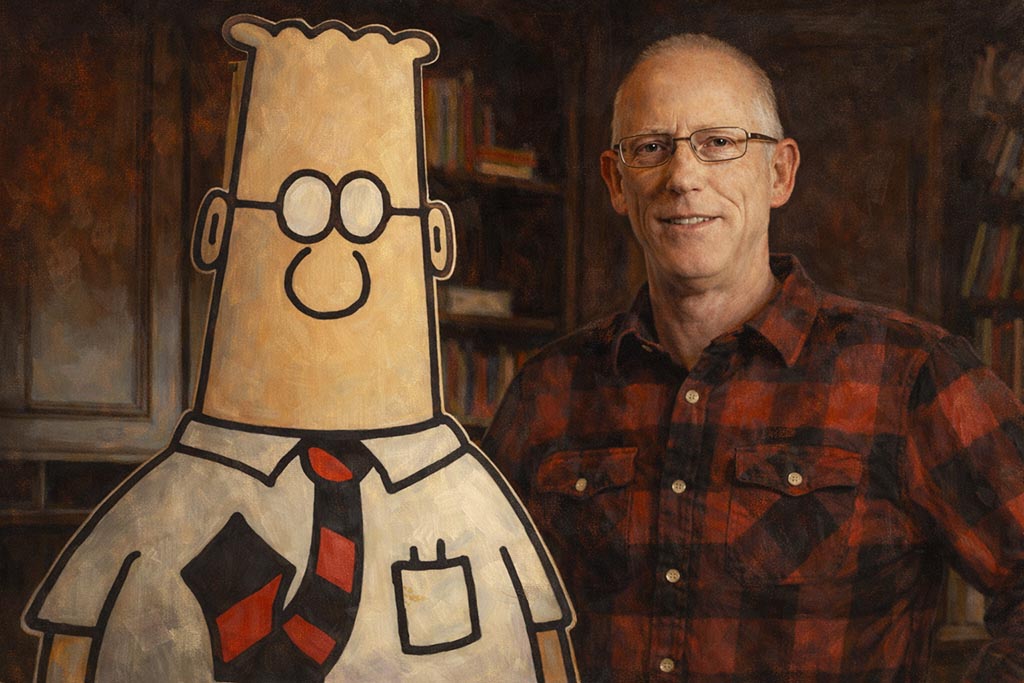
Yesterday, January 13, 2026, controversial cartoonist Scott Adams died at the age of 68 after a tough battle with prostate cancer. Many people knew him as the creator of Dilbert, but in his final messages he talked in a very real, very human way about mortality, meaning, and the question that matters most in life: what comes after death.
When someone’s life ends, we pay attention to their last words. We want to know what they believed when the curtain closed. In Adams’ case, he said something that sounded very Christian. He wrote that “many of my Christian friends have asked me to find Jesus before I go. I’m not a believer.” Then he said that accepting Jesus Christ as Lord and Savior seemed like the logical choice, and he wrote a prayer of sorts saying, in effect, I accept Jesus Christ as my Lord and Savior and look forward to eternity with him.
A lot of people are going to read that and feel relieved for him. They’re going to share it, comment “Praise God!” and move on. But I want us to stop and think honestly about what that really says, what it really means, and what it doesn’t mean.
Because this moment highlights a very important truth in Christianity: simply saying the words “Jesus is Lord” or repeating a prayer is not the same thing as truly trusting Christ with your soul. There’s a difference between acknowledgment and trust. There’s a difference between intellectual agreement and personal surrender. And Scott Adams’ last statement helps us see that difference clearly.
I want to unpack that with you. I want to talk about Pascal’s Wager. I want to talk about why apologetics, logic, evidences, arguments, and even the “Sinner’s Prayer” are not magic formulas or tickets that God has to shruggingly let you into heaven because you said them the right way or in the right order. And I want to urge you, with all my heart, to come to Christ not with a shallow acknowledgment but with deep personal trust.
This matters because I have talked to many people, especially men, who think that intellectually agreeing Jesus is Lord is enough. Or if they think that if the words come out of their mouth, the box is checked. But Jesus Himself said something very different.
What Scott Adams Actually Said
Let’s look at what Scott Adams wrote in his final message. Here is the key part, in his own words:
Next, many of my Christian friends have asked me to find Jesus before I go. I’m not a believer, but I have to admit the risk-reward calculation for doing so looks attractive.
So, here I go: I accept Jesus Christ as my lord and savior, and I look forward to spending an eternity with him. The part about me not being a believer should be quickly resolved if I wake up in heaven. I won’t need any more convincing than that. And I hope I am still qualified for entry.”
That’s powerful to read. And I think Scott was honest, earnest, and sincere. I appreciate that. I’m not here to mock him or twist his words. I’m here to think with him and you about what he said.
The first thing he acknowledges is that he wasn’t a believer. He admits it plainly. Then he says the risk-reward calculation looks attractive. That’s Pascal’s Wager in a nutshell.
Pascal’s Wager: Good Logic, But Not Enough
Blaise Pascal was a brilliant Christian thinker who lived in the 17th century. He pointed out that life presents a choice:
- Either God exists, or He does not.
- You can choose to believe in God, or you can choose not to believe.
- If you choose to believe and God is real, you gain everything forever.
- If you choose not to believe and God is real, you lose everything.
- If you choose to believe and God is not real, you lose very little.
- If you choose not to believe and God is not real, you gain very little.
From that perspective, it seems like believing in God is the safest bet, the one that wins the biggest “prize.” That is what is now known as Pascal’s Wager.
The thought exercise in this wager can be a useful tool. It challenges people who say, I’m not sure God is real. It says, Ok, but what if He is? Wouldn’t you rather be on the winning side where you lose the least and gain the most?
But Pascal’s Wager is a logical argument, not a gospel message. It can move someone from “I don’t know” to “I think believing makes sense.” It can take someone from skepticism to tentative intellectual assent. But that is not the same as saving faith. The Bible is clear: what saves is trusting in Jesus himself, not just agreeing with an idea about Him.
James 2:19 says, “You believe that God is one; you do well. Even the demons believe—and shudder.” That verse tells us that mere belief about God isn’t enough. Even demons agree God is real! What matters is whether your heart trusts Christ and turns to Him.
Don’t get me wrong. I love the use of apologetics in many ways, and they can be a great tool for Christians, because they can overcome many intellectual hurdles that may trip some people up. Through apologetics, we can see a mountain of evidence that God exists, that the universe is intelligently designed, that the New Testament is the most trustworthy book of the ancient world, that hundreds of prophecies in the Old Testament can be verified to have come to pass, and that the resurrection of Jesus Christ is a verifiable, historical fact. And so many other logical arguments can be used to prove that Christianity is real.
But what do you and I do with all of that information? Just admit that it exists and then move on? No, apologetics evidence must lead us to that place where we have to take that last, final step of faith and make it personal.
Let me explain more.
The Danger of Mere Acknowledgment
Continuing in his final note, Adams said, “I’m not a believer, but I won’t need any more convincing than that if I wake up in heaven.” That sounds tentative. It sounds like he is hoping things will work out. It sounds like he wants to rationalize that hopefully…maybe…this is all true. But it does not sound like he fully did believe at the time he wrote it.
And that is the key point I want you to see.
You can acknowledge Jesus is Lord and still be lost. You can say the words and still not have a real relationship with Him. You can follow a prayer formula and still not have saving faith.
Jesus Himself warns about this. In Matthew 7:21-23, Jesus says:
Not everyone who says to me, ‘Lord, Lord,’ will enter the kingdom of heaven, but the one who does the will of my Father who is in heaven. On that day many will say to me, ‘Lord, Lord, did we not prophesy in your name? Did we not cast out demons in your name? Did we not do many mighty works in your name?’ And then I will declare to them, ‘I never knew you; depart from me, you workers of lawlessness.’”
This is stunning. These are people who called Him Lord. They did good things in Jesus’ name. They used the right words. Yet Jesus says, I never knew you. Why? Because trust and relationship are more than words. They are about turning from sin and relying on Christ alone for salvation.
The “Sinner’s Prayer” Is Not a Magic Formula
Many Christians, including myself, use a “Sinner’s Prayer” to help someone express their need for a Savior. That prayer is helpful because it can help someone articulate turning from sin and trusting in Jesus. But the words themselves are not what saves you.
You can recite the prayer with your lips and still not have saving faith if your heart is not truly trusting in Christ.
What saves a person is not the reciting of a prayer but the trust of the heart. Romans 10:9-10 says:
If you confess with your mouth that Jesus is Lord and believe in your heart that God raised him from the dead, you will be saved. For with the heart one believes and is justified, and with the mouth one confesses and is saved.”
Notice what this verse says. It does not say, If you repeat the right words, or If you agree with a checklist of doctrines. It says you must believe in your heart that Jesus is Lord and that God raised Him from the dead.
That is the difference between someone who says a prayer and someone who trusts Jesus.
And that is why I want to be careful and compassionate when I talk about Scott Adams. I am glad he thought about Jesus. I am glad he wanted to be on the right side of eternity. But I am not convinced, based on his statement, that he truly trusted Christ in the biblical sense. I pray that I am wrong, and that he, between the time he wrote his last statement, he went from intellectual agreement to full-blown personal belief and trust in Jesus Christ. But I don’t know.
Why This Matters for You
You might be reading this and thinking, I don’t want to make the same mistake. I want to show you the difference so you don’t fall into the trap of thinking that words alone are enough.
Maybe you have said “Jesus is Lord” before. Maybe you’ve prayed a prayer. Maybe you think that if you said the words, then you’re fine. But let me ask you this: Do you really trust Jesus? Do you truly depend on Him, with your life, with your eternity, with your hope?
There’s a world of difference between an intellectual belief that “Jesus probably exists and it would be beneficial to believe in Him” and a personal trust that Jesus is your Savior who died for your sins and rose again to give you new life.
The Gospel is Good News
So what is the Gospel? What does it mean to truly be saved?
The Bible tells us:
- We are all sinners in need of a Savior. Romans 3:23 says, “For all have sinned and fall short of the glory of God.”
- Our sin separates us from God. Isaiah 59:2 teaches that our sins create a barrier between us and a holy God.
- Jesus Christ died for sinners. 1 Peter 3:18 says, “For Christ also suffered once for sins, the righteous for the unrighteous, that he might bring us to God.”
- He rose again, conquering sin and death. 1 Corinthians 15:3-4 says Christ died for our sins, was buried, and was raised on the third day, according to the Scriptures.
- Salvation is a free gift of God by grace through faith, not by works. Ephesians 2:8-9 says salvation is a gift of God, not a result of human effort.
This is not a formula. This is a Person, in the form of Jesus Christ. The Gospel is not a checklist that makes God “like” you. The Gospel is a Savior who loved you enough to die for you.
What You Must Do
To be saved, you must:
- Acknowledge that you are a sinner.
- Turn from your sin.
- Trust in Jesus Christ alone as your Lord and Savior.
- Submit your life to Him, not just your words but your heart.
That is what Scripture calls repentance and faith.
You cannot be saved by intellectual agreement, by positive thinking, by logical calculation, or by hoping to wake up in heaven. You are saved when you personalize the Gospel and trust Christ with your whole heart.
An Urgent Invitation
If you have never done that, I want to invite you to do it right now. Don’t let your last words be tentative. Don’t let your Christianity be based on what seems logical. Take that step from logic to personal trust and let it be based on relationship.
Pray something like this, but mean it in your heart:
Lord Jesus, I know I am a sinner. I know I cannot save myself. I believe that You died for my sins and rose again. I turn from my sin and I trust You alone as my Lord and Savior. Thank you for your grace and mercy. Come into my life and be my God. Amen.
If that prayer reflects your heart, not just your lips, then the Bible says you are saved. The moment you truly trust Christ, He gives you new life.
Final Thought
I’m glad Scott Adams thought about eternity. I’m glad he acknowledged Jesus. But I don’t want anyone, including you, to rest on mere acknowledgment. I want you to rest in personal trust in Jesus Christ, proven by a life turned toward Him.
Jesus said in John 10:27-28:
My sheep hear my voice, and I know them, and they follow me. I give them eternal life, and they will never perish.”
That is not a gamble. That is a promise.
If you want that promise, trust Him today.