The Theology of Thomas Watson Series: Part 3
This third part of my Thomas Watson Series is about his view on repentance.
We live in a time when almost everything gets explained away. Sin gets renamed. Conviction gets treated like trauma. Confession gets replaced with vague spiritual statements that never actually name anything. And the result is predictable: we stay stuck, we stay shallow, and we stay strangely defensive.
Thomas Watson would have zero patience for that kind of Christianity.
Watson wrote The Doctrine of Repentance as a physician of the soul. He knew Scripture. He knew the human heart. He knew the tricks we play on ourselves when we want comfort without cleansing, forgiveness without honesty, and grace without change.
And that is why, in a generation drowning in excuses, Watson is still one of the clearest voices you can read on this subject. He will not let repentance become sentimental. He will not let repentance become cosmetic. He will not let repentance become a performance. He drives you down to the root and asks: Has God actually changed you, or have you only felt bad?
Why Repentance Must Follow the Attributes of God
Watson would insist that repentance only makes sense after God has been seen rightly. A minimized view of God produces a minimized view of sin. A casual view of holiness produces a casual view of repentance.
That is why this topic fits perfectly after reflecting on the attributes of God. Once you see God as holy, sovereign, wise, just, and good, repentance stops being a side hobby for “serious Christians.” It becomes the normal Christian posture. It becomes the doorway back into fellowship when sin has dulled the soul.
Watson defines gospel repentance with a simplicity that still hits like a hammer:
Repentance is a grace of God’s Spirit whereby a sinner is inwardly humbled and visibly reformed.”
(The Doctrine of Repentance)
Right there, Watson blocks off two popular ditches.
First, repentance is not mere outward behavior modification. It is “inwardly humbled.” Second, repentance is not mere inward emotion. It is “visibly reformed.” Heart and life. Inner sorrow and outward change.
Then Watson gets even more specific. He describes repentance as “spiritual medicine” made up of six ingredients:
Repentance is a spiritual medicine made up of six special ingredients:
1. Sight of sin
2. Sorrow for sin
3. Confession of sin
4. Shame for sin
5. Hatred for sin
6. Turning from sin. If any one of these is left out, repentance loses its virtue.”
(The Doctrine of Repentance)
That list is worth slowing down over. Watson is telling you that repentance is not one vague thing. It is a full work of God in the soul, with recognizable marks. You can test yourself by it. You can measure your life by it. You can stop hiding behind generalities.
Repentance Is Not Regret
One of Watson’s strongest contributions is his refusal to confuse repentance with regret. A man can feel terrible and still never repent. A man can suffer consequences and still cling to the sin that caused them. A man can hate the pain, while still loving the poison.
Watson makes this distinction in the way he describes true sorrow. He says godly sorrow is sincere because it is directed toward the offense against God, not merely the discomfort that follows sin:
It is sorrow for the offense rather than for the punishment. God’s law has been infringed, and his love abused. This melts the soul in tears. A man may be sorry, yet not repent, just as a thief is sorry when he is captured – not because he has stolen, but because he has to pay the penalty.”
(The Doctrine of Repentance)
That illustration is painfully relevant. Many people are “sorry” because life got messy. Their reputation took a hit. Their marriage got strained. Their conscience got loud. Their future got threatened. But Watson presses deeper: Are you sorry because you sinned against God?
This is why Watson points readers to examples like Judas, where remorse is real but repentance is absent. Judas felt anguish, but he did not run to Christ. He collapsed inward. He did not turn outward and upward toward mercy.
Modern Christianity often treats any strong feeling as spiritual progress. Watson will not do that. He demands the kind of sorrow that leads to confession, hatred of sin, and actual turning.
Repentance Begins With Seeing Sin Clearly
Watson emphasizes that repentance begins with light. You cannot hate what you will not name. You cannot flee what you will not admit exists. You cannot confess what you keep re-labeling as “not that big of a deal.”
Watson calls this first ingredient “sight of sin,” and he uses a vivid phrase:
The first part of Christ’s medicine is eye-salve.”
(The Doctrine of Repentance)
That is the beginning. God opens the eyes. He does not merely inform the mind, though he does that too. He gives spiritual sight. He makes sin appear as sin. Not as a personality quirk. Not as a bad habit. Not as “a mistake.” Sin becomes what it really is: rebellion against a holy God.
And once that happens, a man stops negotiating. A man stops defending. A man stops calling darkness “complex.” He starts dealing with it.
Repentance Involves Godly Sorrow
Watson does not downplay sorrow. He simply refuses to let sorrow be shallow. He describes godly sorrow as something that goes deep, something that is not performative, something that reaches the heart where sin was conceived.
Godly sorrow goes deep, like a vein which bleeds inwardly. The heart bleeds for sin.”
(The Doctrine of Repentance)
Then he goes even further. He says true godly sorrow includes grief over heart-sins, not only the obvious scandals. It includes grief over the “first outbreaks and stirrings” of sin. In other words, repentance is not only about what you did. It is about what you love, what you secretly want, what you entertained, and what you fed.
Watson is also careful to keep sorrow from turning into despair. He describes spiritual sorrow as mixed with faith, and warns about sorrow that blinds the eye of faith. There is a kind of grief that is actually unbelief wearing religious clothing. It circles endlessly around guilt but never looks to Christ.
True repentance does not avoid grief. It refuses despair. It mourns sin and runs toward mercy at the same time.
Repentance Requires Confession Without Evasion
Watson is relentless on confession. Not vague “I have not been perfect” statements. Not “if I offended anyone” language. Not the kind of spiritual fog that protects favorite sins.
Watson says a true penitent gets specific. He does not confess sin “wholesale.” He confesses it honestly, as it actually happened. Watson writes:
In true confession a man particularizes sin.”
(The Doctrine of Repentance)
This is where excuses go to die.
Watson understood what we all know if we are honest: general confession can be a way of hiding. It can become a religious smokescreen. Specific confession is different. It is humbling. It destroys pride. It collapses self-justification.
And Watson’s whole approach implies something else: confession cannot be paired with self-protection. If the confession is really a defense strategy, it is not repentance. If you name sin but keep it cushioned with justification, you are still negotiating with it.
True confession tells the truth because God is true. It stops the spin. It stops the softening. It agrees with God.
Repentance Produces Shame Without Despair
Watson is careful here. He does not glorify shame as a virtue in itself. He does not turn repentance into self-hatred. But he refuses the modern obsession with being “unbothered” by sin.
When God opens the eyes and softens the heart, there is a holy blushing that follows. Watson calls believers to take “holy shame” to themselves for sin. That shame is not the end goal. It is a fruit of truth. It is what happens when sin is finally seen in the light of God’s holiness.
Watson’s point is simple: if a man can sin casually, confess casually, and continue casually, something is wrong. Repentance has weight. It carries moral seriousness. It is not fake tears for social approval. It is the heart bowing under the reality of what sin actually is.
Repentance Means Hatred of Sin
This is where Watson gets especially sharp. He does not define repentance as “I wish I had not gotten caught.” He defines it as a changed posture toward sin itself.
Watson writes:
Sound repentance begins in the love of God, and it ends in the hatred of sin.”
(The Doctrine of Repentance)
That is an astonishing line. It means repentance is not merely a moment. It is a movement. It begins with God, and it ends with a new relationship to sin.
Watson describes the true penitent as a “sin-loather.” He says there is a difference between leaving sin and loathing sin. A person may abandon a sin for fear or convenience, like throwing cargo overboard in a storm. But loathing means the soul detests the thing itself.
Watson says something else that needs to be heard in every generation: Christ is never loved until sin is loathed. Heaven is never longed for until sin is loathed. That is not poetic exaggeration. It is spiritual reality. A man cannot cling to sin and sincerely embrace Christ at the same time.
Watson then lists marks of true hatred of sin, including these kinds of realities:
- A man’s spirit is set against sin, not merely his mouth.
- Hatred becomes universal, aimed at all sin, not only the sins that ruin reputation.
- A holy heart detests sin for its inner pollution, not only for its external consequences.
- Hatred becomes implacable, refusing reconciliation with sin.
Watson’s point is painfully direct: if a man “loves sin instead of hating it,” he is “far from repentance.” Repentance and secret indulgence do not belong in the same sentence.
Repentance Must Lead to Turning
Watson insists repentance always moves somewhere. It is not only grief looking backward. It is a turn that changes direction.
He calls this the sixth ingredient: turning from sin. Not pretending. Not bargaining. Not a half-turn. A real turning.
Watson presses that this turning must be from the heart, from all sin, on spiritual grounds, and in a way that turns to God. Repentance is not only leaving the mud. It is running toward the Father.
This is one reason Watson is so refreshing: he does not reduce repentance to a single emotional moment. Repentance is a lived posture. It has direction. It has traction. It leaves footprints.
Repentance Is Ongoing, Not One-Time
Watson dismantles the idea that repentance belongs only at conversion. Yes, repentance is necessary at the beginning of the Christian life. But it does not end there. Repentance continues because sanctification continues, because sin still resists, because the heart still needs humility.
In the section on the “trial of our repentance,” Watson describes the penitent as one who has felt sin’s bitterness and is now afraid to come near it. He describes a “tender heart” as a “trembling heart,” not because the believer doubts God’s grace, but because the believer knows the ugliness of sin and does not want to return to it.
That ongoing posture is not bondage. It is wisdom. It is love for God. It is spiritual sobriety.
Why Watson’s Doctrine of Repentance Is Needed Today
Watson would recognize much of modern Christianity immediately: excuses, redefinitions, blame-shifting, soft language around hard sins, and a tendency to treat repentance as optional. He would also recognize the fruit: weak assurance, shallow holiness, and fragile faith.
Repentance, for Watson, is not morbid. It is cleansing. It is freeing. It is life-giving. It is spiritual medicine that heals by removing poison.
There is a line often repeated in modern conversations about the Puritans: “Repentance is the vomit of the soul.” You will hear it attributed to Watson in various places. Whether that wording is Watson’s exact phrase or a later summary of his imagery, the point behind it is very much in Watson’s lane: repentance is ugly to the prideful heart, but it is merciful to the soul. It is humiliating, and it is healing. It is not cute. It is not polished. It is the soul rejecting what is killing it.
Watson himself uses vivid bodily imagery when he compares affliction producing repentance to a viper expelling its poison:
“The viper, having stricken, throws up its poison. So God’s rod striking us, causes us to spit away the poison of sin.”
(Thomas Watson, The Doctrine of Repentance)
That is repentance. Spitting out poison. Not sipping it slower. Not renaming it. Not learning to coexist with it. Getting it out.
A Final Word for the Man Who Knows He Needs This
If you read Watson and feel exposed, that is not a bad sign. That is often the beginning of the medicine working. Repentance does not start with you becoming impressive. It starts with you becoming honest.
So do not hide. Do not delay. Do not soften what God calls sin. Bring it into the light. Confess it particularly. Let godly sorrow do its work. Ask God for a hatred of sin that is real. Turn. Keep turning. And look to Christ the entire time, because repentance is never meant to replace faith. Repentance is meant to drive you back to the Savior who pardons and cleanses and restores.
Watson’s sequence is simple and it is deadly serious: see sin, mourn sin, confess sin, take shame, hate sin, and turn from sin. That is not self-salvation. That is the Spirit of God bringing a man back to sanity.
IN the Next Article…
Watson never leaves repentance isolated. It flows into sanctification, obedience, and the fear of God. Once sin is hated, holiness becomes desirable. Once excuses die, obedience gets room to breathe.
That is where we go next.
Thomas Watson Series
If this post helped you, you may also want to read the rest of this series on Thomas Watson. Each article looks at a different aspect of his life, teaching, and lasting value for Christians today.
- Who Was Thomas Watson and Why Should Modern Christians Read Him? – Part One
- The God Who Is: Thomas Watson on the Attributes of God – Part Two
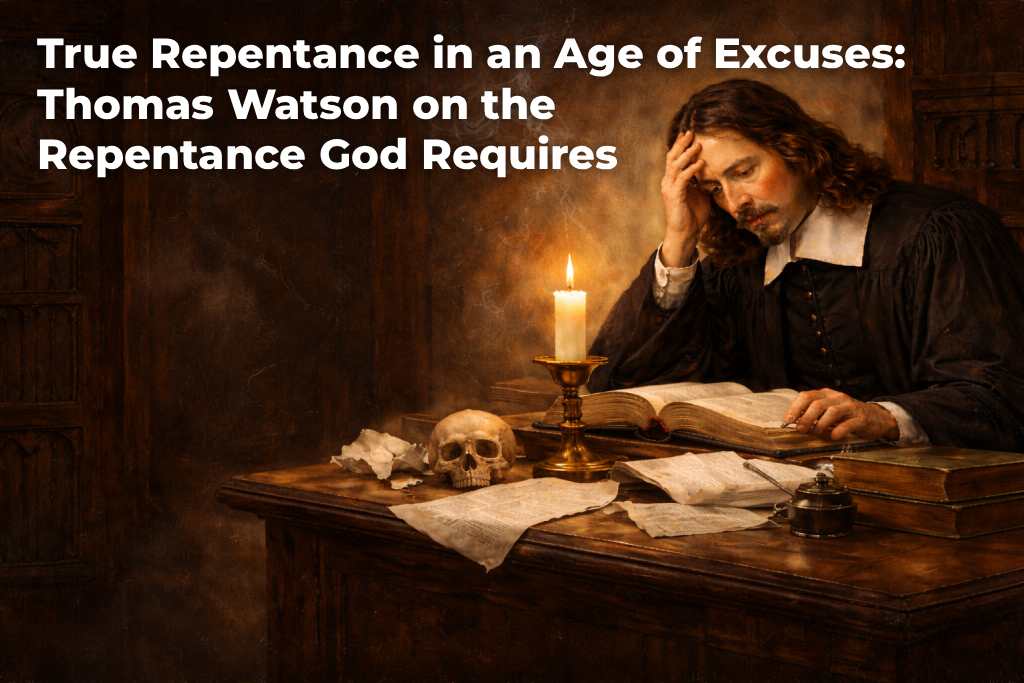
- True Repentance in an Age of Excuses: Thomas Watson on the Repentance God Requires – Part Three
- Grace That Trains Us: Thomas Watson on Holiness and Sanctification – Part Four
- The Fear of God and the Death of Casual Christianity: Thomas Watson on Reverence, Awe, and Obedient Fear – Part Five
- Why Shallow Faith Collapses Under Pressure: Thomas Watson on Rooted Faith, Trials, and Endurance – Part Six
- Thomas Watson on Prayer, Meditation, and the Disciplined Mind – Part Seven
- Heaven, Hell, and Eternity Through the Eyes of Thomas Watson – Part Eight
- Why Thomas Watson Took Sin Seriously, and So Should We – Part Nine
- Reading the Puritans Without Becoming Weird or Proud – Part Ten
- A Beginner’s Guide to Reading Thomas Watson Today – Part Eleven
- What Reading Thomas Watson Did to My Faith – Part Twelve