
A meme recently circulated online showing a frustrated Baptist arguing with several early church figures like Augustine and Hippolytus. The implication was obvious: “The early church baptized babies, Baptists are denying history, end of discussion.”
The problem is that the meme oversimplifies a very complicated issue.
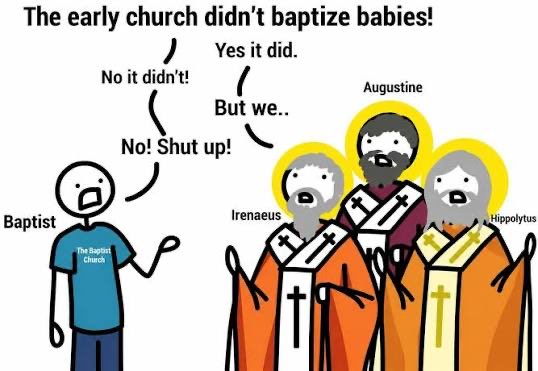 Historically speaking, the claim that “the early church didn’t baptize babies” is false if by “early church” we mean the post-apostolic church broadly across the second, third, and fourth centuries. There is real historical evidence that infant baptism existed very early. At the same time, the meme also glosses over the fact that the evidence is sparse in the earliest period, debated in interpretation, and accompanied by major theological developments that were already beginning to move away from the simplicity of New Testament ecclesiology.
So both simplistic Baptist dismissals and simplistic paedobaptist triumphalism fail historically.
The real question is not merely, “Did any early Christians baptize infants?” The real question is, “Was infant baptism apostolic, universal, normative, and grounded clearly in the teaching of Scripture?” Those are very different questions.
What Does the New Testament Actually Show?
Start with the New Testament itself. There is no explicit instance anywhere in Scripture of an infant being baptized. Not one. No verse directly commands infant baptism, either.
Every unambiguous baptism account in the Book of Acts involves people hearing the Gospel, responding in faith, and then being baptized. That pattern matters because Acts is the inspired historical record of apostolic mission.
Consider the repeated pattern:
Acts 2:41: “Those who received his word were baptized.”
Acts 8:12: “When they believed Philip… they were baptized, both men and women.”
Acts 8:36-38: The Ethiopian eunuch hears, believes, and is baptized.
Acts 10:44-48: Cornelius and his household receive the Spirit before baptism.
Acts 16:31-34: The Philippian jailer rejoices after believing in God with his household.
Acts 18:8: “Crispus… believed in the Lord, together with his entire household.”
Again and again, the sequence is proclamation, belief, and baptism.
That is why credobaptists argue that baptism in the New Testament is consistently tied to conscious faith and repentance. The argument is not merely silence about infants. The argument is that the entire positive pattern points toward believer’s baptism.
The Household Baptism Argument
Paedobaptists usually respond first by pointing to household baptisms.
Lydia’s household, the jailer’s household, Stephanas’ household, and others are all brought forward as examples. The argument is that households in the ancient world ordinarily included children and infants. Therefore, infant baptism is at least plausible within these narratives.
The problem is that plausibility is not proof.
In several of these household texts, belief is attributed to the household itself. For example, Acts 16:34 speaks of the jailer rejoicing “with his entire household that he had believed in God.” Likewise, in 1 Corinthians 16:15, the household of Stephanas is described as devoted to ministry. That sounds more like believing participants in the families than passive infants.
Still, the household passages remain one of the strongest inferential arguments for paedobaptism because they at least leave conceptual room for family inclusion.
Covenant Theology Is The Real Debate
The real foundation of infant baptism is not actually the household passages. It is covenant theology.
Paedobaptists argue that baptism replaces circumcision as the covenant sign. Under Abraham, covenant children received the sign before personal faith. Therefore, children of believers should likewise receive baptism under the New Covenant.
This is where the debate becomes fundamentally theological rather than merely historical.
Credobaptists respond that the New Covenant differs from the Old Covenant precisely because all members of the New Covenant know the Lord personally. They appeal especially to Jeremiah 31:31-34.
“They shall all know Me, from the least of them to the greatest.”
The argument is that the Old Covenant contained mixed membership: believers and unbelievers, regenerate and unregenerate. But the New Covenant community is defined by regeneration and faith. Therefore, the covenant sign should belong only to those who credibly profess faith.
Hebrews becomes extremely important here because Hebrews repeatedly contrasts the Old and New Covenants and emphasizes internal transformation rather than merely external covenant membership.
What Did The Earliest Christians Actually Practice?
Now we move into church history.
The Didache (c. AD 70-120)
The earliest extra-biblical Christian document discussing baptism in detail is the Didache, probably written around AD 70-120, with many scholars placing it near the end of the first century or beginning of the second.
The Didache gives instructions about baptism: “Baptize in the name of the Father and of the Son and of the Holy Spirit in living water.”
It also instructs fasting before baptism for the baptizer and the one being baptized. That instruction strongly suggests candidates old enough to fast consciously.
Yet the Didache never mentions infant baptism at all.
That silence does not prove infant baptism did not exist, but it is significant because the Didache is highly practical and procedural. If infant baptism were already a universal apostolic practice, many scholars argue that it is surprising that no mention appears.
Justin Martyr (c. AD 100-165)
Justin Martyr, writing around AD 150 in his First Apology, describes baptism as connected to persuasion and belief: “Those who are persuaded and believe that what we teach and say is true… are brought by us where there is water.”
Again, the emphasis is on conscious faith and discipleship.
Irenaeus (c. AD 130-202)
The earliest explicit reference that may indicate infant baptism appears in Irenaeus around AD 180. He speaks of Christ saving “infants and children and boys and youths and old men.”
Some paedobaptists interpret this alongside baptismal regeneration themes to imply infant baptism. But the text itself does not explicitly mention baptizing infants. It is indirect evidence at best.
Tertullian (c. AD 155-220)
The first unmistakable evidence comes with Tertullian around AD 200. Ironically, Tertullian opposes infant baptism. That fact is extremely important historically because you do not argue against a practice unless it exists.
Tertullian writes: “Therefore, according to the condition and disposition and even age of each person, the delay of baptism is preferable, principally, however, in the case of little children.”
This proves infant baptism existed by AD 200. But it also proves it was disputed. Tertullian clearly did not think infant baptism was an unquestioned apostolic norm. That single fact destroys simplistic historical claims on both sides.
Origen (c. AD 184-253)
By the third century, infant baptism became increasingly visible. Origen explicitly supports it and claims it came from the apostles: “The Church received from the apostles the tradition of giving baptism even to infants.”
But historical caution is necessary here. Origen lived roughly 150 years after the apostles. His claim matters, but it is not itself proof. Church fathers sometimes projected contemporary practice backward into apostolic times.
Cyprian Of Carthage (c. AD 200-258)
Cyprian strongly supports infant baptism. Around AD 253, a council under Cyprian argued that infants should be baptized even before the eighth day after birth. He said in his Letter 64 (also called Epistle 58 in some numbering systems), written around AD 253 to a man named Fidus.
Cyprian states:
“As to what pertains to the case of infants: whereas you said that they ought not to be baptized within the second or third day after their birth, and that the law of ancient circumcision should be regarded… we all rather judge that the mercy and grace of God ought to be denied to no man born.”
And then he explicitly says:
“We all thought very differently in our council… no one agreed to the course which you thought should be taken. Rather, we all judge that the mercy and grace of God is not to be refused to any one born of man.”
The council reportedly involved 66 bishops.
By this point, the practice is clearly established in significant parts of the church.
The Fourth Century Explosion
As Christianity moves into the fourth century, infant baptism becomes increasingly widespread, though not yet absolutely universal in practice. Several major church figures lived during this era:
Gregory Nazianzen (c. AD 329-390)
Basil the Great (c. AD 330-379)
Ambrose (c. AD 339-397)
John Chrysostom (c. AD 347-407)
Augustine of Hippo (AD 354-430)
Augustine becomes enormously influential in shaping Western Christianity’s understanding of baptism.
For Augustine, infant baptism was tied closely to original sin. Infants were baptized because they were believed to be born guilty in Adam and therefore needed cleansing from sin. Augustine’s sacramental theology helped solidify infant baptism throughout the medieval church.
But this is where historical development becomes extremely important. The farther you move from the apostolic era, the more sacramental theology develops. Baptism increasingly becomes viewed not merely as a sign of faith but as an instrument that actually conveys regenerative grace automatically or nearly automatically.
This matters a lot because many modern paedobaptists, especially Reformed ones, do not hold the same baptismal regeneration theology as Augustine, Cyprian, or much of the ancient church. Modern Reformed paedobaptists often argue that baptism is a covenant sign, not necessarily the moment of spiritual regeneration (AKA being born again) itself.
So historical appeals can become selective. Someone cannot simply quote Augustine approving infant baptism while ignoring Augustine’s broader sacramental system.
What About The Didactic Passages?
One of the strongest credobaptist arguments comes from the didactic portions of the New Testament. The epistles repeatedly explain the meaning of baptism:
- Romans 6 connects baptism to union with Christ in death and resurrection.
- Galatians 3 links baptism to faith.
- Colossians 2 connects baptism with being raised through faith.
- 1 Peter 3 speaks of an appeal to God for a good conscience.
In virtually every explanatory passage, baptism is treated as bound up with personal faith, repentance, union with Christ, discipleship, and conscious participation in the Gospel. Romans 6 is especially important because Paul assumes baptized individuals are participants in Christ through faith. The entire argument presupposes conversion reality.
Credobaptists, therefore, argue that the didactic sections interpret the narrative sections. The theology of baptism in the epistles consistently points toward believers.
Paedobaptists respond that covenant children can still receive the sign before fully understanding its meaning, just as circumcised Israelite infants did under the Old Covenant.
Delayed Baptism Complicates The Discussion
There is another historical issue people often ignore. Several major figures in the early church were not baptized as infants, even when raised in Christian homes. Gregory Nazianzen, Basil the Great, John Chrysostom, Ambrose, and even Augustine himself were baptized later in life, mostly during the fourth century. Why?
In part because many Christians feared post-baptismal sin and delayed baptism. Some believed baptism washed away previous sins in a uniquely powerful way, so delaying baptism until later in life became common in some regions and periods.
Constantine himself, the Roman emperor who legalized Christianity, was only baptized shortly before he died in AD 337.
That practice complicates the idea that universal infant baptism existed from the apostolic beginning. If infant baptism had been universally mandatory and unquestioned from the start, the frequency of delayed baptism would become harder to explain. At the same time, by the fourth and fifth centuries, infant baptism became dominant and nearly universal in the broader church.
So, What Are The Hard Historical Facts?
Here are the facts that can reasonably be established:
- The New Testament never explicitly records infant baptism.
- The dominant pattern in the New Testament is believer’s baptism following faith and repentance.
- Household baptisms exist but do not explicitly mention infants.
- The earliest extra-biblical Christian writings do not clearly teach infant baptism.
- Infant baptism definitely existed by around AD 200.
- The practice was disputed in at least some circles at that time.
- By the third and fourth centuries, infant baptism became widespread.
- Much of the historical defense of infant baptism developed alongside increasingly sacramental understandings of baptism.
- Appeals to “the early church” are often overly simplistic because early Christianity was not monolithic.
- The strongest case for infant baptism is theological and covenantal, not an explicit biblical command.
- The strongest case for believer’s baptism is the consistent New Testament pattern and didactic connection between baptism and personal faith.
Final Thoughts
Objectively speaking, if someone asks, “Did some early Christians baptize infants?” the answer is unquestionably yes.
If someone asks, “Can infant baptism be proven clearly from Scripture?” the answer is no.
If someone asks, “Is believer’s baptism more directly and explicitly reflected in the New Testament documents themselves?” many historians and exegetes would say yes.
If someone asks, “Did infant baptism become widespread very early in church history?” the answer is also yes.
That is why this debate has endured for centuries among serious Christians. The evidence is real on both sides, but it is not equal in type.
The biblical evidence for believer’s baptism is more explicit. The historical evidence for early infant baptism is substantial by the third century onward. The theological argument for paedobaptism depends heavily on covenant continuity between circumcision and baptism.
In the end, the meme succeeds as internet polemics but fails as careful history.
The Baptist caricature is inaccurate because infant baptism undeniably emerged very early. But the meme also implies a level of unanimity and apostolic clarity that the historical record simply does not support.