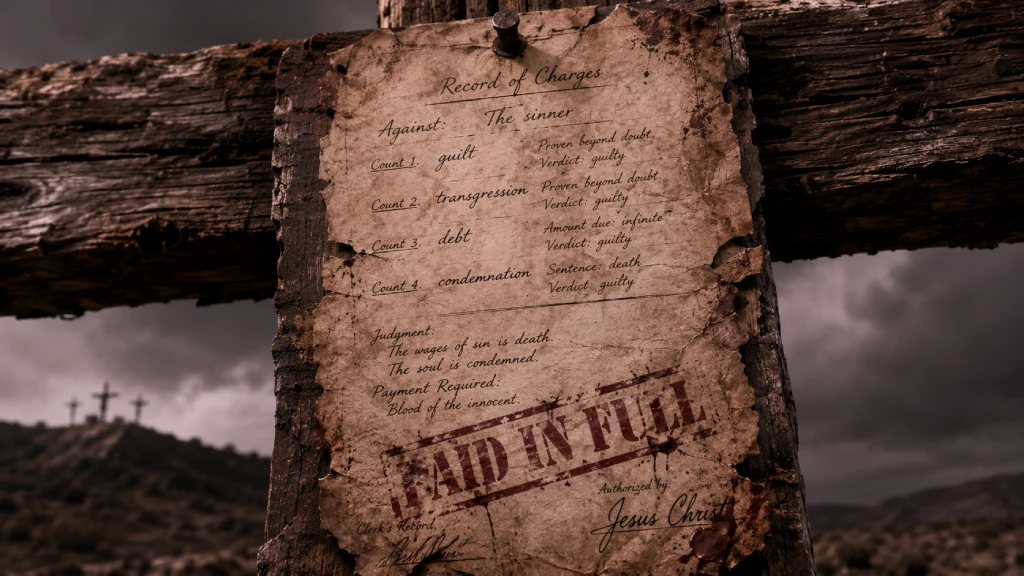
He Bore Our Curse: A Thorough Biblical and Historical Defense of the Doctrine of Penal Substitutionary Atonement
Few Christian doctrines have been as cherished, misunderstood, and fiercely attacked as Penal Substitutionary Atonement (PSA). For many believers, the doctrine expresses the heart of the gospel: Jesus Christ stood in the place of guilty sinners, bore the judgment their sins deserved, and secured their forgiveness through His sacrificial death. For its critics, however, the doctrine portrays God as vindictive, treats forgiveness as a financial transaction, and appears to punish an innocent third party for crimes He did not commit.
Those objections deserve serious answers. Christians should never defend the cross with shallow slogans or careless language. We are speaking about the holy Son of God, the justice and mercy of God, and the means by which sinners are reconciled to their Creator. We should therefore state the doctrine precisely, establish it from the whole counsel of Scripture, trace its presence through Christian history, and answer its strongest objections honestly.
When that work is done, penal substitution does not emerge as an embarrassing theory imposed upon the Bible. It emerges from the Bible’s own explanation of why Christ died.
What Is Penal Substitutionary Atonement?
The words themselves provide a helpful starting point.
“Penal” refers to a penalty imposed because God’s law has been broken.
“Substitutionary” means that Christ acted in the place of others.
“Atonement” refers to Christ’s work of dealing with sin and bringing guilty people into reconciliation with God.
Penal substitutionary atonement may therefore be defined in this way:
Jesus Christ, acting voluntarily as the covenant representative of His people, bore in their place the judicial penalty that their sins deserved, satisfying divine justice and securing their forgiveness, justification, and reconciliation with God.
Christ did not become morally sinful. He remained “holy, innocent, unstained, separated from sinners” throughout His suffering (Hebrews 7:26). Our corruption was not infused into His character. Our guilt was judicially counted to Him as our representative, just as His righteousness is judicially counted to those who are united to Him by faith (2 Corinthians 5:21).
Christ was also no unwilling victim. He declared, “I lay down my life for the sheep” and “No one takes it from me, but I lay it down of my own accord” (John 10:15, 18). The Father sent the Son, the Son willingly offered Himself, and He did so “through the eternal Spirit” (Hebrews 9:14). The atonement is the united work of the triune God – Father, Son, and Holy Spirit.
Penal substitution also does not mean that the Father stopped loving the Son, that the Trinity was divided, or that the divine nature somehow fractured on the cross. The Father eternally loves the Son (John 17:24), and the Son remained the Father’s righteous servant even while bearing our curse. The cross involved genuine judgment and forsakenness, but never an ontological rupture within the one undivided God.
With those clarifications in place, we can turn to the biblical case.
The Biblical Foundation
1. Sin Creates Real Judicial Guilt
The Bible does not describe sin as a minor imperfection, an unfortunate habit, or an illness alone. Sin is rebellion against the personal authority of the holy God.
God warned Adam that disobedience would bring death (Genesis 2:17). The prophets repeatedly connected sin with guilt, judgment, wrath, condemnation, and death. “The soul who sins shall die” (Ezekiel 18:4). Paul writes that “the wrath of God is revealed from heaven against all ungodliness and unrighteousness of men” (Romans 1:18), that “all have sinned and fall short of the glory of God” (Romans 3:23), and that “the wages of sin is death” (Romans 6:23).
God’s wrath is not an emotional tantrum. It is His holy, settled, and judicial opposition to evil. Because God is perfectly righteous, He cannot pronounce evil good or simply pretend that guilt does not exist. Abraham asked, “Shall not the Judge of all the earth do what is just?” (Genesis 18:25). The answer throughout Scripture is yes.
This creates the central human problem. We need more than moral improvement. We need more than inspiration. We need our guilt removed, our condemnation answered, and our relationship with God restored.
2. The Old Testament Sacrifices Teach Substitution
The sacrificial system prepared Israel to understand that sin deserves death and that God provides a substitute.
When an Israelite brought a burnt offering, he laid his hand upon the animal, which was then accepted “to make atonement for him” (Leviticus 1:4). On the Day of Atonement, the high priest laid both hands upon the live goat, confessed Israel’s sins over it, and symbolically placed those sins upon the animal. The goat then “bear[s] all their iniquities on itself” into the wilderness (Leviticus 16:21-22).
The animal had committed no sin. It stood in the sinner’s place. Its blood represented a life yielded under the sentence of death, for “the life of the flesh is in the blood,” and God gave it upon the altar “to make atonement for your souls” (Leviticus 17:11).
Animal sacrifices could never finally remove human guilt. Hebrews explicitly says that “it is impossible for the blood of bulls and goats to take away sins” (Hebrews 10:4). Their purpose was preparatory and typological. They established the categories of holiness, guilt, sacrifice, blood, substitution, cleansing, and atonement that would reach their fulfillment in Christ.
Jesus did not die as an unfortunate martyr whose followers later searched for meaning in His death. He died as the true Passover Lamb, the final sin offering, and the great High Priest who offered Himself.
3. Isaiah 53 Describes a Penal Substitute
Isaiah 53 is among the clearest descriptions of penal substitution anywhere in Scripture. The passage repeatedly contrasts what belonged to us with what happened to the Servant.
“He has borne our griefs.”
“He was pierced for our transgressions.”
“He was crushed for our iniquities.”
“Upon him was the chastisement that brought us peace.”
“The LORD has laid on him the iniquity of us all.”
“He was cut off out of the land of the living, stricken for the transgression of my people.”
“He shall bear their iniquities.”
“He bore the sin of many.”
The language is unmistakably substitutionary. The sins, transgressions, iniquities, and deserved chastisement belong to others, yet the Servant bears them. It is also penal. He is pierced, crushed, chastised, stricken, and cut off because of those sins.
The expression “the chastisement that brought us peace” is especially significant. Chastisement falls upon Him; peace comes to us. His wounds bring our healing. Our iniquity is laid upon Him; His righteous standing provides acceptance for many.
Isaiah also says that the Servant’s soul would be made “an offering for guilt” (Isaiah 53:10). This connects His death directly with Israel’s sacrificial system. The Servant is simultaneously the righteous representative, the sin-bearing sacrifice, and the willing sufferer who justifies many.
This is more specific than saying Jesus suffered because human beings are cruel. He suffered under a divine judicial purpose: “It was the will of the LORD to crush him” (Isaiah 53:10). Human rulers were morally responsible for crucifying Him, yet God sovereignly accomplished through their evil actions what His plan had predestined to occur (Acts 2:23; 4:27-28).
4. Jesus Interpreted His Death as Substitutionary
Jesus understood His mission through the categories of Isaiah’s suffering Servant and Israel’s sacrificial system.
In Mark 10:45 He said, “The Son of Man came not to be served but to serve, and to give his life as a ransom for many.” His life is given in the place of many to obtain their release.
At the Last Supper, Jesus interpreted His approaching death before it occurred: “This is my blood of the covenant, which is poured out for many for the forgiveness of sins” (Matthew 26:28). His blood would establish the new covenant and secure forgiveness.
Jesus also spoke about drinking a “cup” (Mark 10:38; 14:36). In the Old Testament, the cup frequently represents God’s judicial wrath against sin (Psalm 75:8; Isaiah 51:17; Jeremiah 25:15). In Gethsemane, Jesus was not merely afraid of Roman execution. Many martyrs have faced death with remarkable composure. Jesus was preparing to bear the eschatological cup of judgment as the representative of His people.
Yet He did so willingly. He prayed, “Not what I will, but what you will” (Mark 14:36). His human will was fully obedient to the Father’s saving purpose.
5. Romans 3 Explains How God Is Just and the Justifier
Romans 3:21-26 is foundational to the doctrine.
Paul has already concluded that Jews and Gentiles alike are under sin. No one can be justified by works of the law because the law exposes guilt rather than erasing it. Paul then announces that God has revealed a righteousness received through faith in Jesus Christ.
Believers are “justified by his grace as a gift, through the redemption that is in Christ Jesus,” whom God presented as a “propitiation by his blood” (Romans 3:24-25).
Propitiation refers to the turning away of righteous wrath through an atoning sacrifice. Christ’s blood does not persuade a reluctant God to become loving. God Himself provides the sacrifice because He loves sinners. Nevertheless, His love does not cancel His justice. His love provides the means by which His justice is satisfied.
Paul explicitly says that the cross demonstrates God’s righteousness. God had passed over former sins with patience, but He had not declared them morally irrelevant. At the cross, He publicly demonstrated that sin truly deserves judgment. He did this “so that he might be just and the justifier of the one who has faith in Jesus” (Romans 3:26).
God does not save by suspending justice. He saves through the satisfaction of justice in the representative sacrifice of Christ.
God Condemned Sin in Christ’s Flesh
Romans 8:1 announces, “There is therefore now no condemnation for those who are in Christ Jesus.”
Why is there no condemnation for them? Paul answers in verse 3: God sent His Son “in the likeness of sinful flesh and for sin” and “condemned sin in the flesh.”
God did not condemn sin by ignoring it. He condemned sin in the flesh of His incarnate Son. The condemnation that threatened the believer has already been executed in Christ’s representative death. Because believers are united to Him, the sentence has been answered.
This explains the logic connecting Romans 8:1 and Romans 8:3. No condemnation remains for those in Christ because sin was condemned in Christ.
7. Christ Became Sin So That We Might Become Righteous
Second Corinthians 5:21 states:
“For our sake he made him to be sin who knew no sin, so that in him we might become the righteousness of God.”
Christ “knew no sin.” He did not become corrupt, disobedient, or morally blameworthy. He was made sin in the judicial and sacrificial sense. He was treated as the sin-bearing representative of His people.
The structure is an exchange. The sinless One is counted as bearing our sin, and those who are united to Him receive a righteous standing before God. This is sometimes called double imputation: our guilt is credited to Christ, and His righteousness is credited to us.
The surrounding context concerns reconciliation. God was “not counting their trespasses against them” because Christ had been made sin for them (2 Corinthians 5:19-21). Their trespasses are no longer counted against them because those trespasses were dealt with in their substitute.
John Chrysostom, preaching on this passage in the fourth century, said that God allowed the One who had done no wrong “to be punished for those who had done wrong.”
8. Christ Became a Curse for Us
Galatians 3 establishes another direct line of argument.
Everyone who fails to keep the whole law is under its curse (Galatians 3:10). Christ then “redeemed us from the curse of the law by becoming a curse for us” (Galatians 3:13).
The movement is judicial and substitutionary:
- We were under the curse.
- Christ became a curse for us.
- We receive the blessing promised to Abraham.
The curse does not simply disappear. Christ bears it. The blessing comes to us because the curse fell upon Him.
Paul supports this by quoting Deuteronomy 21:23: “Cursed is everyone who is hanged on a tree.” Crucifixion visibly marked Jesus as one suffering under a covenant curse. He had no personal guilt deserving that curse, but He voluntarily bore the curse belonging to His people.
9. Peter Teaches That the Righteous Died for the Unrighteous
Peter writes that Christ “bore our sins in his body on the tree” (1 Peter 2:24). To bear sin in biblical language means more than sympathizing with sinners. It means carrying the liability and consequences of sin.
Peter then summarizes the gospel with extraordinary clarity:
“Christ also suffered once for sins, the righteous for the unrighteous, that he might bring us to God” (1 Peter 3:18).
The contrast is deliberate. He is righteous; we are unrighteous. He suffers for sins; the sins are ours. The result is reconciliation: He brings us to God.
Christ’s death was therefore objective before it became transformative. His death changes our legal relationship with God, and the reconciled believer is then called to die to sin and live to righteousness.
10. Hebrews Presents Christ as Priest and Sacrifice
Hebrews describes Jesus as the great High Priest who offers the final sacrifice for sin.
He made “propitiation for the sins of the people” (Hebrews 2:17). He offered Himself “without blemish to God” (Hebrews 9:14). He appeared “to put away sin by the sacrifice of himself” (Hebrews 9:26). He was “offered once to bear the sins of many” (Hebrews 9:28).
Unlike the repeated sacrifices of the old covenant, Christ’s offering is complete. “By a single offering he has perfected for all time those who are being sanctified” (Hebrews 10:14).
The finality of His sacrifice rests upon its effectiveness. Christ did not merely make forgiveness possible in an abstract sense. He actually dealt with guilt, cleansed consciences, obtained eternal redemption, and opened access to God.
11. Propitiation Begins in the Love of God
John writes:
“In this is love, not that we have loved God but that he loved us and sent his Son to be the propitiation for our sins”
– 1 John 4:10
This verse destroys the idea that propitiation presents an angry Father reluctantly persuaded by a compassionate Son. The Father sends the Son because the Father loves us. The Son willingly gives Himself because the Son loves us (Galatians 2:20). The Spirit applies the benefits of Christ because the Spirit participates in the one saving work of God.
Divine love provides the propitiation. Divine justice requires that sin be dealt with. At the cross, God’s love and justice meet without either attribute being compromised.
12. The Resurrection Vindicates the Sacrifice
Penal substitution does not end with a dead substitute.
Christ “was delivered up for our trespasses and raised for our justification” (Romans 4:25). His resurrection is the Father’s public vindication of His person and the confirmation that His atoning work has been accepted.
Death had no rightful claim upon Christ personally. Once He had borne the sin charged to Him as representative, death could not hold the righteous Son of God. The resurrection announces that the sacrifice was sufficient, the curse was exhausted, death was defeated, and justification was secured.
The cross and resurrection must therefore remain together. The crucified substitute is also the risen Lord.
Penal Substitution and the Other Biblical Pictures of the Cross
Scripture describes Christ’s work with several complementary images:
- Sacrifice
- Propitiation
- Redemption
- Reconciliation
- Justification
- Covenant
- Victory
- Healing
- Union with Christ
These are not rival theories fighting for exclusive control of the cross. They describe different dimensions of the same saving achievement.
Christ conquers Satan by dealing with the guilt through which Satan accuses sinners. Colossians 2 connects the cancellation of our legal debt with Christ’s victory over demonic powers. God cancels “the record of debt that stood against us with its legal demands” by nailing it to the cross, and then disarms the rulers and authorities (Colossians 2:13-15).
Christus Victor and penal substitution therefore fit together beautifully. The powers are defeated because the debt is cancelled. Death loses its claim because sin’s penalty has been borne. The accuser is silenced because no charge can stand against those whom God has justified (Romans 8:31-34).
Christ’s death is also the supreme revelation of love and the pattern for Christian self-sacrifice. Yet His death can transform us precisely because it first accomplishes something for us. A martyr may inspire us, but a martyr cannot justify us. Christ’s death saves because the One who loved us also “gave himself for our sins” (Galatians 1:4).
Did the Early Church Believe This?
The historical question requires precision. The phrase “penal substitutionary atonement” is relatively modern, and the early church never issued an ecumenical definition of the atonement comparable to the Nicene definition of the Trinity or the Chalcedonian definition of Christ’s person. Early Christian writers also described Christ’s saving work through several biblical themes, including sacrifice, ransom, victory over Satan, recapitulation, healing, reconciliation, participation, and deliverance from death.
That does not mean the Reformers invented the central substance of penal substitution. The real historical question is whether Christians before the Reformation taught that sin incurs divine judgment, death, curse, or punishment; that the sinless Christ voluntarily stood in the place of sinners; that He bore what belonged to them; and that His suffering secured their forgiveness, justification, reconciliation, or release.
When the question is framed that way, the evidence is substantial.
The early church did not always combine these elements into the precise theological system later found in Lutheran and Reformed confessions. Nevertheless, Christian writers long before Martin Luther and John Calvin spoke of Christ bearing our curse, carrying our sins, enduring our sentence, paying our debt, receiving punishment for wrongdoers, and giving His life in place of theirs.
The Epistle to Diognetus, c. AD 150-225
The anonymous Epistle to Diognetus is usually dated to the second century or early third century. Its ninth chapter gives one of the earliest post-apostolic descriptions of Christ’s saving exchange.
The writer begins with the human predicament. Humanity’s wickedness had grown great, and sinners had become worthy of punishment and death. God did not abandon them to the judgment they deserved. Instead, He gave His own Son, described as “the holy One for transgressors,” “the blameless One for the wicked,” and “the righteous One for the unrighteous.”
The author then exclaims, “O sweet exchange!” He marvels that the wickedness of many should be covered by one righteous person and that “the righteousness of One should justify many transgressors.”
This passage contains several elements that later become central to Protestant accounts of the atonement and justification. Sinners face punishment. The righteous Son is given for the unrighteous. Their wickedness is covered through Him, while His righteousness provides the basis upon which many transgressors are justified.
The Epistle to Diognetus does not provide a technical explanation of imputation or define precisely how Christ bears the penalty of sin. It does, however, present salvation as a divinely provided exchange between the righteous One and guilty people who could not justify themselves. That is far removed from the claim that substitution and judicial exchange were absent from early Christianity.
Justin Martyr, c. AD 100-165
Justin Martyr was one of the earliest major Christian apologists. In his Dialogue with Trypho, probably written during the middle of the second century, Justin defends the crucified Messiah against the Jewish objection that anyone hanged upon a tree is under God’s curse.
Justin begins by affirming that the whole human race has come under a curse because no one has perfectly kept God’s law. Christ, however, was personally innocent. He did not suffer the curse because He had broken the law. Justin says that the Father willed Christ “to take upon Him the curses of all” so that the human race might be delivered from the curse resting upon it.
Justin’s explanation closely follows the logic of Galatians 3:10-13. Humanity lies under the law’s curse. Christ does not deserve that curse personally. Nevertheless, He voluntarily undergoes the cursed death of the cross for the deliverance of others.
Justin does not offer a complete account of justification or the imputation of righteousness. His emphasis is deliverance from the curse through Christ’s crucifixion. Yet the basic movement is plainly substitutionary and penal: the curse belongs to sinners, but the sinless Christ bears it on their behalf.
Irenaeus of Lyons, c. AD 130-202
Irenaeus is most famous for his doctrine of recapitulation. Christ comes as the new Adam, retraces humanity’s path, obeys where Adam disobeyed, and restores human nature through His incarnation, obedience, death, and resurrection.
Some critics appeal to Irenaeus as though recapitulation excluded substitution. That conclusion does not follow from his writings. Irenaeus did not reduce the atonement to a single image. Alongside recapitulation, he spoke of sacrifice, blood, ransom, forgiveness, redemption, and Christ’s representative self-giving.
In Against Heresies, Irenaeus says that Christ redeemed us through His own blood, “giving His soul for our souls, and His flesh for our flesh.” He describes Christ as giving Himself as the redemption price for those who had been led into captivity.
The statement “His soul for our souls” expresses a genuine substitution. Christ’s life is given for the lives of others. His blood obtains their redemption, and His self-offering reunites human beings with God.
Irenaeus does not normally explain this exchange through the later Reformed categories of legal imputation and the exact punishment of the law. His dominant framework is broader, involving incarnation, recapitulation, victory, immortality, and union with God. Nevertheless, his theology includes a representative exchange in which Christ gives His life and blood for the liberation of His people.
The responsible conclusion is not that Irenaeus taught a fully developed sixteenth-century doctrine. It is that substitution was already one strand within his larger account of redemption.
Athanasius of Alexandria, c. AD 296-373
Athanasius wrote On the Incarnation during the fourth century, possibly in an earlier form before the Council of Nicaea in AD 325. The work is especially concerned with humanity’s corruption, mortality, and restoration through the incarnation of the divine Word.
Athanasius argues that humanity had come under a divine sentence of death through transgression. God could not simply allow His declared sentence to become meaningless. At the same time, humanity was incapable of rescuing itself from corruption and death.
The Word therefore assumed a mortal human body so that He might offer it on behalf of all. Athanasius in his On the Incarnation, Chapter 2, says that Christ’s body, because it was united to the divine Word, was sufficient to “die in the stead of all.” He also writes that the Word “satisfied the debt by His death.”
The language of sentence, debt, sacrifice, and death in the place of others is unmistakable. Christ does not owe death because of personal sin. He enters death as the representative of those who do owe it. His death answers the debt, and His resurrection overthrows corruption and mortality.
Athanasius places strong emphasis upon Christ’s victory over death. Yet that victory occurs through substitution. The Word defeats death by entering the condition that sin had brought upon humanity, offering His sinless body in place of others, and exhausting death’s claim through His sacrificial death.
His account is not identical to later penal substitution. Athanasius often speaks of the death penalty in terms of corruption and mortality rather than offering a detailed analysis of divine wrath. Still, the claim that he knew nothing of substitution, sentence, or satisfaction is difficult to sustain.
Cyril of Jerusalem, c. AD 313-386
Cyril of Jerusalem delivered his Catechetical Lectures during the fourth century to instruct people preparing for baptism. In his thirteenth lecture, devoted to the crucifixion, Cyril presents an especially clear account of the relationship between God’s justice and mercy.
Cyril writes that humanity had become God’s enemy through sin and that “God had appointed the sinner to die.” This created what he describes as two apparent alternatives. God could execute the sentence against humanity, demonstrating the truthfulness of His judgment, or He could cancel the sentence in loving-kindness.
Cyril then declares that divine wisdom preserved both “the truth of His sentence” and “the exercise of His loving-kindness.” How could both be preserved? “Christ took our sins in His body on the tree,” so that through His death sinners might die to sin and live to righteousness.
Cyril’s reasoning is remarkably close to the concern later expressed in Romans 3:26: how can God remain just while justifying sinners? God’s sentence against sin is not dismissed as an empty threat. It is upheld in Christ’s death, while God’s mercy delivers the sinner.
Cyril also emphasizes the infinite worth of the person who died. Christ was not a mere animal, man, or angel. He was God incarnate. The righteousness of the One who died was greater than the transgressions of those for whom He gave His life.
Here we find sin, a divine sentence of death, Christ bearing our sins, the preservation of justice, the exercise of mercy, and the unique worth of the God-man. Cyril does not use Reformation terminology, but the judicial and substitutionary structure is plainly present.
Ambrose of Milan, c. AD 339-397
Ambrose, bishop of Milan and an important influence upon Augustine, also interpreted Christ’s death through the curse language of Galatians 3.
In his Exposition of the Christian Faith, Ambrose explains that Christ was called cursed because “He bore our curses.” He was not cursed because of any evil in Himself. He entered the condition belonging to fallen human beings so that they could share in the blessings belonging to Him.
Ambrose’s language preserves the essential distinction required by a responsible doctrine of penal substitution. Christ does not become morally corrupt. He bears what belongs to us without becoming sinful in His own character.
The curse is ours, but He bears it. The weakness is ours, but He assumes it. The blessing and life are His, but He shares them with those united to Him. Ambrose presents the cross as a representative exchange grounded in the incarnation.
Gregory of Nazianzus, c. AD 329-390
Gregory of Nazianzus was one of the great Cappadocian theologians and a principal defender of Nicene Trinitarianism. His writings on the atonement require careful treatment because he rejected crude theories in which Christ’s blood was paid as though either the devil or the Father were a commercial creditor demanding a price.
That rejection does not mean Gregory denied substitution, sin-bearing, or curse-bearing.
In Oration 37, Gregory discusses Paul’s statements that Christ was “made sin” and “made a curse.” He immediately clarifies that Christ was neither sinful nor accursed in Himself. The One who frees us from sin cannot personally be sinful, and the One who redeems us from the law’s curse cannot personally deserve that curse.
Gregory’s point is representative identification. Christ is called sin because He assumes the burden of sinners. He is called curse because He enters the cursed condition from which He delivers them. He accepts these designations for our sake without undergoing a moral transformation into evil.
Gregory therefore guards two truths simultaneously. Christ remains personally holy, and Christ genuinely bears what belongs to sinful humanity. That distinction is also essential to Protestant penal substitution. Our sin is judicially charged to Christ, but He never becomes morally sinful.
Gregory did not formulate a comprehensive penal theory, and it would be misleading to place an entire later Reformed system into his writings. It would be equally misleading to cite his rejection of crude ransom theories as though he denied representative sin-bearing and curse-bearing.
John Chrysostom, c. AD 347-407
John Chrysostom, the celebrated preacher of Antioch and later bishop of Constantinople, used some of the most explicit substitutionary and penal language found among the Greek Fathers.
Commenting on Galatians 3:13, Chrysostom compares Christ’s work to an innocent person voluntarily dying for someone who has been sentenced to death. The innocent person dies in the condemned person’s place and thereby rescues him from punishment.
Chrysostom then applies the illustration directly to Christ. Christ assumed the curse in order to remove the curse resting upon others. “By dying He rescued from death those who were dying,” and by taking the curse upon Himself He delivered them from it.
The illustration contains all the central categories: an innocent person, a condemned person, deserved punishment, voluntary substitution, and deliverance because the substitute accepts what threatened the guilty.
Chrysostom is similarly direct when preaching on 2 Corinthians 5:21. He says that God allowed the One “that did no wrong to be punished for those who had done wrong.”
Chrysostom did not believe Christ became personally sinful. Elsewhere he strongly affirms Christ’s sinlessness. His language concerns the treatment Christ received as the representative of sinners. The One who knew no sin was made sin for us and suffered what wrongdoers deserved.
This does not prove that Chrysostom held every element of later Reformed theology. He did not write within the same debates over justification, imputation, and the covenant of redemption. It does prove that explicitly penal and substitutionary language existed in Greek Christian preaching more than a thousand years before Calvin.
Augustine of Hippo, AD 354-430
Augustine’s theology of the atonement includes sacrifice, ransom, victory over the devil, cleansing, reconciliation, love, and participation in Christ. He did not reduce Christ’s work to a single mechanism.
Nevertheless, Augustine repeatedly presents Christ’s death as the payment of a debt that sinners owed, and Christ did not.
In On the Trinity, Augustine explains that Christ had no sin and therefore owed no death. Yet He proceeded voluntarily to His passion “that He might pay for us debtors that which He Himself did not owe.”
That sentence is deeply substitutionary. We are the debtors. Christ is not. Nevertheless, He pays what we owe through His passion.
Augustine also rejects the idea that Christ’s death was a ransom paid to the devil as though Satan possessed a legitimate ownership claim over humanity. The devil is defeated through God’s justice. Satan brings death upon the sinless Christ, over whom he has no rightful claim, and thereby loses his hold upon those Christ represents.
For Augustine, the incarnation is necessary because the Mediator must be both God and man. As man, Christ can suffer and die for human beings. As God, He possesses the power and worth necessary to accomplish their deliverance. His passion is voluntary rather than forced.
Augustine’s account is broader than later penal substitution. Even so, it contains sinlessness, voluntary suffering, debt, substitution, justice, and deliverance. The innocent Christ pays what guilty debtors owe.
From the Medieval Church to the Reformation
Theological language became more systematic during the medieval period. The major development was the increasing use of “satisfaction” to explain how Christ’s work answered the disorder, debt, and offense created by sin.
Satisfaction and penal substitution are closely related, but they are not automatically identical. Satisfaction means that Christ’s work objectively answers what sin has violated or withheld. Penal substitution specifies that Christ accomplishes this by bearing, in the sinner’s place, the judicial penalty sin deserves.
The movement from the Fathers through medieval theology and into the Reformation is therefore best understood as development and increasing precision rather than sudden invention.
Anselm of Canterbury, AD 1033-1109
Anselm’s Cur Deus Homo, usually dated to approximately AD 1098, was a turning point in the history of atonement theology. The title means “Why the God-Man?” and the work attempts to explain why human salvation required the incarnation and death of Christ.
Anselm argues that sin is a failure to give God the obedience and honor that are due to Him. This creates a debt. Humanity cannot merely begin obeying again and thereby erase the past, because perfect obedience was already owed to God. Something beyond humanity’s ordinary obligation is necessary to make satisfaction.
The difficulty is that humanity owes the satisfaction but cannot provide it. God can provide what is necessary, but the satisfaction ought to be made by a human being because humanity committed the offense. Anselm therefore concludes that the one who makes satisfaction must be both God and man: “none but God can make and none but man ought to make” it.
Christ owes no debt because He is sinless. His freely offered life possesses a value surpassing every created thing and every debt sinners owe. He gives what He does not owe on behalf of those who cannot pay.
Anselm’s satisfaction theory should not simply be equated with mature Reformed penal substitution. His central category is the restoration of God’s honor through a superabundant gift, rather than Christ’s endurance of the precise penalty threatened by the law. His account also lacks the later Protestant emphasis upon the imputation of sin and righteousness.
Nevertheless, Anselm decisively rejected the idea that God simply overlooks sin without any objective satisfaction. Sin creates a real debt. Humanity cannot pay it. Christ, the sinless God-man, gives Himself on behalf of sinners and thereby makes the satisfaction they could never provide.
Anselm did not invent substitution. He gave a more systematic form to themes already found in earlier Christian writers.
Thomas Aquinas, AD 1225-1274
Thomas Aquinas developed the concept of satisfaction further during the thirteenth century. Although Aquinas’s broader theology differs significantly from Reformed Protestantism, his statements concerning Christ’s voluntary punishment are unusually direct.
In the Summa Theologiae, Aquinas asks whether one person may be punished for another’s sin. He distinguishes involuntary punishment from voluntary satisfaction. An innocent person cannot justly be condemned as though he were personally guilty of another person’s crime. A person may, however, voluntarily bear a satisfactory punishment for another when there is a real union between them.
Aquinas then writes: “Christ bore a satisfactory punishment, not for His, but for our sins.”
Elsewhere, he says that Christ “willingly bore the punishment, not of His own sin, but of the sins of others.”
Aquinas grounds this substitution in the union between Christ and His people. Christ is the head, and believers are His members. The head and members form what Aquinas calls “one mystic person.” Therefore, Christ’s satisfaction can belong to those who are united to Him.
He also teaches that Christ’s passion was a sufficient and superabundant satisfaction and that it delivers believers from the debt of punishment.
Important differences remain. Aquinas did not teach the Reformation doctrine of justification by faith alone. He placed Christ’s satisfaction within a sacramental and participatory framework that included human acts of penitential satisfaction. He also believed that God, considered in His absolute power, could have chosen to forgive humanity through another means.
Those differences should be acknowledged. They do not erase his explicit teaching that Christ voluntarily bore satisfactory punishment for the sins of others. Whatever one calls Aquinas’s complete theology, the claim that punishment-bearing substitution was wholly unknown before the Reformation is historically untenable.
The Reformation’s Greater Precision
The Reformers did not discover for the first time that Christ died for sinners, bore their curse, satisfied divine justice, or gave His life in their place. Their distinctive contribution was to gather these themes into a more precise account of law, guilt, punishment, imputation, justification, covenant representation, and union with Christ.
They also connected the atonement more rigorously to justification by faith alone. Christ’s guilt-bearing obedience provides the judicial foundation for the believer’s complete pardon, while His righteousness provides the believer’s positive standing before God.
Martin Luther, AD 1483-1546
Martin Luther’s lectures on Galatians, delivered in 1531 and published in expanded form in 1535, contain some of the strongest penal substitutionary language in Reformation theology.
Commenting on Galatians 3:13, Luther says that a sentence of death and condemnation had been pronounced over sinners. Christ then took their sins upon Himself and died for them upon the cross.
“But Christ took all our sins and died for them on the Cross,” Luther writes.
Luther’s language can sound deliberately shocking because he wants troubled consciences to see that their sins have truly been dealt with outside themselves. Christ stands before God’s law as the representative sin-bearer. The curse strikes Him so that those who trust in Him may receive blessing.
Luther does not mean that Christ became morally wicked. Christ remains the holy Son of God. He is treated as the bearer of sins that are not personally His, just as believers receive a righteous standing that does not originate in their own obedience.
For Luther, this is the ground of Christian assurance. The believer does not look inward to determine whether enough righteousness has been produced. Faith looks outward to Christ, who has borne the curse and answered the sentence of the law.
John Calvin, AD 1509-1564
John Calvin gave penal substitution one of its clearest systematic expressions in the Institutes of the Christian Religion, particularly in its final Latin edition of 1559.
Calvin carefully preserves the priority of divine love. The Father did not become loving only after Christ died. God loved sinners and therefore provided the means of reconciliation. Yet Calvin also insists that God’s holy opposition to sin had to be answered.
Commenting upon Christ’s condemnation under Pontius Pilate, Calvin writes that “the punishment to which we were liable was inflicted on that Just One.”
Calvin describes Christ as bearing the curse that belonged to sinners, enduring the judgment of God, and offering Himself as the sacrificial victim who expiates guilt. The condemnation that threatened us was laid upon Him so that it would no longer be counted against those united to Christ.
Calvin’s formulation brings together several strands already visible throughout Christian history: the sacrificial categories of Scripture, the curse language emphasized by Justin and Chrysostom, the debt language found in Athanasius and Augustine, the satisfaction framework developed by Anselm and Aquinas, and the Reformation doctrine of justification through the imputed righteousness of Christ.
His theology is a maturation and synthesis of earlier themes. Calling it an invention gives the false impression that its central ideas appeared without historical or biblical precedent.
The Reformation Confessions
Penal substitution was not confined to the private writings of Luther or Calvin. It entered the public confessions and catechisms of major Protestant churches.
The Belgic Confession of 1561 declares that Christ “presented himself in our place before his Father,” appeased God’s wrath through “full satisfaction,” and offered Himself upon the cross to purge away sins. It directly connects this confession to Isaiah 53, where the chastisement that brings peace falls upon the suffering Servant.
Article 31 of the Church of England’s Thirty-Nine Articles, finalized in 1571, calls Christ’s once-for-all offering the “perfect redemption, propitiation, and satisfaction” for the sins of the world. It adds that there is no other satisfaction for sin besides Christ’s solitary offering.
The Westminster Larger Catechism, completed during the 1640s, states that Christ “felt and borne the weight of God’s wrath,” laid down His life as an offering for sin, and endured the cursed death of the cross.
These confessions show that penal substitution became embedded in the public doctrinal identity of Lutheran, Reformed, Presbyterian, and Anglican Christianity. It was not an obscure speculation held by a few isolated theologians. It was regarded as a faithful summary of the Bible’s teaching about Christ’s sacrificial death.
John Owen, AD 1616-1683
The English Puritan theologian John Owen gave one of the most rigorous seventeenth-century defenses of penal substitution in The Death of Death in the Death of Christ, published in 1647.
Owen argues that death and the curse of the law express the punishment due to sin. Scripture says that Christ bore our sins, was made sin for us, and became a curse for us. Owen therefore concludes that Christ underwent the punishment connected with the sins laid upon Him.
“The wrath of God, the curse of the law, the pains of hell, due to sinners, in body and soul,” Owen writes in his Two Short Catechisms, Q. 7, suggests that Christ underwent that punishment as the surety and representative of His people.
Christ does not become personally guilty of committing His people’s sins. He assumes legal responsibility for their debt and answers the demands standing against them.
Owen also rejects the idea that Christ paid Satan. The debt concerns God’s law and justice. Satan is an enemy to be conquered, not a creditor whose moral claims must be satisfied. Christ defeats Satan by dealing with the guilt through which Satan accuses and enslaves sinners.
Although Owen is particularly associated with definite atonement, his account of substitution rests upon broader Christian themes: sacrifice, suretyship, curse-bearing, satisfaction, ransom, and victory.
Jonathan Edwards, AD 1703-1758
Jonathan Edwards integrated penal substitution into his account of God’s moral government, divine justice, and sovereign grace.
In his sermon Pardon for the Greatest Sinners, Edwards argues that God’s justice as Judge requires that sin be punished. God’s mercy and justice are brought into perfect harmony through the sufferings of Christ, “in which sin is punished fully, and justice answered.”
Edwards explains that Christ voluntarily becomes the believer’s surety. He legally stands in the place of His people, sustains their guilt, and bears their punishment. Because justice has been fully satisfied in their representative, the law presents no remaining barrier to their pardon.
Edwards also distinguishes Christ’s satisfaction from His merit. Christ’s suffering answers the penalty of sin and secures pardon. His positive obedience fulfills the righteousness God’s law requires and secures the believer’s title to eternal life.
This distinction reflects the Reformed doctrine of Christ’s passive and active obedience. “Passive obedience” does not mean Christ was unwilling or inactive. It refers to His willingly suffering the penalty of sin. “Active obedience” refers to His entire life of perfect obedience to the Father.
For Edwards, both belong to the one saving righteousness of Christ.
Charles Hodge, AD 1797-1878
Charles Hodge, the influential Princeton theologian of the nineteenth century, defended penal substitution as the doctrine arising from the Bible’s teaching about priesthood, sacrifice, guilt, law, propitiation, and justification.
Hodge argues that the Old Testament sacrifices were substitutions in which an unblemished victim died in relation to another person’s sin. Their purpose was to prepare God’s people to understand the true sacrifice of Christ.
Christ, Hodge writes, “bore their guilt and suffered the penalty of the law in their stead,” thereby reconciling sinners to God.
Hodge is careful to distinguish the transfer of guilt from the transfer of moral character. Christ does not become personally blameworthy or morally polluted. Guilt in this context means liability to punishment. Christ assumes the legal liability of those He represents while remaining the spotless and righteous Son of God.
Hodge also rejects the claim that penal substitution reduces salvation to an impersonal legal transaction. The legal satisfaction of the cross results in reconciliation, the gift of the Holy Spirit, sanctification, communion with Christ, and eternal life.
The judicial dimension is foundational, but it is never the whole of salvation. The One who satisfies the law also unites His people to Himself and shares His resurrection life with them.
The Historically Responsible Verdict
The historical evidence calls for a carefully qualified conclusion.
The early church did not possess one universally accepted and technically precise theory called “penal substitutionary atonement.” The Fathers used several biblical models of salvation, and they did not always explain how those models related to one another. Their terminology, philosophical assumptions, pastoral concerns, and theological controversies differed from those of the Reformers.
The mature Protestant doctrine, especially its connection to justification by faith alone, double imputation, covenant representation, and the distinction between Christ’s active and passive obedience, received its clearest systematic expression during and after the Reformation.
Yet the central substance of the doctrine did not appear from nowhere in the sixteenth century.
Long before Luther and Calvin, Christian theologians taught that:
- Sin brings death, curse, sentence, debt, and punishment.
- Christ is personally innocent and righteous.
- Christ voluntarily gives Himself for sinners.
- He bears their sins, curses, debts, or punishment.
- His suffering preserves divine justice while displaying divine mercy.
- His death delivers, justifies, reconciles, and restores those He represents.
The language varies from writer to writer. The emphasis varies as well. Some speak primarily of curse, others of debt, sentence, sacrifice, punishment, ransom, recapitulation, or victory. These themes should not be flattened into one formula.
Still, the historical trail is clear. The righteous One given for the unrighteous, the innocent One dying for the condemned, the sinless One bearing our curse, the God-man paying a debt He did not owe, and Christ voluntarily enduring punishment for the sins of others were not Reformation inventions.
The Reformers sharpened, organized, and systematized these truths. They did not create them out of nothing.
Answering the Strongest Objections
Objection 1: “Punishing an innocent person is unjust”
Ordinarily, punishing an unrelated innocent person against his will would be a horrific injustice. Penal substitution does not describe that situation.
Christ is not an unwilling third party seized by God. He is the eternal Son who shares the one divine nature, purpose, and saving will with the Father and the Spirit. The Son voluntarily assumes human nature, becomes the covenant head of His people, and lays down His life for them.
He possesses authority over His own life: “I have authority to lay it down, and I have authority to take it up again” (John 10:18). He is also organically and covenantally united to those He represents. Scripture describes believers as being “in Christ,” as members of His body, and as united with Him in His death and resurrection.
Human criminal courts cannot ordinarily permit substitution because one human judge does not own the life of another person, an ordinary citizen cannot simply transfer criminal responsibility, and a substitute lacks the representative union Christ has with His people. Those limitations do not apply to the incarnate Son acting voluntarily under divine authority.
Even contemporary philosophical analysis has argued that penal substitution can be morally permissible when the substitute acts willingly, bears the cost in a way the offender cannot, and restores the offender rather than enabling further evil.
The cross is unique. It cannot be reduced to one human judge randomly executing an uninvolved bystander.
Objection 2: “This is cosmic child abuse”
That accusation depends upon a rejection of orthodox Trinitarian theology.
The Son is not a powerless child. He is the eternal Word through whom all things were made (John 1:1-3). He willingly became flesh and gave Himself. The Father did not force an unwilling Son to suffer. Christ “loved us and gave himself up for us” (Ephesians 5:2).
The New Testament can say both that the Father delivered up the Son and that the Son delivered Himself up because their saving purpose is united. Augustine observed that the Father delivered Him up, the Son delivered Himself up, and the will of the Father and Son is one.
At Calvary, God does not demand that someone else absorb a cost He refuses to bear. In the person of the incarnate Son, God bears the cost Himself.
Objection 3: “A loving God could simply forgive”
This objection usually treats forgiveness as though it were the same thing as pretending that no wrong occurred.
When someone forgives a personal offense, the cost does not vanish. The offended person absorbs it. If someone destroys your property and you forgive the debt, the loss does not cease to exist. You bear it.
Furthermore, God is not only a private individual forgiving a personal slight. He is the Judge of all creation. A judge who simply ignores proven evil is unjust. Scripture condemns those who “acquit the guilty for a bribe, and deprive the innocent of his right” (Isaiah 5:23).
God’s justice is not an external law imposed upon Him. Justice expresses His own holy nature. He cannot deny Himself or call evil good.
At the cross, God assumes the cost of forgiveness while publicly demonstrating His righteousness. This is precisely Paul’s argument in Romans 3:25-26. God remains just while justifying the ungodly because Christ has been presented as the propitiatory sacrifice.
Objection 4: “Penal substitution makes God loving only after Jesus dies”
Biblical penal substitution teaches the opposite.
“God so loved the world, that he gave his only Son” (John 3:16). “God shows his love for us in that while we were still sinners, Christ died for us” (Romans 5:8). “In this is love,” John says, because God sent His Son as the propitiation for our sins (1 John 4:10).
The cross originates in divine love. Propitiation does not transform a cruel God into a gracious God. God’s gracious love provides the propitiation that His holiness and justice require.
Calvin emphasized this point centuries ago. God did not begin to love us after reconciliation. He reconciled us because He loved us, even while our sin remained the object of His righteous opposition.
Objection 5: “God cannot be both wrathful and loving”
Human anger often involves selfishness, irrationality, and loss of control. God’s wrath contains none of those defects.
A person who is entirely indifferent toward cruelty, exploitation, murder, and abuse would not be loving. Holy love necessarily opposes what destroys its objects. God’s wrath is His righteous response to evil because He loves what is good.
At the cross, love and wrath are not competing personalities within God. The one holy God lovingly provides the Son, and the Son lovingly bears the judgment sin deserves.
Objection 6: “Christus Victor is the biblical view, so penal substitution must be wrong”
This creates a false choice and a false dichotomy that Scripture itself refuses to make.
Christ defeats death by bearing sin’s penalty. He disarms Satan by cancelling the legal record that stood against us. He liberates captives by paying the ransom. He reconciles us to God by removing the guilt that alienated us. He heals us through the wounds He suffered for our transgressions.
Victory explains what Christ accomplished against our enemies. Penal substitution explains how the judicial claim of sin was answered. Both are true, and Colossians 2:13-15 places them in the same passage.
Objection 7: “The Father could not have forsaken the Son”
Jesus’ cry, “My God, my God, why have you forsaken me?” comes from Psalm 22. It should neither be emptied of its force nor interpreted as a rupture in the divine essence.
Christ truly entered the God-forsaken condition associated with bearing the covenant curse. He experienced judgment, darkness, anguish, and the withdrawal of the Father’s comforting presence according to His human nature. Yet the eternal communion of Father, Son, and Spirit was never ontologically dissolved.
The Father remained Jesus’ God. Jesus continued addressing Him in faith: “My God, my God…” He later entrusted His spirit into the Father’s hands (Luke 23:46). The forsakenness was judicial and experiential, not a division of the Trinity.
Objection 8: “Jesus did not spend eternity in hell, so He could not have borne our penalty”
Scripture does not teach that Christ had to reproduce every circumstance of the final state of the condemned in identical duration.
The value of His sacrifice rests upon the dignity of His person. The one who suffered is the divine Son in an authentic human nature. His suffering possesses a worth no finite creature could possess.
Christ bore the curse, wrath, condemnation, shame, suffering, and death due to sin. Because He is the holy and infinite God-man, His sacrifice was fully sufficient. The resurrection demonstrates that death had exhausted its claim and could not hold Him.
We should speak where Scripture speaks and avoid speculative descriptions that go beyond it. Scripture declares His sacrifice complete, sufficient, and once for all.
Objection 9: “Penal substitution turns salvation into a cold transaction”
The Bible does use legal and economic language, including debt, ransom, justification, condemnation, redemption, and payment. Yet it never reduces salvation to an impersonal commercial exchange.
- The judge is the Father who adopts us as children.
- The substitute is the Son who loves us and gives Himself for us.
- The one who applies redemption is the Spirit who dwells within us.
- The justified are united to Christ, welcomed into God’s family, transformed into Christ’s likeness, and promised resurrection life.
Penal substitution supplies the judicial foundation for a profoundly personal reconciliation. Because our guilt has been removed, we draw near to God with confidence rather than terror.
Objection 10: “The doctrine encourages victims to tolerate abuse”
Christ’s atonement is a unique redemptive act performed by the incarnate Son. It does not give abusers permission to punish innocent people, nor does it require victims to remain in danger.
Scripture commands civil authorities to punish wrongdoing, church leaders to confront serious sin, and Christians to protect the vulnerable. Personal forgiveness does not eliminate the need for truth, boundaries, restitution, discipline, or lawful justice.
The cross reveals the seriousness of evil. Sin is so destructive that the Son of God had to die to redeem us from it. Any use of the cross to excuse ongoing abuse contradicts the moral meaning of the cross.
What Is Lost When Penal Substitution Is Removed?
Without penal substitution, the Bible’s strongest explanations of the cross become difficult to maintain.
- Why was Christ pierced for our transgressions?
- What chastisement brought us peace?
- How did He bear our sins?
- What does it mean that the Lord laid our iniquity upon Him?
- How did He become a curse for us?
- Why does His blood propitiate?
- How did God condemn sin in Christ’s flesh?
- Why does Christ’s sacrifice demonstrate God’s righteousness?
- How can God justify the ungodly while remaining just?
Other dimensions of the atonement provide precious truths, but they do not answer these questions by themselves. Moral influence explains how the cross moves us. Christus Victor explains Christ’s triumph over evil powers. Recapitulation explains Christ’s representative renewal of humanity. Healing explains the restoration sin requires.
Penal substitution explains how guilty sinners can be acquitted before a holy Judge without justice being denied.
Remove it, and the gospel becomes less than the biblical gospel. Sin becomes less judicially serious. God’s wrath becomes difficult to explain. Sacrifice loses its penal logic. Propitiation is weakened. The curse language of Galatians becomes obscure. Isaiah’s suffering Servant is reduced to a sympathetic sufferer rather than the sin-bearing substitute the text describes.
The Glory of the Cross
Penal substitution is not a theory Christians should defend reluctantly. Properly understood, it displays the holiness, justice, wisdom, and love of God with breathtaking unity.
At the cross:
- God’s holiness is displayed because sin is judged.
- God’s justice is displayed because guilt is not ignored.
- God’s love is displayed because He provides the sacrifice.
- Christ’s obedience is displayed because He willingly lays down His life.
- God’s wisdom is displayed because mercy and justice meet.
- God’s power is displayed because death and Satan are defeated.
- The sinner’s salvation is secured because Christ bears the curse and grants His righteousness.
The cross tells the truth about us. Our condition was so desperate that nothing less than the death of the Son of God could save us.
The cross also tells the truth about God. His love was so great that He did not spare His own Son but gave Him up for us all (Romans 8:32). In the incarnate Son, God took upon Himself the judgment His own holiness required.
Jesus did not die merely to show that suffering can be meaningful. He did not die merely to inspire moral courage. He did not die merely because political and religious authorities felt threatened by His teaching.
“Christ died for our sins in accordance with the Scriptures” (1 Corinthians 15:3).
- He bore our sins.
- He carried our curse.
- He endured our condemnation.
- He satisfied divine justice.
- He defeated our enemies.
- He brought us to God.
The righteous One stood in the place of the unrighteous so that everyone who trusts in Him may be forgiven, justified, reconciled, adopted, and raised to everlasting life.
That is penal substitutionary atonement.
That is the message proclaimed by the prophets, explained by the apostles, confessed throughout Christian history, and treasured by every sinner who has learned to sing:
My hope is built on nothing less than Jesus’ blood and righteousness.”