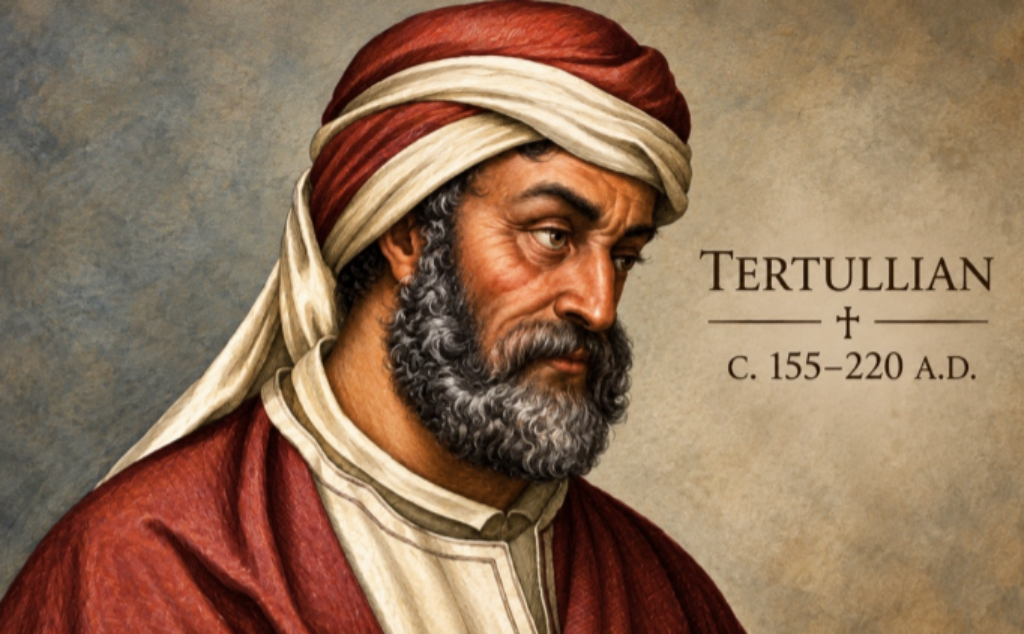
One of the most influential theologians of the early Church was Tertullian of Carthage, who, during the late 2nd and early 3rd Centuries, wrote extensively on doctrinal issues that the Church had yet to define. Tertullian defended the Church against external attacks by the Greeks who claimed Christianity was polytheistic, as well as the growing internal influence of Modalism, which taught that God is one person appearing in three different modes: Father, Son, and Holy Spirit.
In response to these false views, Tertullian was the first to use the word “Trinity” to describe the Godhead as three distinct and eternally existent persons, each possessing the same divine nature and substance – an explanation later included in the Nicene Creed and adopted at the Council of Nicaea in 325 A.D., and which is said by parishioners and congregants in both Catholic and Protestant Churches to this day.
However, the Church hierarchy did not appreciate all of Tertullian’s views. Tertullian grew increasingly enraged by the growing ethical corruption among the Church’s bishops. What deeply angered him was the granting of absolutions to influential Christians who were known to be compromising with the Roman government in order to save themselves from occasional periods of persecution. He was also incensed by the fact that absolutions were being far too easily granted to those guilty of adultery and fornication.
In response to what he saw as the Church’s insufficient seriousness about personal holiness, Tertullian aligned himself with the Montanists — an ascetic, prophetic movement that demanded rigorous moral discipline – and insisted that certain grave sins were beyond forgiveness and therefore not deserving of absolution.
According to Tertullian, these unpardonable sins included murder, idolatry, and apostasy. For these, no amount of penance could ever possibly assuage either God’s or Tertullian’s anger. His position on these issues and his joining in with the Montanists led to him being declared apostate by the Church – a state within which he remained until his death.
Tertullian’s View on the Intermediate State
The view Tertullian held that caused the greatest long-term damage to the Church, and that is pertinent to the present discussion, was his belief and teaching on the intermediate state. This state occurs between a person’s death and the final resurrection, before the body is reunited with the soul. During this intermediate period, the soul exists in a conscious state, either in endless bliss in Christ’s presence or in torment outside his presence.
Unlike most who rightly view the word “Hades” as synonymous with Hell and “Paradise” as synonymous with Heaven, Tertullian believed these words represented separate places. Tertullian’s view of Hades mostly aligned with Greek mythology, which saw Hades as a subterranean region within the bowels of the earth where all who die go to dwell.
As in later Greek mythology, Tertullian believed Hades consisted of two realms separated by an impassable gulf. Using biblical terminology, Tertullian described these two realms as Paradise, where the righteous dwell until the Day of Judgment, when they would be ushered into heaven, and Gehenna, where the wicked would be punished before eventually being cast into hell. Like all false doctrines, this erroneous understanding of Hades, shaped mostly by false cultural philosophy, gradually led to even more errant beliefs and practices in the decades and centuries that followed.
The first wrongful practice to develop from Tertullian’s false notions was that of praying for the relief of suffering for those supposedly being punished in Gehenna. Tertullian even encouraged this practice, saying, “We offer sacrifices for the dead on their birthday anniversaries.” He also stated, “The widow who does not pray for her dead husband has as good as divorced him.”
From the Relief of Suffering to Total Deliverance
Soon Christians began to believe that prayers could not only bring relief for those suffering in Gehenna but also their total deliverance from this formerly inescapable place of pre-Hell punishment.
They came to believe their prayers could move the angels to lift their loved one from Gehenna, transport them across the great divide, and place them in the blissful region of Paradise, where they would eventually experience the joys of Heaven rather than being cast into Hell.
As expected, this wishful, comforting new belief became extremely popular among those concerned about the postmortem fate of friends and family members who had lived less-than-exemplary lives on earth. As a result, praying for the dead became so widespread that the Church, rather than dispel this false belief, incorporated prayers for the dead into the liturgy of the Mass.
From Prayers for the Dead to Masses for the Dead
As time went on, ways to further facilitate the transfer of deceased loved ones from Gehenna to Paradise grew to include Masses being offered in the name of one who had recently died. These, known as Gregorian Masses, were offered in monasteries and started during the reign of Pope Gregory the Great, from 590 to 604 A.D.
This practice of offering Masses for the dead for thirty consecutive days began during Pope Gregory’s reign after a disgraced and deceased monk named Justus, presumed to be suffering in Gehenna, was said to have appeared to a living monk. According to the monk, the deceased Justus told him that after thirty Masses were said in his name, he had been delivered from a state of suffering to one of peace.
As this story spread, people began paying both monasteries and seminaries to offer Masses for deceased loved ones, hoping they, like Justus, might be delivered from suffering in Gehenna to the peace of Paradise.
From Gehenna to Purgatorium
By the thirteenth century, Tertullian’s view of Gehenna as an inescapable destination before judgment day had been transformed in people’s minds into only a temporary place of punishment. This new view became so firmly established in the Church’s belief system, liturgy, and people’s daily prayer lives that the Church renamed Gehenna Purgatorium (the place of purging) and affirmed it as official Church doctrine at the Second Council of Lyons in 1274.
Under this affirmation, Purgatorium, or Purgatory, was where unconfessed venial (minor) sins, as well as the lingering effects of even confessed and forgiven sins on the soul, were purged through a fiery and painful purification process.
Once the soul was purified and made holy, it would transition into heaven, where it would live eternally in the presence of Christ, awaiting the resurrection of the body. The Council of Trent, held in 1563, reaffirmed the newly named Roman Catholic Church’s belief in Purgatory and the purification process that supposedly takes place there.
Indulgences Enter the Afterlife
The concept of indulgences, once quite easily granted by the Church, is as interesting as it is contrived. The original Latin term for indulgence, “indulgentia,” means “to permit,” or, in a religious context, means “to pardon.” Indulgences were originally granted to lessen the temporal (earthly) punishment for serious sins that required severe public penance after the sinner received absolution.
Penance for what were considered serious sins ranged from public confession to the wearing of sackcloth and ashes to the most extreme form of being required to fast and pray until one’s death.
The Church taught that indulgences were possible by drawing from the “Treasury of Merit” accumulated from various saints, who, during their lives, had earned more merit than they needed to enter heaven. Supposedly, whatever merit these super-saints earned beyond what they ended up needing went into this treasury to be used by someone else who would eventually need it.
It is not exactly known when the Church began granting indulgences, but Pope Urban II greatly increased the number of them granted by using them as a recruitment tool during the First Crusade, lasting from 1096 to 1099 A.D. Centuries later, Pope Leo X would use the same approach to finance his major pet project, but instead of requiring military service, he would solicit people’s money directly for their purchase.
The Rebuilding of St. Peter’s Basilica
As far back as the mid-15th century, popes such as Nicholas V and Julius II began planning to rebuild St. Peter’s Basilica in Rome. Pope Leo X, who reigned from 1513 until his death in 1521, was determined to start the construction. The need for large sums of money to begin construction led to a widespread, unregulated campaign to sell indulgences solely to raise the necessary funds.
Pope Leo tasked a Dominican friar and preacher named Johann Tetzel, famous for his highly effective fundraising, with raising enough funds to start the project. A gifted and persuasive orator, Tetzel was most notably known for his frequent use of the phrase, “As soon as the coin in the coffer rings, the soul from purgatory springs.” People throughout Europe responded enthusiastically and generously to his sales line, contributing greatly to Tetzel’s collection box, made from an improvised coffin.
Due to this groundswell of financial support, Pope Leo was able to begin reconstruction of St. Peter’s Basilica on April 18th, 1506. His successors continued the project using the same fundraising method until they completed it on November 18th, 1626. The Church fully financed it through the sale of indulgences that were purchased based on the false belief that buying them in a loved one’s name would immediately free the deceased from Purgatory.
This abuse, in which buildings and art were being financed at the expense of people’s spiritual health and understanding, led clergymen like Martin Luther, a German Augustinian monk, to begin openly stating their strong opposition to these activities. Luther argued that many purchased indulgences not for deceased loved ones but for themselves, falsely assuming they could sin with impunity, without fear of temporal or eternal consequences.
The Need for Ethical Reform
Centuries of corruption within the Church hierarchy, capped by this fundraising method that paid architects for plans, builders for construction, and artists like Michelangelo for paintings and sculptures, made reform long overdue. Luther’s posting of his 95 Theses on the door of the Castle Church in Wittenberg on October 31st, 1517, marked the first step in his and other clergymen’s efforts to return the Church to conformity with biblical orthodoxy and orthopraxis.
Included in his theses were the following points:
- Jesus’ command to “repent” meant maintaining a continual inner hatred of sin, with the intention of daily turning away from it, not merely performing the occasional sacramental penance assigned by a priest.
- Neither priests nor popes could personally pardon guilt; they could only declare God’s forgiveness to those who were truly repentant.
- Clergy capitalizing on people’s fear of Purgatory to sell indulgences was spiritually misleading and financially exploitative.
The Need for Doctrinal Reform
In the months and years that followed, Luther attacked not only the Pope’s spiritually harmful fundraising methods, but also the centuries-old doctrinal errors that made these corrupt practices possible in the first place. Luther’s painstaking study of Pauline epistles such as Romans, Galatians, and Ephesians, along with Augustine’s theological treatises, led him to conclude that the Church’s emphasis on salvation through personal merit differed entirely from the gospel message Paul had written about in his epistles.
Luther and other theological reformers began to speak of a gospel based not just partially, but entirely on God’s gracious unmerited favor. In this gospel, salvation was not earned through a sacrament such as confessing sins to a priest and receiving absolution. Salvation was not gained by performing acts of charity to earn enough merit to outweigh a lifetime of sins. Nor could salvation be eventually acquired in the afterlife through fiery suffering in a place known as Purgatory, of which there was no biblical evidence.
The Reformers’ interpretation of Paul’s and Augustine’s theology was that salvation was a gracious and unearned gift bestowed by God through total trust in the sufficiency of Christ’s obedient life and sacrificial death. This saving faith was separate from “the works of the law,” meaning the commandments. They also taught that whatever obedience to God’s commandments or acts of love and mercy the believer manifested in his or her life was not the basis of salvation, but the result of it.
To Luther and his fellow reformers, this was the true gospel (the good news) which the apostle Paul was explaining when he wrote in Ephesians 2:8-10, “For by grace you have been saved through faith, and that not of yourselves; it is the gift of God, not of works, lest anyone should boast. For we are His workmanship, created in Christ Jesus for good works, which God prepared beforehand that we should walk in them.”
Luther also gradually came to understand Augustine’s explanation of the apostle Paul’s words in Romans 3:21,22: “But now the righteousness of God apart from the law is revealed, being witnessed by the Law and the Prophets, even the righteousness of God, through faith in Jesus Christ, to all and on all who believe.”
Through his studies, Luther understood Augustine’s phrase “alien righteousness” to mean not one’s own personal righteousness, but Christ’s righteousness imputed (credited) to the believer through spiritual rebirth and by total trust in Christ’s redemptive work on earth.
With this, Luther’s call for ethical and doctrinal reform within the Church became much more serious and dangerous for him and for other reformers committed to returning the church to the true message of the gospel, to sound biblical doctrine, and to biblical ethics.
Because the Church was, at that stage, being literally “built” with a system of merit, the Pope took strong action to quell the uprising that surged across Europe as Luther and others proclaimed the gospel of salvation by grace through faith alone. Their message freed people from the fear of Purgatory and eternal damnation, which the Pope and Tetzel were using to raise vast sums of money.
Rather than allow the entire false system of merit to collapse and thereby lose his main source for fundraising, Pope Leo opted to persecute and put to death those who proclaimed and taught that salvation was a free gift of God bestowed through faith.
These actions led to the establishment of the Protestant Church throughout Europe and to the Church renaming itself the Catholic (Universal) Church, as an insult to those who vehemently opposed its long-held but highly questionable doctrines and practices.
The Catholic Church’s Current Position
Despite the doctrinal and ethical challenges raised during the Reformation and since, the Catholic Church still believes and operates the same way, based on the same theology of Purgatory. Though the sale of indulgences is nowhere near what it was under Tetzel, the Church still offers and provides them under certain circumstances.
At viewings, Mass cards with envelopes are still available and on display, inviting friends to pay for Masses said on behalf of the deceased. At the funeral Mass, prayers are offered for the person whose earthly body is present in the sanctuary, but whose soul is assumed to be languishing in Purgatory.
Priests today seldom, if ever, speak of Purgatory. When and if they do, they usually depict it as far less trying and painful than what Catholic doctrine has always stated. Therefore, Catholics tend to conceive of Purgatory as a temporary state that mostly resembles earthly life. At most, it is believed to be a slightly less comfortable place where one spends time working off remaining guilt until they are inevitably received into heaven.
Unfortunately, contrary to this popular, far less punishing view, the Roman Catholic Church’s official position remains that all unconfessed venial sins as well as the residual effects of confessed sins, still present within the soul, must be purged by a fiery and painful purification process before they are holy enough to enter Heaven.
Moreover, it is important to understand that, according to the Roman Catholic Church, anyone, including any priest, who rejects or fails to believe any aspect of the Church’s teaching on Purgatory, in whole or in part, is considered guilty of heresy. This includes the traditional conception of Purgatory as a place where sin is purged by means of painful fire, as the name implies.
Given these historical facts, one might reasonably ask: Is it wrong to have serious doubts about a doctrine known to have been drawn from Greek mythology, with no hint of it anywhere in the Scriptures? Is it sacrilegious to question the authenticity of a story about a deceased monk returning to his monastery? Finally, is it sinful to wonder whether a “treasury of merit” truly exists?
According to Catholic doctrine, such scrutiny is, indeed, wrong, sacrilegious, and sinful. In fact, even having such questions and doubts, without openly expressing them, is considered a mortal sin that requires confession, absolution, and penance to avoid eternal damnation.
Summation
Since the Second Council of Lyons in 1274, when the Catholic Church affirmed the existence of a place called Purgatory, what began as Tertullian’s erroneous understanding of Hades has underpinned most Catholic doctrines, practices, and sacramental requirements.
While nearly all Catholics just assume they will eventually get to Heaven, what tends to occupy their minds as they grow old is whether Purgatory involves more suffering than they had always thought and, if so, how much time they will have to spend being purified in its fires. Rather than living with the assurance and peace that come from having a saving faith in Christ, Catholics spend their last years filled with doubt and concern about what sort of painful experience awaits them with their passing.
It is sad but undeniably true that much of what Roman Catholicism represents, much of what it teaches, and much of what it demands from Catholics is based, not on the Word of God, but on what can best be described as Catholic mythology. Unfortunately, Catholic mythology does not provide the truth needed to save a person’s soul. Instead, it greatly obscures it.
If salvation depends on merit, then a place like Purgatory becomes necessary for those who fall short. However, the Bible clearly declares that we all fall short. The remedy for our fallenness is not to suffer a burning purification process after death. The remedy is to believe that Jesus took on the punishment our sins deserve as he suffered and died on the cross, and that he took on not just some of it, but all of it.
For more information concerning Roman Catholic beliefs regarding prayers for the dead, consider the
following link: Praying for the Holy Souls in Purgatory: A Complete Catholic Guide | Guide Catholic (for informational purposes only).