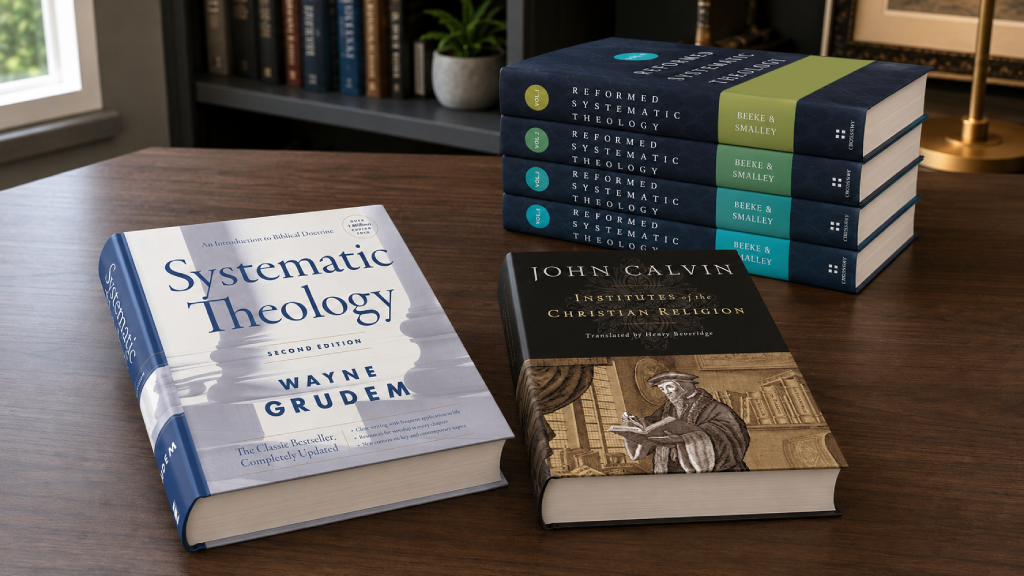
Few kinds of books have helped believers, including myself, understand the breadth, unity, and richness of the whole of Christian doctrine as much as systematic theologies. A good systematic theology gathers and groups together the Bible’s entire teaching on God (theology proper), Scripture (bibliology), creation (cosmology), humanity (anthropology), sin (hamartiology), Christ (christology), salvation (soteriology), the Holy Spirit (pneumatology), the Church (ecclesiology), and the last things/end times (eschatology). It helps us see how these doctrines relate to one another and form one coherent body of truth centered upon the glory of God in Jesus Christ.
No systematic theology is inspired or infallible. Every theologian has limitations, blind spots, and conclusions with which I disagree (and often, I can be wrong myself). These books must always remain subordinate to the authority of Scripture, which alone is the final and unerring authority for Christian faith and practice. Nevertheless, the best systematic theologies serve the church by organizing biblical teaching, answering difficult questions, preserving the wisdom of previous generations, and helping Christians think more carefully about what they believe.
In this article, I am ranking my ten favorite systematic theologies and major works of comprehensive Christian theology. Some are enormous multi-volume works written primarily for scholars and pastors. Others are clear enough to serve ordinary Christians who want to understand their faith more deeply. My rankings reflect what I think is biblical faithfulness and accuracy, theological depth, clarity and readability, pastoral usefulness, accessibility, and the influence each work has had on my own understanding of Christian doctrine.
Keep in mind that I have not read a few of these from cover to cover, as these are generally massive volumes or, as I just mentioned, consist of multiple volumes. These come from my work scouring them across different sections and topics.
I will begin with number ten and work my way toward my favorite.
10. Geerhardus Vos, Reformed Dogmatics
Geerhardus Vos is best known as one of the fathers of modern Reformed biblical theology, but his Reformed Dogmatics shows that he was also a careful and accomplished systematic theologian. The work originated in the form of theological questions and answers, which makes it more concise than many other multivolume works. Vos brings together precise Reformed doctrine and a deep awareness of how God’s revelation unfolds throughout redemptive history. I found it dense and wordy in places, but it mostly rewards careful and patient reading.
9. Charles Hodge, Systematic Theology
Charles Hodge’s three-volume Systematic Theology is one of the defining works of nineteenth-century American Presbyterianism. Hodge possessed a deep confidence in the authority and truthfulness of Scripture, and he worked within the confessional Reformed tradition represented by the Westminster Standards. His discussions are thorough, logically organized, and frequently engage alternative theological positions. Some of the scientific and cultural discussions naturally reflect his century, but the theological substance remains valuable. Hodge gives me a window into the careful, Bible-saturated theology associated with Old Princeton. Overall, even though his Systematic Theology is a long-time classic, I simply thought others did things better in certain areas.
8. Jonathan Edwards, A History of the Work of Redemption
Jonathan Edwards’ A History of the Work of Redemption differs from the other books on this list because it follows the historical unfolding of God’s redemptive plan rather than arranging every doctrine under your typical, traditional systematic categories. Edwards traces the work of redemption from eternity past through creation, the fall, Israel, Christ, the church, and the final consummation. I value it because Edwards helps me see Scripture as one great, unified account of God’s purpose to glorify Himself through Jesus Christ. His theological vision is sweeping, Christ-centered, and filled with confidence in God’s sovereign plan.
7. Francis Turretin, Institutes of Elenctic Theology
Francis Turretin’s Institutes of Elenctic Theology is one of the greatest achievements of seventeenth-century Reformed orthodoxy. “Elenctic” theology refers to theology presented through disputed questions and the careful refutation of error. Turretin states a theological question, distinguishes between possible meanings, presents the opposing arguments, and then builds a precise biblical case for the Reformed position. His method can feel quite demanding to a modern reader (and I had to knock it down on my list a few places because of that), but his distinctions are enormously helpful. When difficult doctrinal questions require more than a quick answer, Turretin often supplies the depth and precision I sometimes need.
6. Herman Bavinck, Reformed Dogmatics
Herman Bavinck’s four-volume Reformed Dogmatics combines confessional Reformed theology with an extraordinary knowledge of Scripture, historical theology, philosophy, and modern intellectual movements. Bavinck understood that Christian truth speaks to every area of life because all reality belongs to God. He engages the church fathers, medieval theologians, Reformers, post-Reformation thinkers, and modern critics while remaining rooted in historic Reformed Christianity. His writing can be very heavy, but it is also beautiful and deeply worshipful. Bavinck shows how rigorous theology can lead the reader toward wonder, praise, and a fuller vision of God’s glory.
5. John M. Frame, Systematic Theology: An Introduction to Christian Belief
John Frame’s Systematic Theology is biblical, practical, readable, and distinctly shaped by the lordship of God. Frame repeatedly examines doctrine through his three perspectives: the normative perspective of God’s authoritative Word, the situational perspective of God’s world, and the existential perspective of the believing person. I do not always find his triperspectival method equally necessary in every discussion, but it often reveals interesting connections other theologians overlook. I absolutely love Frame’s writing; he words things with unusual clarity and crispness, and he continually brings theology back to worship, obedience, ethics, and daily Christian living. Highly recommended.
4. Louis Berkhof, Systematic Theology
Louis Berkhof’s Systematic Theology has become a standard summary of continental Reformed doctrine, and with good reason. It is a powerhouse! Systematic Theology is orderly, concise, confessionally grounded, and surprisingly comprehensive for a single-volume work. Berkhof rarely wastes words. He defines important terms, identifies the main theological questions, summarizes historical positions, and presents the Reformed conclusion in a clear structure. At times, I wish he offered more direct biblical exposition or pastoral application, but that is a minor gripe. When Berkhof “clicks,” this volume is amazing. When I need a dependable overview of the classical Reformed position on a doctrine, Berkhof is one of the two volumes I consult (the other being Beeke’s and Smalley’s, listed below).
3. Wayne Grudem, Systematic Theology: An Introduction to Biblical Doctrine
Wayne Grudem’s Systematic Theology has introduced an enormous number of Christians to the serious study of doctrine. It was my very first systematic theology, so it will always hold a special place in my heart.
I would say that the greatest strength of Grudem’s work is its accessibility. He writes cleanly and clearly, defines an array of theological terminology very well, quotes Scripture extensively, raises practical questions and counter-issues and superbly answers them, and encourages readers to respond to doctrine with worship. I disagree with him on a couple of subjects, including his continuationism and some features of his theology proper, but I still recognize the tremendous usefulness of the work.
Grudem helped demonstrate that systematic theology could be rigorous enough for the classroom while remaining understandable and spiritually profitable for Christians without formal theological training. Many solidly reformed people may not like Grudem’s views, as they take some very baptistitic stances, although being very Calvinistic in its soteriology. That having been said, I think it’s a suitable book for most anyone wanting to take their first deep dive into the topic.
Note: if you’ve never dug into systematic theologies and want something “lighter” to start with, try Wayne Grudem’s Bible Doctrine, Second Edition: Essential Teachings of the Christian Faith. It takes the material from his Systematic Theology, and condenses it down to about half its size.
2. Joel R. Beeke and Paul M. Smalley, Reformed Systematic Theology
Joel Beeke and Paul Smalley’s four-volume Reformed Systematic Theology is a massive contemporary presentation of Reformed doctrine. Beeke writes from the confessional Dutch Reformed tradition and serves as a pastor in the Heritage Reformed Congregations, a denomination rooted in the Three Forms of Unity and strongly influenced by English Puritanism. Smalley comes from a Reformed Baptist background and previously served as a Baptist pastor. Their differing denominational backgrounds become especially evident in their treatment of baptism, where the work presents both the paedobaptist and credobaptist positions. That difference is one of the strong points of their magnum opus, as they work together to “steelman” (the opposite of “strawman”) the positions and try to present them as biblically as they can. Both authors are Calvinistic, committed to Scriptural authority, and are deeply shaped by historic Reformed theology.
The work is marked by rock-solid biblical exposition, awareness of church and theological history, experiential application, and, very importantly, deep pastoral concern. The authors draw heavily from the Reformers, Puritans, Reformed confessions, and Dutch Further Reformation. They continually ask how doctrine should shape the believer’s heart and life. I especially appreciate their conviction that theology should produce reverence, holiness, assurance, and communion with God. This work offers the depth of a major academic theology while retaining the warmth of pastors who want truth to transform the people of God.
If you’re serious about the study of the Bible, this is as fine as you can get for a modern systematic theology. Ask for the full set for Christmas; you won’t go wrong with it.
1. John Calvin, Institutes of the Christian Religion
John Calvin’s Institutes of the Christian Religion remains my favorite work of systematic theology. Calvin combines elements like careful biblical interpretation, theological clarity, and an overwhelming concern for the immeasurable glory of God. He writes about the knowledge of God, Scripture, providence, Christ, justification, sanctification, prayer, the church, and the Christian life with a depth that continues to nourish the church centuries later. Calvin’s theology is never mere intellectual speculation. He wants believers to know God deeply and trust His promises, finding their rest in Christ as they pursue holiness, endure suffering, and live faithfully before God’s face.
The Institutes has influenced nearly every later work of Reformed theology on this list, but its value extends far beyond its historical importance. I continue to return to Calvin because he consistently directs my attention back to the majesty of God, the sufficiency of Christ, the authority of Scripture, and the believer’s complete dependence upon divine grace.
Institutes of the Christian Religion is a “desert island” book, in my top five favorite books and my top five most influential books of all time. This is a must-own work that contains lots of prime, theological “meat,” once you grow beyond sipping on biblical and spiritual milk.
Among all the works listed here, this is the one I would most want to read again from beginning to end.
Other Important Systematic Theologies
The following books did not make my personal top ten, but they remain important works worthy of study. Some are historic classics, while others are influential modern contributions to Baptist, Reformed, or broader evangelical theology.
Petrus van Mastricht, Theoretical-Practical Theology
A. A. Hodge, Evangelical Theology: A Course of Popular Lectures
William Ames, The Marrow of Theology
John Murray, Collected Writings of John Murray
Millard J. Erickson, Christian Theology
Michael Horton, The Christian Faith: A Systematic Theology for Pilgrims on the Way
Robert Letham, Systematic Theology
Robert L. Reymond, A New Systematic Theology of the Christian Faith
William G. T. Shedd, Dogmatic Theology
Wilhelmus a Brakel, The Christian’s Reasonable Service
John Gill, A Body of Doctrinal Divinity
John L. Dagg, Manual of Theology
What Do You Think?
How would you rank these systematic theologies? Which one has most helped you understand Scripture and grow in your knowledge of God? Let me know which books I ranked too high, too low, or left off the list entirely.