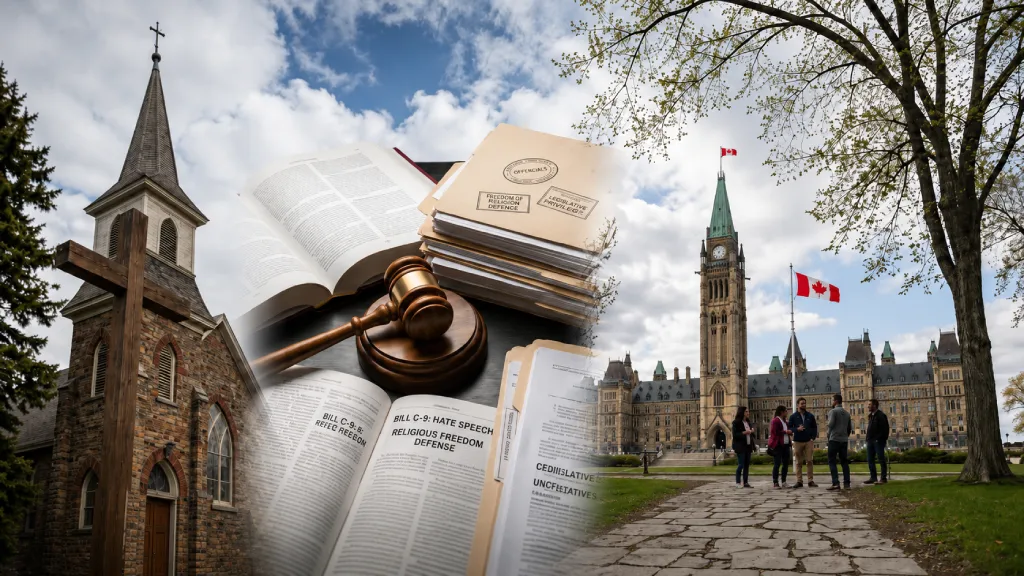
On June 4, 2026, the Canadian Senate Passed the Bill. What Now?
Over the past several years, Canada has witnessed growing debates about hate speech, freedom of expression, religious liberty, and the role of government in regulating public discourse. Those discussions have now culminated in Bill C-9, known as the Combatting Hate Act. While many Christians may have only heard brief comments about the bill online, it is worth taking the time to understand what it is, how it developed, and why many believers, churches, legal organizations, and religious leaders have expressed concern.
What Is Bill C-9?
To be clear, Christians should oppose genuine hatred, violence, intimidation, and discrimination. Scripture teaches us to love our neighbors, pray for our enemies, and treat all people as image-bearers of God. There is no biblical justification for hateful conduct toward others. At the same time, Christians should also care deeply about preserving the freedom to preach, teach, discuss, and defend biblical truth without unnecessary government interference.
The story of Bill C-9 began in September 2025 when the federal government introduced the Combatting Hate Act. The stated purpose of the legislation was to address rising incidents of antisemitism, Islamophobia, and other forms of hate-motivated crime in Canada. Among other things, the bill proposed new Criminal Code offenses related to hate crimes, intimidation, obstruction of access to places of worship and community facilities, and the public display of certain hate symbols. The government argued that existing laws were not sufficient to address growing concerns surrounding hate-motivated activity.
How Did We Get Here?
The bill moved through Parliament during late 2025 and early 2026. On March 25, 2026, it passed third reading in the House of Commons. The Senate then reviewed the legislation throughout the spring.
On June 4, 2026, the Senate passed the bill and returned it to the House of Commons because of a Senate amendment involving the list of prohibited symbols. As of this writing, the legislation has completed nearly all stages of the parliamentary process.
Why Are Christians Concerned?
So why are many Christians concerned?
The primary concern is not that the government is attempting to criminalize Christianity directly. There is no provision in Bill C-9 that says Christians cannot preach the Bible, teach biblical morality, or quote Scripture. Claims that pastors will immediately be arrested for preaching Romans 1 or 1 Corinthians 6 are not supported by the text of the bill.
However, there is another issue that deserves careful attention.
For many years, Canada’s hate speech laws included a specific defense related to religious expression. In simple terms, the Criminal Code contained language recognizing that “good-faith” expressions of religious belief and discussions based on religious texts should receive legal protection. During the legislative process, that protection was removed. Numerous faith groups, legal organizations, and religious leaders urged Parliament to restore or strengthen those protections, but those efforts were ultimately unsuccessful.
This does not mean Christians suddenly lose all constitutional protections. Freedom of religion and freedom of expression remain protected under the Canadian Charter of Rights and Freedoms. Courts have historically recognized those freedoms. Even supporters of the bill have repeatedly stated that reading Scripture, teaching religious doctrine, and expressing sincerely held religious beliefs should not be treated as criminal conduct.
What Could Actually Happen For Canadian Christians?
Nevertheless, many legal experts and religious organizations have argued that removing an explicit religious defense creates uncertainty. Laws are not judged merely by how politicians describe them when they are introduced. They are ultimately interpreted by police, prosecutors, tribunals, judges, and future governments. What concerns many believers is not necessarily how the law will be applied tomorrow morning, but how it could be interpreted five, ten, or twenty years from now.
What might that uncertainty look like in practice? Realistically, the greatest concern is probably not pastors being arrested simply for reading Bible verses from the pulpit. The more likely concern is the possibility of increasing legal scrutiny, investigations, complaints, and court challenges involving biblical teaching on controversial subjects such as sexuality, marriage, gender identity, and human sinfulness. Even if churches or pastors ultimately prevail in court, the process itself can be costly, time-consuming, and intimidating. Legal battles often become a punishment of their own, requiring significant financial resources and years of litigation.
Christians are also concerned about the gradual expansion of legal definitions over time. Throughout history, many laws have begun with broad public support directed at clearly harmful behavior, only to see their application widened through judicial rulings and evolving cultural standards. What one generation understands as protected religious teaching may be viewed differently by a future government, tribunal, or court. The removal of explicit religious protections does not automatically create persecution, but it does leave a lot more room for future interpretation than many faith communities would prefer.
Could Christians face fines, restrictions, or even criminal prosecution in the future? The honest answer is that nobody knows with certainty. Under Canada’s constitutional framework, religious freedom remains protected, and any attempt to directly criminalize historic Christian doctrine would almost certainly face serious legal challenges. However, concerns remain that certain forms of public speech, publications, online content, counseling practices, or ministry activities could increasingly become the subject of complaints, investigations, regulatory actions, or litigation. For many believers, the issue is less about what the government intends today and more about whether sufficient safeguards remain in place to protect religious liberty as cultural and political winds continue to shift.
History reminds us that freedoms are often lost slowly rather than suddenly. Few restrictions begin with dramatic announcements. The “slippery slope” often begins very, very gradually. More often, legal boundaries shift incrementally over time through court decisions, administrative rulings, and changing cultural assumptions. Christians, therefore, have legitimate reasons to monitor developments carefully while avoiding exaggerated claims.
Lessons from History
It is also important to remember that the church has faced legal and cultural pressure throughout its history. The apostles preached under governments that were often hostile to Christianity. The early church grew under the Roman Empire. Believers throughout history have faithfully proclaimed Christ in environments far less friendly than modern Canada.
That perspective helps us maintain balance.
How Should Christians Respond?
On the one hand, Christians should not panic. God remains sovereign. The Gospel is not dependent upon government approval. The Word of God has survived emperors, dictators, persecutions, and countless attempts to silence it. No act of Parliament can change that reality.
On the other hand, Christians should not be indifferent. We should stay informed. We should support organizations that defend religious liberty. We should respectfully engage elected officials. We should pray for our leaders as Scripture commands. And we should understand that freedom of religion is a precious gift that should not be taken for granted.
Perhaps the greatest lesson from Bill C-9 is that Christians must be prepared to speak the truth with both courage and grace. Our calling has never been merely to preserve cultural influence or legal protections. Our calling is to faithfully proclaim Christ regardless of whether the culture applauds or opposes us.
Canada may be entering a period where biblical convictions increasingly conflict with prevailing cultural values. If that happens, the answer is not fear, anger, or retreat. The answer is the same response Christians have always needed: conviction rooted in Scripture, wisdom guided by the Holy Spirit, love toward our neighbors, and unwavering confidence in the Lord Jesus Christ.
Bill C-9 deserves our attention. It deserves thoughtful scrutiny. It deserves prayerful consideration. But above all, it should remind us that our ultimate hope has never rested in Parliament, courts, political parties, or legislation. Our hope rests in Christ alone.