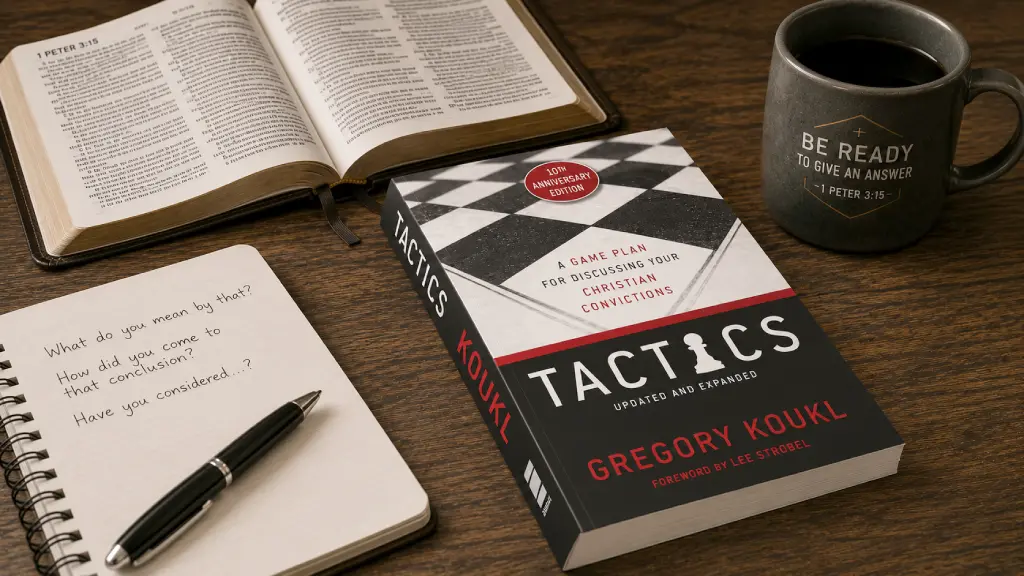
I consider Greg Koukl’s Tactics to be one of the ten best Christian books available, and that every believer own a copy. Below are several reasons why.
More than ten years ago, I sat in a classroom at Central Presbyterian Church in Clayton, Missouri, learning a way of engaging people that permanently changed how I think about evangelism. The course was taught by Jeremy Smith of ReThink315, and it introduced me to Greg Koukl‘s book Tactics. I had read books on apologetics before. I had studied arguments for the existence of God, the reliability of Scripture, and the resurrection of Christ. Those things were important, but this course gave me something different. It taught me how to have conversations.
That distinction matters.
Many Christians know what they believe, but they struggle to communicate those beliefs in everyday conversations. Others become intimidated because they think evangelism requires debating like a philosopher or memorizing hundreds of answers to difficult questions. Greg Koukl’s approach removes much of that fear by teaching Christians to become thoughtful question-askers instead of anxious speech-makers.
To this day, Tactics remains one of my top ten favorite Christian books of all time. In fact, I think every Christian should own a copy, read it carefully, and revisit it regularly. If you want to become more confident sharing your faith without becoming argumentative, this is one of the best resources available.
The Goal Is Not Winning Arguments
One of the biggest lessons I learned from Koukl is that apologetics is not primarily about defeating opponents. It is about helping people think.
That may sound obvious, but many of us unknowingly approach difficult conversations like courtroom battles. We feel pressure to produce the perfect answer, dismantle every objection, and somehow convince the other person before the conversation ends.
But real life rarely works that way. People usually don’t change their minds because someone overwhelmed them with information. They change because the Holy Spirit uses truth to reshape their thinking over time. Our responsibility is to faithfully present Christ, answer honestly, ask thoughtful questions, and leave the results to God.
That perspective takes enormous pressure off the Christian. I don’t have to know everything. I don’t have to answer every objection immediately. I simply need to be faithful, gracious, and wise.
Jesus Frequently Asked Questions
One of the reasons Koukl’s approach resonates so strongly with me is because it reflects the ministry of Jesus Himself. When you read the Gospels carefully, you notice that Jesus regularly answered questions with questions. He did not do this to avoid the truth. He did it because questions force people to think.
When someone asked Him about paying taxes, Jesus asked whose image was on the coin.
When His disciples worried about His teaching, He questioned them.
When people were wondering about aspect of the Law and of faith, Jesus queried them to draw out information and reasoning from them.
When religious leaders tried to trap Him, He often responded with carefully chosen questions that exposed the assumptions behind their arguments.
Jesus knew that people often arrive at truth more deeply when they are forced to examine what they actually believe. Questions reveal motives. Questions expose contradictions. Questions uncover hidden assumptions. Questions invite conversation instead of immediately creating conflict.
This doesn’t mean Jesus never made bold statements. He certainly did. He proclaimed Himself to be the Son of God, the Messiah, and the only way to the Father.
But throughout His earthly ministry, thoughtful questions were one of His favorite teaching tools. In fact, in the four Gospels, Jesus asked over 200 questions of other people.
Christians should not underestimate the power of asking good questions.
The Columbo Tactic
The best-known principle in Tactics is what Greg Koukl calls the “Columbo Tactic,” named after the classic television detective Lieutenant Columbo. If you’ve ever watched the show, you know Columbo wasn’t loud, aggressive, or intimidating. In fact, he often appeared almost absent-minded and even slightly bumbling.
But behind that humble demeanor was a sharp mind that patiently uncovered the truth by asking thoughtful questions. Instead of accusing people or making long speeches, he simply kept asking one question after another until inconsistencies began to surface. Koukl recognized that this same approach can be incredibly effective in gospel conversations.
The first question is remarkably simple: “What do you mean by that?” At first glance, it almost seems too basic to matter, but I’ve found it to be one of the most valuable questions a Christian can ask. People regularly make sweeping statements about God, Christianity, morality, or truth without ever defining what they actually mean. Someone might say, “All religions basically teach the same thing,” or “The Bible has been changed so many times that nobody knows what it originally said.” Rather than immediately trying to correct them, ask what they mean. Ask them to fill in some more details and explain their claim. You may discover that they haven’t really thought through what they’re saying, they haven’t applied logic to it, or you may realize you’ve misunderstood them. Either way, the conversation becomes clearer before anyone starts offering answers.
The second question follows naturally: “How did you come to that conclusion?” This is one of my favorite questions because it gently shifts the burden of explanation back to the person making the claim. We live in a culture where people often repeat ideas they’ve heard online on social media, in college classrooms, or on TV without ever examining whether those ideas are actually true. Asking how they arrived at their conclusion isn’t hostile; it’s respectful. It communicates that you’re genuinely interested in understanding their reasoning. Sometimes you’ll discover there’s solid thought behind their position. Other times you’ll find that the belief rests almost entirely on assumptions, emotions, or something they heard years ago and simply accepted without question.
Then comes the third Columbo question: “Have you considered…?” This is where you begin introducing truth into the conversation without turning it into a lecture. Instead of saying, “You’re wrong, and here’s why,” you invite the other person to think about something they may never have considered before. “Have you considered that objective moral standards point to a moral Lawgiver?” “Have you considered what it would mean if Jesus really did rise from the dead?” “Have you considered whether your standard for judging God assumes an objective standard of justice?” Questions like these don’t force people into a corner. They invite reflection. They plant seeds that the Holy Spirit may continue watering long after the conversation has ended.
What I appreciate most about this approach is that it removes so much of the pressure Christians often feel in evangelism. Many believers are terrified they’ll be asked a question they can’t answer. Koukl’s method reminds us that we don’t have to carry every conversation by ourselves. Good questions slow the discussion down, help us understand the other person’s thinking, and often reveal that the issue isn’t as complicated as it first appeared. Instead of scrambling for the perfect response, we can patiently explore what the other person actually believes and why.
Gathering Information Before Giving Answers
One of Koukl’s recurring themes throughout the book is the importance of gathering information before attempting to answer objections. That may sound like common sense, but it’s surprisingly easy to skip this step. We’ve all had conversations where we assumed we knew what someone meant, only to discover several minutes later that we had been answering a completely different question. Asking good questions prevents that mistake.
I’ve found this especially helpful because not every objection to Christianity is really an intellectual objection. Sometimes people raise philosophical questions because they’re masking something much deeper. A person who says, “I don’t believe God exists,” may actually be wrestling with suffering, hurt, disappointment, or anger over something that happened years ago.
For instance, I’ve run across at least five atheists who have told me, after some conversation, that they have a negative view of fathers. They could have had an abusive dad, and they projected that tarnished view of a father onto God; therefore, they rejected Him. It ultimately had nothing or little to do with a perceived lack of evidence for a divine being.
Someone who claims the Bible is full of contradictions may have been deeply wounded by hypocrisy inside a church.
If we immediately launch into apologetic arguments without first listening carefully, we may miss the real issue entirely.
Jesus never treated people like projects. He dealt with individuals, and He often asked questions that exposed what was happening in their hearts before addressing their theological misunderstandings. That alone should encourage us to slow down. Evangelism isn’t about delivering the same speech to every person we meet. It’s about faithfully pointing individuals to Christ, and that requires listening as much as speaking.
Putting a Stone in Their Shoe
Another illustration from Tactics that has stayed with me over the years is Koukl’s idea of “putting a stone in someone’s shoe.” The point isn’t to annoy people or intentionally make them uncomfortable. Rather, it’s the recognition that a thoughtful question can stay with someone long after the conversation is over. Just as a small rock or pebble in your shoe is difficult to ignore when you’re walking, a carefully placed question can continue working in someone’s mind for days, weeks, or even years.
I’ve experienced this firsthand. Some of the most meaningful conversations I’ve had about Christianity didn’t end with someone immediately embracing the Gospel. In fact, many of them ended with both of us simply walking away to think.
Looking back, I realize that God often works that way. We faithfully speak the truth, ask thoughtful questions, and trust the Holy Spirit to continue His work after the conversation has ended. We don’t always get to see the harvest, but we can still be faithful in planting seeds.
That perspective has been freeing for me. I don’t measure the success of a conversation by whether someone changes their mind on the spot before we part ways. Instead, I ask whether I represented Christ well, spoke the truth in love, and left them with something worth considering. Sometimes that’s exactly what God intends for that particular moment. That is planting the seeds, and remember that it is the Holy Spirit’s job to work in someone’s heart.
Taking the Roof Off
Koukl also describes a tactic he calls “taking the roof off.” The image is memorable because every worldview offers people a kind of shelter. It promises comfort, security, or an explanation for life. But many false worldviews cannot actually support the weight they’re asked to carry. By asking thoughtful questions, we can sometimes expose those weaknesses without becoming argumentative.
For example, someone may insist that morality is entirely subjective and that no one has the right to judge another person’s actions. Rather than immediately arguing against that position, you might simply ask whether that principle also applies to genocide, human trafficking, or the abuse of children. If morality is truly nothing more than personal preference, then on what basis can any action be universally condemned? The purpose of the question isn’t to embarrass the other person. It’s to help them recognize that their worldview may not be internally consistent.
This is one of the strengths of Koukl’s approach. Instead of trying to bulldoze someone with information, he encourages Christians to help people examine whether their own beliefs can withstand careful scrutiny. Often they discover the weaknesses themselves, and lessons we discover on our own tend to stay with us much longer than lessons someone merely lectures us about.
Don’t Make Their Argument Better Than They Can
One principle from Tactics that I’ve never forgotten is Koukl’s advice not to make another person’s argument stronger than they can make it themselves. Christians sometimes have the habit of rescuing weak objections. Someone throws out a vague accusation against Christianity, and before they can even explain it, we begin filling in the details, clarifying the objection, and strengthening their case for them. Koukl wisely reminds us not to do that.
We can find ourselves stuttering around, saying things like, “yeah, that’s true…” and trying to be agreeable, maybe thinking that if we are on the same side as our opponents, they’ll like us. Or we can automatically assume that what they are saying is factual and buy into their premise.
Instead, ask questions. If someone claims the Bible is full of contradictions, ask which contradiction they’re referring to. If they insist science has disproved God, ask what scientific discovery they have in mind. If they believe Christians are intolerant, ask what definition of tolerance they’re using. Those questions aren’t evasive. They’re simply asking people to explain and defend the claims they’ve already chosen to make.
I’ve found that many objections begin losing their force once someone has to articulate them carefully. Sometimes people realize they don’t actually know why they believe what they believe. Other times they recognize that their criticism depends on assumptions they’ve never examined. Either outcome creates an opportunity for a much more meaningful conversation.
A Better Way to Think About Evangelism
Perhaps the greatest contribution Tactics has made to my own life is that it changed how I think about evangelism altogether. I no longer view evangelism (or even just talking about issues like morality, abortion, or the LGBTQ+ movement) as giving polished speeches or winning debates. Instead, I see it as entering thoughtful conversations with people who bear God’s image and desperately need the gospel. That shift has made me a better listener, a more patient communicator, and, I hope, a more faithful witness.
None of this minimizes the importance of knowing Christian doctrine or studying apologetics. We should be prepared to give a reason for the hope that is within us, just as Peter commands in 1 Peter 3:15. But Peter doesn’t stop there. He also tells us to do so “with gentleness and respect.” Koukl’s methodology in Tactics helps Christians obey both parts of that verse. It encourages us to know the truth while also communicating it with humility, wisdom, and genuine love for the person sitting across from us.
If you’ve never read Tactics, I sincerely hope you’ll pick up a copy. It has been one of the most influential books I’ve ever read on evangelism and apologetics, and more than a decade after first learning these principles at Central Presbyterian Church through Jeremy Smith and ReThink315, I still find myself using them regularly. Few books have shaped my conversations as much as this one has. It remains one of my top ten favorite Christian books of all time, and I genuinely believe every Christian would benefit from owning it, studying it, and putting its principles into practice.
Our world doesn’t need more shouting matches. It needs Christians who know the truth, love people well, ask thoughtful questions, and faithfully point others to the Lord Jesus Christ with every conversation.