Which Christians Are Saved?
Which Christian denominations believe in the doctrine of justification by faith alone? More than many people realize. Confessional Lutherans, Reformed and Presbyterian churches, many Baptists, historic Congregationalists, evangelical Anglicans, Methodists and Wesleyans, many Pentecostals, and a wide range of evangelical free and non-denominational churches have all confessed, in one form or another, that God justifies sinners through faith in Jesus Christ apart from their works.
These churches disagree on many important matters. They differ over baptism, the Lord’s Supper, church government, spiritual gifts, election, the security of the believer, and the relationship between the old and new covenants. Those disagreements should not be treated as meaningless. Yet on the question of how a guilty sinner can be declared righteous before a holy God, these Protestant traditions have historically shared a remarkable measure of agreement.
This doctrine is commonly expressed by the Latin phrase sola fide, meaning “faith alone.” It was one of the defining truths recovered and defended during the Protestant Reformation. It remains an essential dividing line because it concerns the very heart of the Gospel: What is the ground of our acceptance before God, and how do we receive it?
What Is Justification?
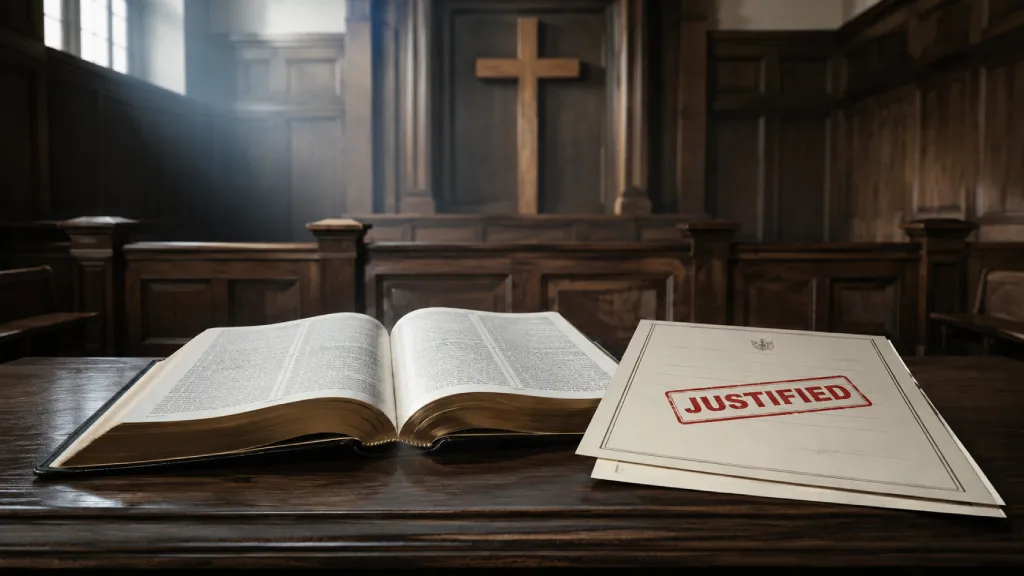
Justification is God’s judicial declaration that a believing sinner is righteous in His sight. God forgives the believer’s sins and credits the righteousness of Jesus Christ to him. Justification does not mean that God pretends a guilty person has never sinned. It means that the believer’s guilt was truly borne by Christ and that Christ’s perfect righteousness is truly counted as the believer’s own.
“For we hold that one is justified by faith apart from works of the law.” (Romans 3:28)
The ground of justification is not the moral worth of our faith. Faith is not a good deed that earns God’s favor. The ground is Christ alone: His sinless life, substitutionary death, and triumphant resurrection. Faith is the empty hand that receives Christ and His righteousness.
Paul makes the contrast unmistakable: “And to the one who does not work but believes in him who justifies the ungodly, his faith is counted as righteousness” (Romans 4:5). God does not justify people after they have made themselves godly enough to deserve it. He justifies the ungodly who abandon every claim of personal merit and trust in Christ.
Faith Alone Does Not Mean a Faith That Remains Alone
Justification by faith alone does not teach that obedience is unnecessary or that a person may profess faith while remaining peacefully devoted to sin. Scripture teaches that we are justified apart from works, while also teaching that genuine faith produces works. Good works are the fruit and evidence of salvation, not its cause, basis, or instrument.
“For by grace you have been saved through faith. And this is not your own doing; it is the gift of God, not a result of works, so that no one may boast. For we are his workmanship, created in Christ Jesus for good works, which God prepared beforehand, that we should walk in them.” (Ephesians 2:8-10, emphasis added)
That order matters. We are not saved by good works, but we are saved for good works. James condemns a dead profession that produces no obedience (James 2:14-26). Paul condemns reliance upon works as a means of justification (Galatians 2:16). The apostles do not contradict one another. Paul addresses how sinners are declared righteous before God, while James exposes the emptiness of a claim to faith that bears no fruit.
Lutheran Churches
Confessional Lutheranism has historically stood firmly upon justification by faith alone. Article IV of the Augsburg Confession teaches that people cannot be justified before God by their own strength, merits, or works, but are freely justified for Christ’s sake through faith. The Lutheran confessions also insist that living faith produces good fruit, while denying that those works merit justification.
This doctrine was central to Martin Luther’s preaching and to the Lutheran Reformation. Although Lutherans differ from Reformed Christians on the sacraments, election, and other doctrines, confessional Lutheranism plainly rejects human merit as the basis of justification.
Reformed and Presbyterian Churches
Reformed and Presbyterian churches strongly affirm justification by faith alone. The Westminster Confession of Faith says that God justifies sinners by pardoning their sins and accounting them righteous for Christ’s sake. It identifies faith as the “alone instrument of justification” and teaches that Christ’s obedience and satisfaction are imputed to believers.
This is one of the clearest features of Reformed theology. The believer’s confidence rests outside himself. His assurance is not grounded in the quality of his works, the intensity of his emotions, or his success in sanctification. His acceptance rests upon the finished work and perfect righteousness of Jesus Christ.
Baptist Churches
Many Baptist denominations and associations clearly teach justification by faith alone. The Second London Baptist Confession of 1689 says that faith, receiving and resting upon Christ and His righteousness, is the alone instrument of justification. The Southern Baptist Convention has likewise officially affirmed the imputation of Christ’s righteousness by grace alone through faith alone in Christ alone, without the addition of good works or human effort.
Baptist churches are congregationally governed and doctrinally diverse, so the Baptist name by itself does not guarantee theological faithfulness. Nevertheless, justification through faith apart from works has been a major conviction within historic and evangelical Baptist theology.
Anglican Churches
Historic Anglican doctrine also confesses justification by faith alone. Article XI of the Thirty-Nine Articles says that we are accounted righteous before God only for the merit of Jesus Christ, by faith, and not for our own works or deserving. It calls justification by faith alone a wholesome and comforting doctrine.
Modern Anglicanism contains wide theological diversity, and some provinces and congregations have departed considerably from historic Protestant teaching. Evangelical Anglicans, however, continue to uphold the Reformation doctrine expressed in the Articles.
Methodist and Wesleyan Churches
Historic Methodism also teaches justification by faith. John Wesley preached that sinners are justified through faith in Christ and not because of works performed before or after conversion. The United Methodist Articles of Religion still state that we are accounted righteous only for Christ’s merit, by faith, and not for our own works or deserving. The Wesleyan Church says even more explicitly that justification is “by faith alone, not on the basis of works.”
Methodists and Reformed Christians disagree significantly about election, prevenient grace, the possibility of apostasy, and entire sanctification. Those disagreements should be acknowledged. Even so, historic Wesleyan theology does not teach that our works earn initial justification before God.
Congregational, Pentecostal, and Independent/Non-Denominational Evangelical Churches
Historic Congregationalists inherited the Reformation’s doctrine of justification and expressed it in confessions such as the Savoy Declaration. Many Pentecostal denominations also teach that salvation is received through repentance and faith in Christ rather than earned by human works. Evangelical Free churches, Bible churches, and many non-denominational congregations commonly confess the same truth.
Here especially, labels must be used carefully. “Non-denominational” tells us little by itself, and churches that share a label may teach very different doctrines. A church’s actual statement of faith, preaching, and practice must be examined. The right question is not merely what name appears on the sign, but what that church teaches about Christ, grace, faith, works, and the sinner’s acceptance before God.
Who Rejects Justification by Faith Alone?
The Roman Catholic Church officially rejects the Protestant doctrine of justification by faith alone. Rome correctly says that grace originates with God and that no one can merit the initial grace of conversion. Yet its system describes justification as involving inner renewal, ordinarily grants it through baptism, and teaches that believers, moved by grace, can merit an increase of grace and the attainment of eternal life. This differs fundamentally from the biblical and Reformation doctrine of a once-for-all forensic declaration grounded entirely in Christ’s righteousness and received through faith alone.
Eastern Orthodoxy likewise rejects sola fide and generally speaks of salvation as a lifelong process of transformation and union with God in which faith, works, sacraments, and human cooperation with divine grace belong together. Orthodox writers may affirm that salvation is by grace and that genuine faith must be living, but they do not confess the Reformation understanding of justification as the imputation of Christ’s righteousness received through faith alone.
Some groups arising from the Restorationist tradition also deny justification by faith alone, commonly making water baptism a condition that must be fulfilled in order to receive the forgiveness of sins. Therefore, we cannot simply divide the issue between people who call themselves Protestant and everyone else. Each church’s actual doctrine must be tested by Scripture.
Does This Mean Every Catholic or Orthodox Person Is Unsaved?
We should speak with both courage and precision. The official Roman Catholic and Eastern Orthodox systems do not teach the biblical doctrine of justification by faith alone. Any person who relies upon personal merit, sacramental participation, religious performance, or cooperation with grace as part of the basis for his acceptance before God is relying upon a false gospel. Paul warned that adding works of the law to faith as the means of justification severs a person from the principle of grace (Galatians 5:2-4).
At the same time, only God knows every individual heart. A person may belong to a church whose official teaching is seriously wrong while personally resting in Christ alone, perhaps inconsistently with that church’s doctrine. We should not pronounce infallibly upon every person merely from a denominational label. We can and must judge doctrine by Scripture, clearly warn against false gospels, and call every person to abandon self-reliance and trust in Jesus Christ alone.
Why Justification by Faith Alone Matters
If our right standing before God depends in any measure upon our own merit, none of us has hope. God’s standard is not that we become slightly better than our neighbors. His standard is perfect righteousness. “For all have sinned and fall short of the glory of God” (Romans 3:23). Even our best deeds cannot erase past guilt, satisfy divine justice, or produce the spotless righteousness God requires.
“Now it is evident that no one is justified before God by the law, for ‘The righteous shall live by faith.'” (Galatians 3:11)
The Gospel directs us away from ourselves and toward Christ. Jesus lived the righteous life we failed to live. He obeyed the Father perfectly. On the cross He bore the wrath deserved by His people, and on the third day He rose bodily from the grave. His resurrection publicly vindicated His person and work and guarantees the final salvation of everyone united to Him by faith.
“Therefore, since we have been justified by faith, we have peace with God through our Lord Jesus Christ.” (Romans 5:1)
This is why justification by faith alone brings such deep comfort. The Christian’s peace with God does not rise and fall with today’s spiritual performance. Our works remain imperfect, but Christ’s righteousness is perfect. Our grip may feel weak, but the Saviour in whom we trust is mighty. The believer can obey God from acceptance rather than laboring to earn acceptance.
The Good News
Salvation is not a wage paid to those who have worked hard enough. And it certainly is not the “default” place where people go to after they die. It is a gift granted to the undeserving because Jesus Christ has accomplished everything necessary to save His people. Repent of your sin, renounce every claim of personal goodness, and trust wholly in Christ.
Christ lived the life we owed. Christ died the death we deserved. Christ rose from the grave in victory. Everyone who turns from sin and rests in Him is freely and fully justified. By grace alone. Through faith alone. In Christ alone. To the glory of God alone!
Historic doctrinal sources: Augsburg Confession, Article IV; Westminster Confession of Faith, Chapter 11; Second London Baptist Confession, Chapter 11; Thirty-Nine Articles, Article XI; United Methodist Articles of Religion, Article IX; The Wesleyan Church Articles of Religion, Article 12; Catechism of the Catholic Church, paragraphs 1987-2029.