Caleb (along with his contemporary Joshua) has long been one of my favorite characters in the Bible. Caleb wasn’t a king, a prophet, or a priest, and Scripture does not record long speeches or dramatic miracles performed through him. What makes Caleb so memorable is the rock-solid, wholehearted faith that marked him across the decades in which Scripture chronicles his actions. When nearly an entire nation surrendered to fear, Caleb believed in God instead. When the fulfillment of God’s promise was delayed for forty-five years, Caleb kept believing. When most men his age would have been looking for an easier road, Caleb was still ready to obey.
His life raises a question every Christian man should eventually ask himself: what kind of man will I be after decades of walking with God? Will years of hardship make me bitter, cautious, and spiritually passive, or will they deepen my faith and strengthen my resolve? Caleb shows us what it looks like when a man grows older without allowing his confidence in God to grow weak.
Caleb, the Godly Example
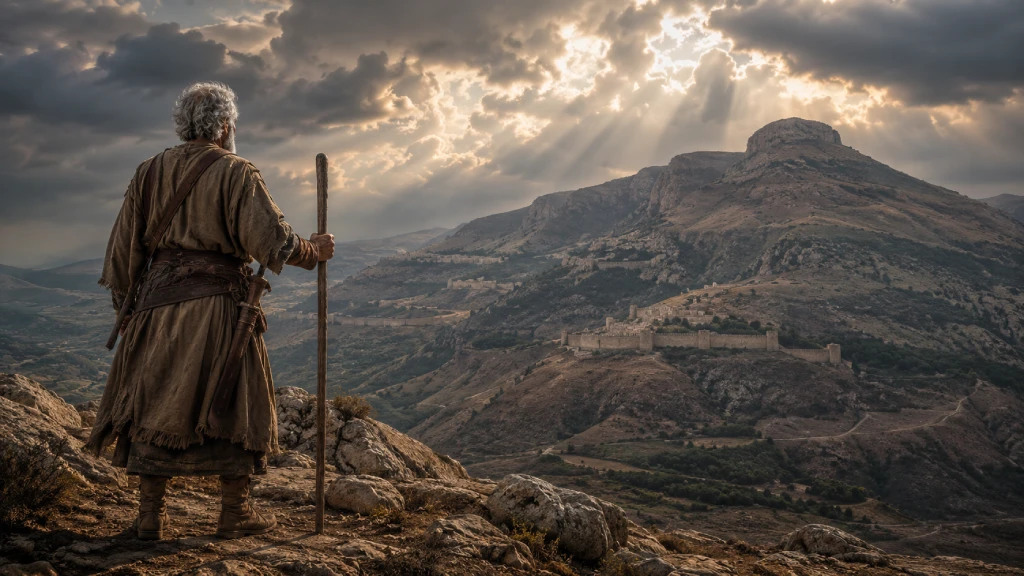
There is something deeply compelling about an eighty-five-year-old man asking for a mountain full of giants.
By the time Caleb appears in Joshua 14, he has already lived a long life. He has walked through the wilderness, watched an entire generation die, crossed the Jordan River, and seen God give Israel victory in Canaan. He has waited forty-five years for the inheritance God promised him, yet he does not approach Joshua asking for an easy place to settle down. He does not request a quiet corner of the land where he can avoid conflict and spend his remaining years in comfort.
Instead, Caleb says, “So now give me this hill country that the Lord promised me on that day, because you heard then that the Anakim are there, as well as large fortified cities. Perhaps the Lord will be with me and I will drive them out as the Lord promised” (Joshua 14:12).
Caleb is eighty-five years old, and he is still thinking about promises to believe, enemies to confront, land to possess, and work to finish.
There is a lesson here for every Christian man, regardless of age. Young men need Caleb because they need a vision of manhood that reaches beyond youthful energy and early success. Middle-aged men need Caleb because this is often the season when disappointment, exhaustion, and accumulated responsibilities begin to wear down their resolve. Older men especially need Caleb because our culture often tells them that their most meaningful years are behind them.
The Bible gives us a much better picture. A man may grow older without becoming spiritually weaker. His body may slow down, while his faith grows stronger. His role may change, but his usefulness to the kingdom of God does not have to disappear.
Psalm 92:14 describes the righteous by saying, “They will still bear fruit in old age, healthy and green.” The passing of years does not place a faithful man beyond the reach of meaningful service. God can continue producing fruit through him for as long as He gives him breath.
Caleb Had Been Faithful for a Long Time
Caleb did not suddenly become courageous at eighty-five. His request for Hebron was the mature fruit of convictions he had carried for decades.
Forty-five years earlier, Moses sent twelve men into Canaan to spy out the land. All twelve saw the same fields, the same cities, the same fortifications, and the same descendants of Anak. Ten of the spies concluded that Israel could not take the land. They said the people were stronger than Israel and described themselves as grasshoppers in comparison.
Caleb looked at the same obstacles and reached a different conclusion. He quieted the people before Moses and said, “Let’s go up now and take possession of the land because we can certainly conquer it!” (Numbers 13:30).
The difference was not that Caleb had better eyesight. He saw the giants. He understood that the cities were fortified. He knew the task would be difficult. Caleb simply believed that the presence and promise of God mattered more than the apparent strength of the enemy.
That kind of faith does not usually appear out of nowhere in old age. It is cultivated through years of obedience. The eighty-five-year-old Caleb was still living from the same basic conviction that guided him at forty: if God has promised something, His people can trust Him enough to obey.
Many men hope to become spiritually strong later, but they do very little to cultivate strength now. They assume maturity will arrive automatically with birthdays. Yet age by itself does not produce wisdom, courage, self-control, or holiness. An undisciplined young man can become an undisciplined old man. A bitter middle-aged man can become a bitter elderly man. Time often deepens the patterns we have already formed.
This is why the daily habits of the Christian life matter so much. The man who reads Scripture today is preparing himself to stand on God’s promises tomorrow. The man who prays through ordinary pressures is learning how to pray when a genuine crisis comes. The man who keeps small commitments is becoming the kind of person who can be trusted with larger responsibilities.
The psalmist says, “I have treasured your word in my heart so that I may not sin against you” (Psalm 119:11). Scripture stored in the heart during ordinary days becomes strength when the difficult day arrives.
Caleb’s courage at eighty-five had roots stretching back more than four decades. He had been learning to trust God for a very long time.
Caleb Refused to Let Other Men’s Unbelief Control Him
Caleb’s faith is even more remarkable when we remember how isolated he was. Of the twelve spies, only Caleb and Joshua believed that Israel should enter the land. The other ten men spread fear throughout the camp, and the congregation responded with panic, anger, and rebellion.
Caleb stood against the overwhelming opinion of the crowd. He did not change his convictions simply because the majority disagreed with him. He did not surrender the truth because unbelief had become popular.
Numbers 14 tells us that Caleb had “a different spirit” and followed the Lord completely. That does not mean Caleb was stubborn for the sake of being different. There is nothing godly about a man who opposes everyone merely because he enjoys conflict. Caleb’s spirit was different because his confidence was fixed upon God rather than public opinion.
Christian men need this same courage today. We live in a culture that exerts enormous pressure upon men to soften biblical convictions, especially when those convictions concern marriage, sexuality, fatherhood, church leadership, the sanctity of life, or the exclusivity of Christ. A man may know what Scripture teaches, yet become hesitant when obedience threatens his reputation, career, friendships, or comfort.
The pressure can also come from within the church. A man may be urged to ignore a serious problem because addressing it would be awkward. He may be expected to remain silent while false teaching spreads or while destructive behaviour is excused. He may find that careful biblical conviction is less popular than keeping everyone comfortable.
Caleb reminds us that the truth does not become less true when fewer people believe it. Faithfulness sometimes requires a man to stand with a small minority, speak carefully but clearly, and accept the consequences of obedience.
The apostles faced that same choice when authorities commanded them to stop preaching Christ. Peter and the apostles answered, “We must obey God rather than people” (Acts 5:29). That remains the governing principle whenever human approval and divine obedience come into conflict.
This does not give Christian men permission to become quarrelsome or arrogant. Caleb’s courage was rooted in faith, not ego. He wanted Israel to enter the land because God had promised it, not because Caleb wanted to prove that he was braver than everyone else.
The modern equivalent is a man who knows when to stand firm without turning firmness into a performance. He does not need to broadcast every disagreement, yet he refuses to betray Scripture when the moment for courage arrives.
Caleb Remembered God’s Promise for Forty-Five Years
One of the most striking features of Joshua 14 is how clearly Caleb remembers what God had said. He tells Joshua, “You know what the Lord promised Moses the man of God at Kadesh-barnea about you and me” (Joshua 14:6).
Forty-five years had passed, but the promise remained alive in Caleb’s mind.
Think about how much had happened during those years. Caleb had watched Israel rebel. He had endured decades in the wilderness because of the unbelief of other people. He had seen friends, neighbours, and fellow soldiers die. He had experienced delay that was not caused by his own disobedience.
Caleb could have become bitter. He could have spent those years thinking about how unfair it was that he had to suffer alongside a faithless generation. He could have concluded that too much time had passed and that the promise was no longer realistic.
Instead, he remembered what the LORD God had said.
There are Christian men nowadays who begin well but gradually allow disappointment to erode their confidence in God. They prayed for a certain outcome, but God answered differently. They served in a church and were wounded by people they trusted. They tried to lead their family faithfully, yet one of their children wandered. They entered marriage with hopes that were not fulfilled in the way they expected.
After enough disappointment, a man can begin living defensively. He still believes Christian doctrine, but he no longer expects much from obedience. He becomes cautious about sacrifice because he does not want to be hurt again.
Caleb shows us that waiting and faithfulness belong together. He did not interpret God’s delay as God’s failure. He continued to believe the promise, even when its fulfillment required decades of patience.
Hebrews 10:23 calls believers to this same endurance: “Let us hold on to the confession of our hope without wavering, since he who promised is faithful.” Our confidence rests in the character of the One who made the promise.
This does not mean every personal dream will come true if we wait long enough. Caleb was holding onto a specific promise God had given. Christian faith is not confidence that God will fulfill every ambition we develop. It is confidence that God will keep everything He has truly promised in His Word.
The older Christian man may have seen many hopes disappointed, yet he possesses promises that cannot fail. Christ will build His church. God will complete the work He began in His people. Nothing can separate believers from the love of God in Christ. The dead in Christ will rise. Every act of service done for the Lord has eternal significance.
A man with those promises can keep going.
Caleb Did Not Use His Age as an Excuse
Caleb says something remarkable in Joshua 14: “I am still as strong today as I was the day Moses sent me out. My strength for battle and for daily tasks is now as it was then” (Joshua 14:11).
We should not turn this statement into a promise that every faithful Christian will retain unusual physical strength into old age. Scripture is honest about the decline that often accompanies aging. Ecclesiastes 12 describes failing eyesight, trembling limbs, diminished hearing, and the weakening of the body. Paul referred to his own outward person as wasting away.
Caleb’s physical strength at eighty-five was an extraordinary gift of God. Yet his words also reveal something about his attitude. He was not searching for a reason to step back from obedience. He was looking for the work God had prepared for him.
Our culture teaches people to view retirement as the point when personal comfort becomes the central goal of life. After decades of employment, a man is told that he has earned the right to spend the rest of his life amusing himself. He may still attend church, but the assumption is that significant responsibility now belongs to younger people.
The Bible never presents age as a stage in which a believer graduates from usefulness. Roles change, physical capacity changes, and wisdom requires us to recognize genuine limitations. An older man may no longer be able to carry the same workload he once did. He may need more rest, greater assistance, and a different pace.
Yet he can still pray. He can still encourage. He can still teach. He can still disciple younger men. He can still love his wife, serve his church, support gospel work, speak wisdom, model perseverance, and show the next generation how a Christian faces aging and death.
Moses was eighty when God sent him to confront Pharaoh. Anna served God in the temple well into old age, worshipping with fasting and prayer. Simeon spent his later years waiting for the consolation of Israel and was ready to recognize Christ when others did not. The apostle John appears to have continued strengthening the churches as an elderly man.
The prayer of Psalm 71 expresses the heart of a man who still wants to be useful late in life: “Even while I am old and gray, God, do not abandon me, while I proclaim your power to another generation” (Psalm 71:18).
Older men possess something younger men desperately need: perspective tested by time. A younger man may know the right doctrine, but an older saint can often show what that doctrine looks like after decades of suffering, marriage, fatherhood, failure, repentance, grief, and perseverance.
A church that sidelines its older men is throwing away a treasure.
Caleb Asked for a Difficult Assignment
Caleb did not merely volunteer to remain active. He asked for the hardest territory.
Hebron was located in the hill country. The Anakim lived there, and the cities were large and fortified. These were the same kinds of people whose size had terrified the spies decades earlier.
Caleb says in Joshua 14:12, “Perhaps the Lord will be with me and I will drive them out as the Lord promised.” His use of “perhaps” does not communicate unbelief. It reflects humility. Caleb was confident in God’s promise, but he did not speak as though victory would come from his own power.
This is mature courage. It takes responsibility without boasting. It faces difficulty while remaining dependent upon God.
Modern Christian men often prefer assignments that are visible, rewarding, or likely to succeed. We may be willing to serve as long as the work matches our gifts, respects our preferences, and provides some recognition. Caleb’s example forces us to ask whether we are willing to take responsibility for difficult ground.
For one man, that hill country may be a struggling marriage that requires humility, patience, and sustained effort. For another, it may be a son who has become distant and needs a father willing to pursue him with both truth and grace. Another man may need to step into an overlooked ministry in his church because everyone agrees it matters, but few are willing to carry it.
An older man may see younger husbands floundering and decide to begin meeting with them. He may notice that boys in the church are growing up without strong Christian fathers and choose to invest in them. He may realize that his years of business experience could help a younger man navigate work, money, and responsibility with biblical wisdom.
The modern equivalent of Caleb’s mountain is usually less dramatic than fighting giants. It often looks like accepting a difficult responsibility and continuing to carry it after the excitement has worn off.
Paul’s exhortation applies directly to this kind of perseverance: “Be steadfast, immovable, always excelling in the Lord’s work, because you know that your labor in the Lord is not in vain” (1 Corinthians 15:58).
Caleb’s Faith Strengthened the Next Generation
Caleb’s influence did not end with his personal victory. Joshua 15 records that he offered his daughter Achsah in marriage to the man who would capture Kiriath-sepher. Othniel took the city, and he later became one of Israel’s judges.
The details of that account belong to a very different cultural setting. Still, the larger point is clear: Caleb’s courage helped create an atmosphere in which the next generation also acted courageously. He did not merely lecture younger men about bravery while protecting himself from danger. He modeled faith and then called others to rise.
This is one of the greatest opportunities available to older Christian men today. A mature man should not spend his later years complaining that younger men are weak while refusing to invest in them. He should use whatever wisdom he has gained to help them become stronger.
Younger men need more than criticism. They need older brothers and fathers in the faith who will invite them into real responsibility. They need someone who will answer their questions, confront their excuses, pray with them, and remain present when they fail.
Paul gave Timothy this pattern for multiplying faithful leadership: “What you have heard from me in the presence of many witnesses, commit to faithful men who will be able to teach others also” (2 Timothy 2:2).
This kind of discipleship requires patience. Younger men will not always listen immediately. They may repeat mistakes that seem obvious to an older man. They may carry cultural assumptions that need to be slowly corrected through Scripture.
Caleb waited decades for his inheritance. He understood that important work often takes time.
A godly older man can help build something he may never live long enough to see completed. He can invest in a young father whose children will one day benefit from lessons taught years earlier. He can train a younger church leader who will serve after he is gone. He can support a ministry whose greatest fruit will come in another generation.
That is kingdom thinking. It refuses to measure usefulness only by what a man personally gets to finish.
Caleb Finished With the Same Faith He Had at the Beginning
The phrase repeated throughout Caleb’s story is that he “followed the Lord completely.” Moses says it. Joshua says it. The narrator says it.
Caleb was not sinless. Scripture does not present him as a perfect man. Yet the settled direction of his life was one of wholehearted faithfulness.
There is something deeply beautiful about a man who finishes with the convictions he had when he began. He has passed through enough years to see religious trends come and go. He has watched once-promising men fall away. He has endured seasons when obedience was costly and when God’s providence was difficult to understand.
Still, he follows the Lord.
I am increasingly convinced that finishing well is one of the greatest testimonies a Christian man can give. A dramatic beginning may attract attention, but decades of steady faithfulness reveal the sustaining grace of God.
Near the end of his life, Paul could say, “I have fought the good fight, I have finished the race, I have kept the faith” (2 Timothy 4:7). Those words describe the kind of conclusion every Christian man should desire.
A man finishes well by continuing to repent. He finishes well by refusing to make peace with secret sin. He finishes well by remaining teachable instead of assuming that age has made correction unnecessary. He finishes well by loving Christ more than his reputation and by staying connected to the church rather than drifting into isolation.
Some men spend their later years replaying old victories. Caleb was grateful for what God had done, but he still looked forward. He believed there was more obedience ahead.
That does not mean an older man must prove himself by remaining constantly busy. Busyness can become its own form of pride. Finishing well means being faithful to the responsibilities God still gives, while accepting that strength, influence, and opportunity now belong to Him.
Give Me This Mountain
Caleb’s words confront every man who has begun to settle into spiritual passivity.
The young man may be tempted to postpone obedience until he feels more prepared. The middle-aged man may be tired from years of responsibility and tempted to lower his expectations. The older man may assume that his season of meaningful service is over.
Caleb stands before us at eighty-five and says, “Give me this hill country.”
He had nothing left to prove. He was not chasing the admiration of others. He simply believed that God had made a promise and that obedience was still required.
Christian men need this kind of settled courage. We need men who can remember God’s faithfulness through long seasons of waiting. We need men who refuse to let the unbelief of the crowd determine their convictions. We need older men who will continue to serve, speak, pray, disciple, and lead with humility.
Your mountain may not look like Caleb’s. It may be a difficult relationship, a neglected ministry, a younger man who needs discipleship, or a responsibility you have been avoiding because it feels too costly. It may involve speaking the truth when silence would be easier. It may involve remaining faithful in a season when you see little visible fruit.
Whatever form it takes, the central question remains the same: do you believe God is still worthy of your obedience?
Caleb did.
At forty, he believed God when the majority trembled. At eighty-five, he still believed God when the promise demanded another battle. His body had aged, but his confidence in the Lord had not withered.
May God raise up Christian men who grow older without growing spiritually passive. May He give us the endurance to wait, the courage to stand, the humility to depend upon Him, and the faith to keep moving toward whatever assignment remains.
And when the world tells us to settle down, protect our comfort, and leave the difficult work to someone else, may we have enough of Caleb’s spirit to say, “Give me this mountain.”