Exploring 10 Key Scripture Passages That Inspired Martin Luther and Helped Spark the Protestant Reformation
I don’t celebrate Halloween. I celebrate Reformation Day on October 31th!
Now, I have to admit that Reformation Day isn’t an official Christian holiday, and the Bible certainly doesn’t command us to observe it. But I believe October 31 is a date that Christians, especially Protestant Christians, ought to remember and appreciate. It marks one of the most significant turning points in church history, when God used an ordinary German monk named Martin Luther to challenge serious errors within the Roman Catholic Church and help bring the truths of the Gospel back into the spotlight.
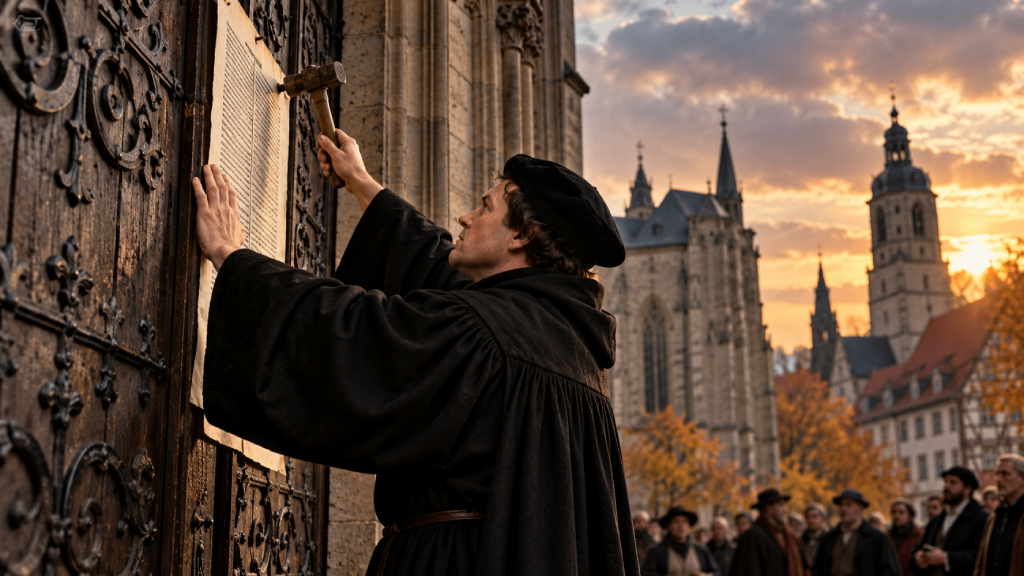
On October 31, 1517, Martin Luther is traditionally said to have nailed his famous 95 Theses to the door of the Castle Church in Wittenberg, Germany. His purpose was to call for an academic debate over the church’s teaching and practices concerning indulgences, which were closely associated with the remission of temporal punishment for sin. What Luther began that day would eventually grow into something much larger than he could have imagined.
The Protestant Reformation changed the course of Christianity and Western history. It challenged the authority of the Roman Catholic papacy, exposed abuses within the medieval church, encouraged the translation of Scripture into common languages, and helped recover the biblical teaching that sinners are justified before God by grace alone, through faith alone, in Christ alone.
Of course, Luther didn’t get everything right. Neither did John Calvin, Ulrich Zwingli, John Knox, or any of the other Reformers. They were sinful, fallible men who sometimes disagreed with one another on various secondary issues, and we should never elevate any of them to the level of Scripture. Nevertheless, God used these and other men in remarkable ways, and I believe we have much to be thankful for.
The Reformation is often summarized by five Latin phrases, commonly called the Five Solas:
- Sola Scriptura: Scripture alone is our supreme, infallible authority for faith and practice.
- Sola Fide: We are justified before God through faith alone.
- Sola Gratia: Salvation is by God’s grace alone.
- Solus Christus: Jesus Christ alone is our Savior and Mediator.
- Soli Deo Gloria: All glory belongs to God alone.
These five statements were not exclusively written or created by any of the Reformers, but they provide a helpful summary of the central theological convictions that came out of the Reformation, even though they were not originally presented together as a formal five-point statement in Luther’s day.
As much as I appreciate studying church history, I believe the greatest way to remember the Reformation is to open our Bibles and examine the truths that were so important to the Reformers. After all, the Reformation was ultimately concerned with what God had revealed in His Word and whether the church was faithfully teaching it.
With that in mind, I want to look at ten important Bible passages associated with the Protestant Reformation. Some played a direct role in Luther’s theological development, while others express doctrines that became central to the movement. My hope is that these verses will deepen our appreciation for the Gospel and encourage us to remain faithful to God’s Word today.
1. Romans 1:16-17: The Righteous Shall Live by Faith
“For I am not ashamed of the gospel, for it is the power of God for salvation to everyone who believes, to the Jew first and also to the Greek. For in it the righteousness of God is revealed from faith for faith, as it is written, ‘The righteous shall live by faith.'” (Romans 1:16-17, ESV)
If I had to choose one passage that best captures the theological heart of Martin Luther’s Reformation, Romans 1:16-17 would probably be my first choice.
Before Luther became the great Reformer we remember today, he was a deeply troubled Roman Catholic monk who struggled with the question of how a sinful man could ever stand righteous before a holy God. He understood that God was perfectly righteous, and that Luther himself was a sinner. The more seriously he examined his own heart, the more he became aware of his guilt.
Luther tried desperately to find peace with God through the religious practices available to him. He confessed his sins, performed acts of penance, and pursued the disciplined life of a monk. Yet he continued to struggle with the fear of God’s judgment.
One of the passages that troubled him was Romans 1:17, particularly the phrase “the righteousness of God.” Luther initially understood this primarily as the righteousness by which God judges sinners. How could such righteousness possibly be good news to someone who knew he was guilty?
Through his study of Romans, Luther came to understand that Paul was speaking of the righteousness God provides to sinners through faith in Jesus Christ. The sinner who trusts in Christ is counted righteous before God because of Christ’s righteousness, received by faith.
Luther later described this discovery as though he had been born again and entered paradise through open gates. His understanding of the passage became foundational to the Reformation’s teaching of justification by faith alone.
This truth remains just as important today. Every one of us must eventually stand before a perfectly holy God. Our religious accomplishments, good intentions, and personal morality cannot provide the righteousness we need. Our only hope is the perfect righteousness of Jesus Christ, received through faith in Him.
2. Ephesians 2:8-9: Salvation Is by Grace Alone
“For by grace you have been saved through faith. And this is not your own doing; it is the gift of God, not a result of works, so that no one may boast.” (Ephesians 2:8-9, ESV)
One of the most beautiful truths recovered and emphasized during the Reformation was that salvation is entirely a work of God’s grace. Paul couldn’t make it much clearer. We are saved by grace through faith, and our salvation is God’s gift. It cannot be earned through our good works, purchased with money, or secured through religious rituals.
This truth stood in sharp contrast to the abuses surrounding indulgences that Luther confronted in 1517. In the medieval Roman Catholic system, indulgences concerned the remission of temporal punishment for sins whose guilt had already been forgiven. However, their promotion was frequently tied to financial contributions, and popular preaching could leave people with the impression that spiritual benefits could be obtained through payment.
Luther recognized that these practices were seriously misleading people about repentance, forgiveness, and their relationship with God.
Ephesians 2:8-9 reminds us that salvation originates entirely in God’s mercy. We contribute nothing that earns our justification. Even the faith through which we receive Christ belongs within the gracious saving work of God.
As someone who holds to Reformed theology, I believe this passage also fits beautifully with Paul’s earlier description of our spiritual condition. In Ephesians 2:1, he tells us that we were dead in our trespasses and sins. Dead sinners cannot bring themselves to spiritual life. God must act first, and that is precisely what Paul describes in verses 4 and 5 when he declares that God, being rich in mercy, made us alive together with Christ.
And we must remember that Paul continues into verse 10, where he explains that believers are created in Christ Jesus for good works. Genuine saving faith produces obedience, but those good works are the fruit of salvation rather than the basis of our acceptance before God.
This should produce tremendous humility in every Christian. If salvation is entirely by grace, none of us has any reason to boast about being better than someone else. All the glory belongs to God.
3. Matthew 4:17 and Mark 1:15: The Call to Genuine Repentance
“From that time Jesus began to preach, saying, ‘Repent, for the kingdom of heaven is at hand.'” (Matthew 4:17, ESV)
“The time is fulfilled, and the kingdom of God is at hand; repent and believe in the gospel.” (Mark 1:15, ESV)
Of all the passages in this article, Matthew 4:17 has one of the most direct connections to Luther’s 95 Theses.
In fact, Luther’s very first thesis begins with Jesus’ command to repent:
“When our Lord and Master Jesus Christ said, ‘Repent’ (Matt. 4:17), he willed the entire life of believers to be one of repentance.”
Think about that for a moment. The very first statement in the document traditionally associated with the beginning of the Protestant Reformation concerned repentance.
Luther was challenging the idea that repentance could be reduced to the sacramental acts of penance administered by the church. He argued that Christ’s command involved the whole life of the believer. There is something here that I believe modern Christians desperately need to hear. Repentance is far more than feeling guilty after doing something wrong. It involves a genuine change of heart and mind concerning sin, accompanied by turning away from that sin and turning toward God. It is inseparably connected to faith in Jesus Christ.
Mark 1:15 brings these truths together beautifully when Jesus commands people to “repent and believe in the gospel.”
Repentance begins at conversion, but it also continues throughout the Christian life. As believers, we should be continually examining our hearts in light of Scripture, confessing our sins to God, and seeking to grow in holiness.
I sometimes wonder whether we have made repentance too small a part of our understanding of discipleship. We rightly emphasize God’s grace and forgiveness, but that same grace teaches us to renounce ungodliness and live in obedience to Christ, as Titus 2:11-12 explains.
Luther’s first thesis remains a needed reminder that the Christian life is one of ongoing repentance before God.
4. Romans 3:28: Justification by Faith Apart from Works
“For we hold that one is justified by faith apart from works of the law.” (Romans 3:28, ESV)
This verse gets directly to the heart of one of the most important disagreements between the Protestant Reformers and the Roman Catholic Church: How is a sinful person justified before God?
The Reformers taught that justification is God’s legal declaration that a sinner is righteous in His sight, based entirely on the righteousness of Jesus Christ and received through faith alone. This doctrine became known as sola fide.
Luther was so convinced of the importance of this teaching that, in his German translation of Romans 3:28, he included the word “alone” to emphasize his understanding of Paul’s argument. Although the word does not explicitly appear in the Greek text of this verse, Luther believed the meaning was clearly supported by the passage and by Paul’s broader teaching. And I agree with the central doctrine Luther was defending.
When we read Romans 3 in context, Paul has already established that all humanity stands guilty before God. In verse 23, he declares that “all have sinned and fall short of the glory of God.” Then he explains that sinners are justified by God’s grace as a gift, through the redemption that is in Christ Jesus.
Our justification rests upon what Christ accomplished through His perfect obedience, sacrificial death, and resurrection.
This doctrine provides genuine assurance for believers. If my standing before God depended upon my ability to maintain a sufficiently righteous life, I would have no lasting confidence. I know my own weaknesses far too well. But because my justification rests upon Jesus Christ, I can trust in the sufficiency of His finished work.
That assurance should lead us to love and obey Him more faithfully, out of gratitude for the grace we have received.
5. Galatians 2:16: No One Is Justified by Works of the Law
“Yet we know that a person is not justified by works of the law but through faith in Jesus Christ, so we also have believed in Christ Jesus, in order to be justified by faith in Christ and not by works of the law, because by works of the law no one will be justified.” (Galatians 2:16, ESV)
Martin Luther had a special affection for Paul’s letter to the Galatians. His lectures and commentary on this book became some of his most influential theological writings, particularly concerning justification by faith.
And when you read Galatians carefully, it is easy to understand why Luther valued it so highly.
Paul wrote this letter because false teachers were troubling the churches of Galatia by insisting that Gentile believers needed to observe requirements of the Mosaic Law, particularly circumcision, in order to belong fully to God’s covenant people.
Paul responded with extraordinary force because the Gospel itself was at stake.
In Galatians 2:16, he repeats the same basic truth three times: justification comes through faith in Christ rather than through works of the law.
Paul wanted his readers to understand that no amount of obedience to God’s Law could provide the righteousness necessary for justification.
This does not mean God’s moral commands are unimportant. The same apostle who defended justification by faith also instructed Christians to walk by the Spirit, love their neighbors, and reject the works of the flesh.
But the order matters tremendously. We obey God because we have been saved by His grace, and because His Spirit is at work within us.
One of the dangers I see in the church today is the tendency to measure our standing before God by our spiritual performance. When we have a particularly good week, we may feel that God must be pleased with us. When we struggle, we may begin to wonder whether He still accepts us.
Galatians reminds us to keep our eyes fixed on Jesus Christ. Our justification rests on Him, and the Christian life must continue in dependence upon His grace.
6. 2 Timothy 3:16-17: The Authority and Sufficiency of Scripture
“All Scripture is breathed out by God and profitable for teaching, for reproof, for correction, and for training in righteousness, that the man of God may be complete, equipped for every good work.” (2 Timothy 3:16-17, ESV)
Another foundational principle of the Protestant Reformation was sola Scriptura, or Scripture alone.
The Reformers believed that the Bible, because it is inspired by God, must be the supreme and infallible authority for everything Christians believe and practice.
This became particularly important as Luther’s disagreements with Rome intensified. By 1521, his writings had attracted the attention of some of the most powerful religious and political authorities in Europe, and he was being pressured to renounce his teachings.
In April of that year, Luther was summoned to appear before the Diet of Worms. Now, despite the rather unusual name, this had nothing to do with eating worms, as you might guess! A “diet” was a formal assembly of political and religious leaders within the Holy Roman Empire, and “Worms” was the German city where the meeting took place. The assembly was presided over by the young Holy Roman Emperor, Charles V, and included influential princes, nobles, and church representatives.
Luther had already been excommunicated by Pope Leo X in January 1521. Now he faced the possibility of being declared an outlaw by the empire itself. Appearing before this assembly was an extremely serious matter, and refusing to cooperate could have devastating consequences for his future and even his life.
On April 17, Luther appeared before the assembly and was asked whether the books displayed before him were his writings and whether he was willing to retract their teachings. He acknowledged that the books were his but requested additional time to consider his response. He returned the following day, April 18, and was again pressed to give a clear answer.
What followed became one of the most memorable moments in the history of the Protestant Reformation.
Luther explained that he could not simply withdraw everything he had written, especially those teachings he believed were firmly established upon Scripture. When pressed for a direct answer, he declared:
“Unless I am convinced by the testimony of the Scriptures or by clear reason (for I do not trust either in the pope or in councils alone, since it is well known that they have often erred and contradicted themselves), I am bound by the Scriptures I have quoted and my conscience is captive to the Word of God. I cannot and I will not retract anything, since it is neither safe nor right to go against conscience.”
These words are recorded in historical accounts of Luther’s appearance and are reproduced in Luther’s Works, Volume 32, pages 112-113. Although Luther is often credited with adding the famous declaration, “Here I stand, I can do no other,” historians debate whether he actually spoke those particular words. They appear in early printed versions of the account but are absent from the surviving contemporary records of his speech.
Nevertheless, the central message of Luther’s response is unmistakable. He was willing to be corrected, but he insisted that his teachings must be evaluated according to the authority of God’s Word. Neither the pope nor church councils possessed the right to demand that he reject what he believed Scripture plainly taught.
I find Luther’s statement about his conscience being “captive to the Word of God” particularly powerful; he was expressing the conviction that his conscience was bound by divine revelation. He could not knowingly deny what he believed God had revealed in Scripture simply because powerful men demanded it.
There is also an important clarification here that Christians today should understand. Luther was not claiming that every personal conviction he held was automatically correct. He was willing to have his arguments examined and corrected through Scripture and sound reasoning. His appeal was to the authority of God’s Word, which stands above every human teacher, church institution, and theological tradition.
This is precisely why the doctrine of Sola Scriptura remains so important. Every pastor, elder, theologian, and Christian teacher, and every Christian him or herself, must ultimately submit to Scripture. No matter how respected or influential a religious leader becomes, his teachings must be tested against what God has actually said.
For those of us who teach and preach the Bible, Luther’s example should also encourage humility. We have to be willing to correct our own opinions and interpretations when Scripture demonstrates that we are wrong, no matter how difficult it is. At the same time, we must have the courage to stand upon biblical truth, even when doing so brings criticism or opposition.
Luther’s refusal to recant eventually contributed to his being placed under the imperial ban through the Edict of Worms. His writings were prohibited, and he was declared an outlaw. Yet the truths he defended continued to spread throughout Europe, helping shape the Protestant Reformation for generations to come.
Whenever I think about Luther standing before that powerful assembly, I am reminded that the authority of Scripture is something Christians must be willing to defend. We should never allow cultural pressure, religious tradition, or the opinions of influential people to take precedence over the revealed Word of God.
I deeply appreciate that conviction.
Second Timothy 3:16-17 tells us that all Scripture is God-breathed. The Bible carries divine authority because its ultimate Author is God Himself. It is profitable for teaching us truth, exposing our errors, correcting our behavior, and training us to live righteously. Paul goes even further by explaining that Scripture equips the man of God for every good work.
This is one of the reasons I place such a high priority on biblical exposition in the local church. I push for it, and encourage believers to seek this kind of thing out. I want pastors to open the Bible, explain what the text actually means, and faithfully apply it to the lives of God’s people.
Church traditions can be useful. Historical creeds and confessions can help us summarize biblical doctrine. I personally value the theological contributions of the Reformers and the great confessions that followed them.
However, every tradition and confession must remain subject to the authority of Scripture.
The Reformation should encourage us to be people of the Book. We should read Scripture regularly, study it carefully, teach it faithfully, and submit our lives to everything God has revealed.
7. Acts 4:12: Salvation Is Found in Christ Alone
“And there is salvation in no one else, for there is no other name under heaven given among men by which we must be saved.” (Acts 4:12, ESV)
One of the great theological declarations associated with the Reformation is Solus Christus, meaning Christ alone.
The apostle Peter could hardly have been clearer when he stood before the Jewish religious authorities and proclaimed that salvation is found exclusively in Jesus Christ.
There is no other Savior. No religious institution can save us. No pope, priest, pastor, saint, or religious ceremony can provide the redemption that only Jesus Christ accomplished.
The Reformers challenged religious practices that obscured the sufficiency of Christ’s saving work, including abuses associated with indulgences and the church’s claims concerning its administration of spiritual benefits. Their concern was that sinners needed to look directly to Jesus Christ as their only hope of salvation. This absolute, rock-solid truth remains the message the church must proclaim today.
We live in a culture where religious exclusivity is frequently considered offensive and bigoted. Many people are comfortable with Jesus being one spiritual teacher among many, but they become uncomfortable when Christians insist that He is the only way to God. Yet this is exactly what Scripture teaches.
Jesus Himself declared in John 14:6 that He is the Way, the Truth, and the Life, and that no one comes to the Father except through Him.
As Christians, we should proclaim this truth with humility and love, recognizing that we ourselves have received salvation only through God’s mercy. We have no reason to look down on unbelievers, but we have every reason to tell them about the Savior they desperately need.
8. 1 Timothy 2:5: Jesus Christ Is Our One Mediator
“For there is one God, and there is one mediator between God and men, the man Christ Jesus.” (1 Timothy 2:5, ESV)
Closely connected to the previous passage is Paul’s declaration that Jesus Christ is the one mediator between God and humanity.
A “mediator” is someone who stands between two parties to bring about reconciliation. Because of our sin, humanity is alienated from God, and we cannot restore that broken relationship through our own efforts. In this case, since we all are sinners (Romans 3:23), we need someone who can reconcile us to our Creator.
Jesus Christ is uniquely qualified to do this because He is fully God and fully man. Through His sinless life and sacrificial death, He accomplished the redemption that sinners could never hope to accomplish for themselves.
The Reformers emphasized Christ’s unique mediation in their criticism of certain Roman Catholic teachings and practices, particularly the invocation of saints and claims that obscured the believer’s direct access to God through Christ. This also connects with the biblical doctrine of the priesthood of all believers, taught in passages such as 1 Peter 2:9. Every Christian has access to the Father through Jesus Christ. We do not need a special human priesthood to obtain that access.
I have to make an important distinction about the definition of “priests” and “pastors.” Just because Christ is now our High Priest, allowing access to God (Hebrews 5:5-6), this does not eliminate the church’s need for pastors/elders and other church leaders. Scripture clearly establishes the need for qualified men to shepherd and teach God’s people. But those leaders are servants of Christ, and they possess no independent power to reconcile sinners to God, and are certainly no “go-betweens.”
Amazingly, we can approach the throne of grace through Jesus Christ, as Hebrews 4:14-16 teaches. Our confidence rests upon our great High Priest, who intercedes for His people.
9. John 8:31-32: God’s Truth Sets Us Free
“So Jesus said to the Jews who had believed him, ‘If you abide in my word, you are truly my disciples, and you will know the truth, and the truth will set you free.'” (John 8:31-32, ESV)
One of the most remarkable results of the Protestant Reformation was the renewed emphasis on making Scripture available to ordinary Christians. It’s hard to imagine that the average, everyday believer in Christ did not have access to Scripture!
During the medieval period, the Latin Vulgate was the standard Bible of the Western church. Although vernacular translations existed before Luther, access to Scripture in the language of everyday people remained limited in many places.
Luther’s translation of the New Testament into German in 1522, followed by his complete German Bible in 1534, helped make the Scriptures accessible to a much wider audience.
Other Reformers and Bible translators pursued similar efforts in different countries, often facing serious opposition. They understood that Christians needed to hear and understand God’s Word for themselves.
John 8:31-32 reminds us of the importance of abiding in Christ’s teaching. In the verses that follow, Jesus explains that the freedom He gives is freedom from slavery to sin. This is a much deeper freedom than simply being able to read a religious book or question a church tradition.
Nevertheless, access to Scripture is vitally important because God’s Word reveals the truth about our sin and directs us to the Savior who sets sinners free.
I sometimes wonder whether we truly appreciate the privilege we have today. Most of us can access dozens of Bible translations within seconds on our phones, and many of us have physical Bibles on our shelves or coffee tables. We can study the original languages, compare commentaries, and listen to faithful preaching from around the world.
Yet with all those resources available, it is still possible for us to neglect the Bible. Sadly, many of us do that on a regular basis.
The Reformers made tremendous sacrifices to help people hear and understand God’s Word. We should honor that legacy by becoming faithful students of Scripture and, more importantly, obedient disciples of Jesus Christ.
10. Habakkuk 2:4: The Righteous Shall Live by Faith
“Behold, his soul is puffed up; it is not upright within him, but the righteous shall live by his faith.” (Habakkuk 2:4, ESV)
Our final passage takes us back into the Old Testament, where the prophet Habakkuk declares that the righteous shall live by faith. This statement becomes especially important because Paul quotes it in Romans 1:17 and Galatians 3:11, two passages closely associated with Luther’s understanding of justification.
In its original setting, Habakkuk was wrestling with difficult questions concerning God’s justice and His dealings with wicked nations. God called His people to trust Him even when His purposes were difficult to understand. The contrast in Habakkuk 2:4 is between the proud person, whose soul is not upright, and the righteous person who lives by faithfulness and trust in God.
When Paul quotes this passage, he shows how the principle of faith relates to the Gospel and the justification of sinners.
This reminds us that salvation through faith was never an invention of Martin Luther or the Protestant Reformers. It was already present in God’s revelation long before the sixteenth century.
People were saved in the Old Testament in this exact same way: by faith and trust in God to forgive them. Abraham believed God, and his faith was counted to him as righteousness, as Genesis 15:6 teaches. Paul develops this truth from Abraham’s time extensively in Romans 4, demonstrating that justification through faith is rooted in God’s dealings with His people throughout redemptive history.
So the Reformers were seeking to recover truths that had already been revealed in Scripture. In general, Christianity does not need new revelations or newly invented doctrines to remain relevant. We need to understand and faithfully proclaim the truth God has already given us in His Word.
The same Gospel that saved Abraham, the same Gospel preached by Paul, and the same Gospel recovered and defended by the Reformers is the Gospel we must believe and proclaim today 100%.
What the Protestant Reformation Should Mean to Christians Today
As we remember October 31, 1517, I believe there are several lessons worth taking to heart.
First, we must never take the Gospel for granted. It is possible for churches to become so occupied with religious traditions, programs, ceremonies, and institutional concerns that the central message of salvation through Jesus Christ becomes obscured. The Reformation reminds us of the need to continually examine our teaching and practices in light of God’s Word.
Second, we must be willing to stand for biblical truth, even when doing so is unpopular. Luther faced enormous pressure from religious and political authorities, and his convictions eventually placed his life in danger. While we should never excuse his faults or assume that every controversy he entered was handled wisely, we can still appreciate his willingness to defend what he believed Scripture taught.
Third, we must remember that theological knowledge should produce genuine Christian living. The doctrines of grace are wonderful truths, but they should lead us to humility, worship, holiness, and love for others. A man who can explain justification by faith but refuses to repent of his sins has missed something essential about the Christian life.
I would also encourage Christians to study church history. We have much to learn from the believers who came before us, including their faithfulness, their mistakes, and the challenges they faced. Understanding the Reformation can help us better appreciate the doctrinal convictions that shape Protestant Christianity today.
However, I want to end by returning to the most important issue of all:
The Reformation matters because the Gospel matters. And the Gospel matters because every human being desperately needs to be reconciled to God.
The Gospel That the Reformers Defended Is the Gospel You Need Today
Perhaps you’re reading this article, and you know something about Martin Luther, the Protestant Reformation, or the history of Christianity. Maybe you’ve attended church for years and consider yourself a “spiritual” or “religious” person.
But have you personally repented of your sins and placed your faith in Jesus Christ?
The Bible teaches that God is perfectly holy and righteous. He created us for His glory, and He has every right to command our obedience. Yet every one of us has sinned against Him.
Romans 3:23 declares, “For all have sinned and fall short of the glory of God.”
Sin is far more serious than occasionally making mistakes or failing to live up to our own standards. Sin is rebellion against our Holy Creator. We have broken God’s commands through our actions, words, thoughts, and desires. We have failed to love Him with all our hearts and have repeatedly chosen our own ways over His.
Because God is perfectly just, He cannot simply ignore our sin.
Romans 6:23 tells us, “For the wages of sin is death, but the free gift of God is eternal life in Christ Jesus our Lord.”
The punishment our sins deserve is death and eternal judgment. Left to ourselves, we have no hope of escaping that judgment. No amount of charitable giving, church attendance, religious devotion, or personal improvement can erase our guilt before God.
But here is the wonderful news of the Gospel: God, in His great love and mercy, sent His Son, Jesus Christ, into the world to save sinners!
Jesus is the eternal Son of God who became truly human while remaining fully divine. He lived the perfectly righteous life that none of us could live. He obeyed the Father completely and never committed a single sin.
Then He willingly went to the cross, where He bore the punishment deserved by sinners.
Second Corinthians 5:21 declares, “For our sake he made him to be sin who knew no sin, so that in him we might become the righteousness of God.”
At the cross, Jesus took upon Himself the judgment that His people deserved. He satisfied God’s justice through His sacrificial death, accomplishing the redemption that we could never earn.
And on the third day, Jesus Christ rose bodily from the grave, demonstrating His victory over sin and death.
His resurrection is an essential part of the Gospel. We serve a living Savior who reigns at the right hand of the Father and will one day return to judge the living and the dead.
So how should you respond to this good news?
Jesus Himself gives the answer in Mark 1:15: “Repent and believe in the gospel.”
Repentance means turning from your sin and acknowledging your guilt before God. Faith means trusting in Jesus Christ alone for the forgiveness of your sins and your acceptance before God.
You must abandon every hope of saving yourself through your own goodness or religious efforts. Most of us think that we might be a little flawed or that we’re generally a “good person.” Instead, come to Christ as a guilty sinner who needs His mercy, trusting completely in His finished work.
Jesus gives this wonderful promise in John 6:37: “Whoever comes to me I will never cast out.”
If you genuinely repent and trust in Christ, God will forgive your sins and declare you righteous in His sight. He will give you new spiritual life, adopt you into His family, and begin transforming you through the work of the Holy Spirit.
And if you have already trusted in Christ, let these truths encourage you to continue growing in your faith. Read your Bible faithfully, devote yourself to prayer, become actively involved in a sound local church, and pursue a life of obedience to your Savior.
The doctrines recovered during the Protestant Reformation are precious because they direct us to the truth of God’s Word and the saving work of Jesus Christ.
Remembering Reformation Day
On October 31, while much of the world is celebrating Halloween, I’ll be remembering the Protestant Reformation and thanking God for the men He used to help recover and proclaim these great biblical truths. I am thankful for Martin Luther’s courage, for the theological contributions of John Calvin and the other Reformers, and for the countless Christians who labored to translate, teach, and defend the Scriptures.
But above all, I am by far most thankful for Jesus Christ, the Savior whose Gospel stands at the center of everything the Reformers sought to defend.
Nearly five hundred and nine years after Luther’s 95 Theses, the church still needs the same message. We still need the authority of Scripture. We still need to understand justification by faith. We still need to proclaim God’s sovereign grace and the sufficiency of Jesus Christ. And we still need to call sinners to repentance and faith in the Gospel.
So this October 31, I encourage you to spend some time reading these passages, learning about the Reformation, and thanking God for preserving His truth throughout the centuries. May we never become so fascinated with the history of the Reformation that we neglect the biblical truths that made it necessary.
Scripture alone. Faith alone. Grace alone. Christ alone. To the glory of God alone.
Soli Deo Gloria!