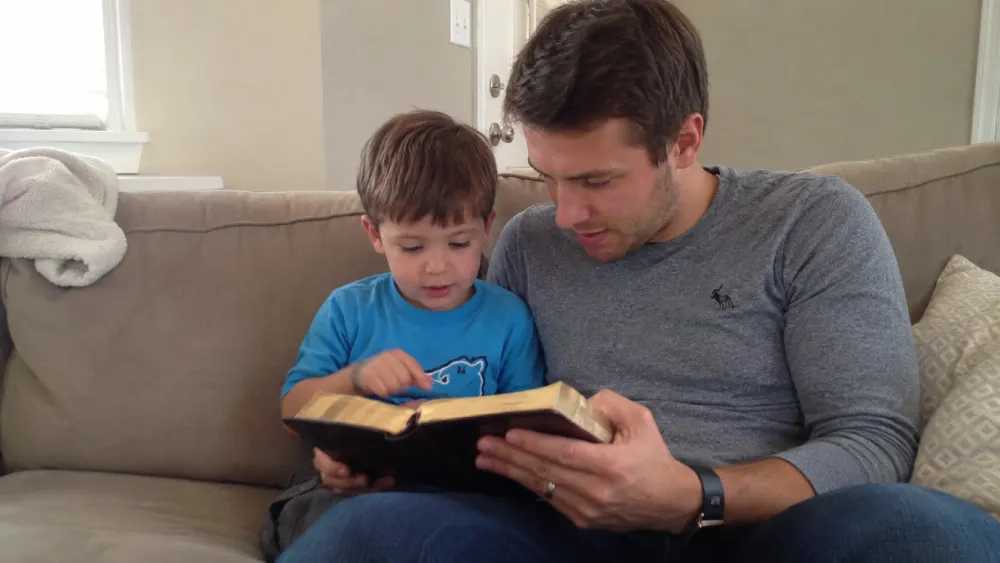
Train Them While They’re Young – A Father’s Calling in the Early Years
There are few seasons of fatherhood that feel more exhausting than raising young children. Between diapers, bedtime routines, endless questions, spilled milk, and sleepless nights, it can feel like you’re simply trying to survive the day. Yet those early years, especially between ages two and seven, are some of the most important years for shaping a child’s heart.
Many fathers assume the “serious” discipleship can wait until their children are older. They imagine that meaningful conversations about God belong in the teenage years. Scripture points us in the opposite direction. The earliest years are when habits are formed, authority is learned, and a child’s understanding of right and wrong begins to take shape. Fathers who invest faithfully during this season are laying a foundation that, by God’s grace, can serve their children for the rest of their lives.
This isn’t about producing perfect children. Only the Lord can change a heart. But God has entrusted fathers with the joyful responsibility of teaching, modeling, correcting, and pointing their children to Christ every single day.
Teach God in Ordinary Moments of Life
One of the most encouraging truths in Scripture is that family discipleship doesn’t require a seminary degree or a complicated curriculum. In Deuteronomy 6, Moses instructed God’s people to teach His words diligently to their children, speaking of them while sitting in the house, walking along the road, lying down, and getting up (more on this concept below).
In other words, discipleship happens in everyday life.
Young children are naturally curious. They notice birds in the sky, changing seasons, acts of kindness, and even moments of discipline. Fathers have countless opportunities to connect these ordinary moments to the character of God. A beautiful sunset becomes a reminder of God’s creativity. Sharing toys becomes an opportunity to talk about loving our neighbor. Asking forgiveness after sin points to the forgiveness we receive through Christ.
These conversations don’t have to be long. In fact, with young children, simple and repeated truths often leave the deepest impression.
Let Them See Your Faith
An important thing to remember is that children learn far more from what they observe than from what they are told.
If your children see you reading your Bible because you genuinely love God’s Word, they notice. If they hear you pray with sincerity instead of only at mealtimes, they notice. If they watch you confess your own sin, ask forgiveness from your wife, or respond to disappointment with trust in the Lord, they notice.
None of this requires perfection. In fact, pretending to be perfect often teaches the wrong lesson. Children benefit from seeing a father who genuinely depends on God’s grace.
The goal isn’t to convince your children that Dad has it all together. The goal is to show them that Jesus is worthy of trusting every day.
Teach Obedience with Love and Consistency
Young children are constantly learning how authority works. That makes these years especially significant.
When fathers lovingly require obedience, they are doing far more than maintaining order in the home. They are helping their children understand that God Himself is the ultimate authority. Delayed obedience, partial obedience, and cheerful obedience all become opportunities for instruction.
Discipline should never be driven by anger or frustration. It should be thoughtful, consistent, and motivated by love. Hebrews reminds us that the Lord disciplines those He loves. Faithful fathers reflect that same loving purpose.
Every act of correction should ultimately point beyond behavior to the heart. Children don’t simply need better manners. They need new hearts, and only Christ can provide them.
Fill Their Minds with Scripture
Young children often memorize far more than we expect.
Many can sing entire songs after hearing them only a few times. They remember favorite books word for word. The same ability can be used for hiding God’s Word in their hearts.
Choose simple verses. Repeat them during meals, bedtime, or car rides. Sing them together. Celebrate when your children remember them. Don’t worry about covering large portions of Scripture. A handful of well-learned verses can become lifelong anchors.
As children grow, those verses often return to their minds at exactly the moments when they need them most.
This is exactly what God commanded His people in Deuteronomy 6:6-9:
“And these words that I command you today shall be on your heart. You shall teach them diligently to your children, and shall talk of them when you sit in your house, and when you walk by the way, and when you lie down, and when you rise. You shall bind them as a sign on your hand, and they shall be as frontlets between your eyes. You shall write them on the doorposts of your house and on your gates.”
Notice how comprehensive this command is. God’s Word was not meant to be confined to one family devotion each evening. It was to saturate the rhythm of everyday life. The home was to become a place where Scripture was regularly heard, discussed, remembered, and applied. That same pattern remains a wise model for Christian families today.
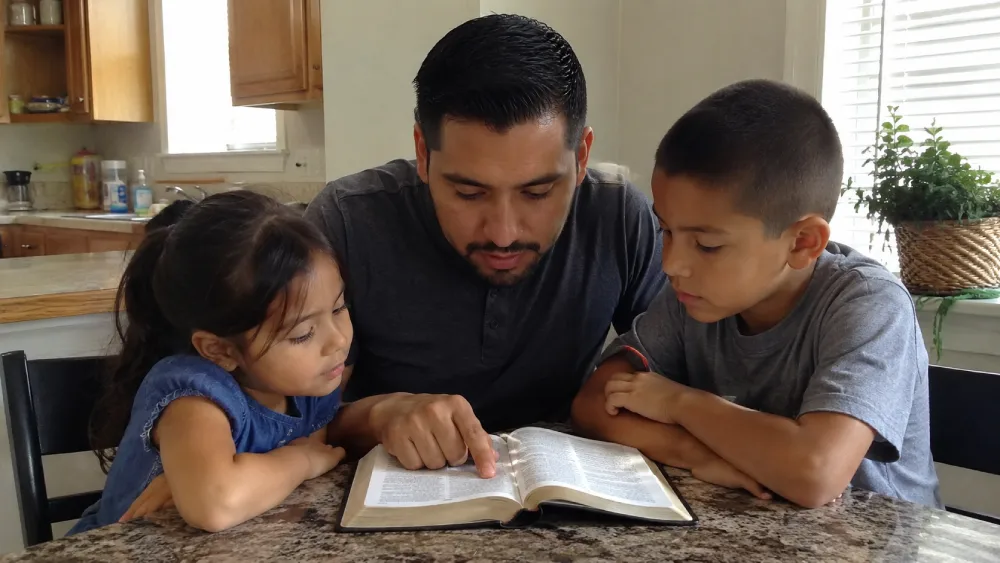
One of the simplest ways to do this is to establish a daily habit of reading the Bible together. It doesn’t need to be long. Read a short passage, explain it in language your children can understand, ask a few simple questions, and close in prayer. Over time, those brief moments accumulate into years of faithful instruction.
Good children’s Bible storybooks can also be helpful, provided they faithfully present the biblical text and point children to Christ rather than merely teaching moral lessons. The goal is not simply to raise well-behaved children, but children who understand God’s character, man’s sin, Christ’s saving work, and the hope of the gospel.
Another rich tool that Christian parents have used for centuries is catechism. A catechism teaches biblical truth through simple questions and answers that children can memorize over time. Young minds are especially equipped for this kind of learning. Long before children can understand every doctrine in depth, they can begin storing biblical truth in their memories.
Many Reformed families have found great benefit in using catechisms that summarize the doctrines taught in historic confessions such as the Second London Baptist Confession of Faith (1689) or the Westminster Confession of Faith. These confessions are not equal to Scripture, nor do they replace it. Rather, they faithfully summarize what the Bible teaches and help fathers systematically instruct their children in foundational truths about God, salvation, the church, sin, prayer, and the Christian life.
Imagine a six-year-old who can answer simple questions like, “Who made you?” “What is sin?” “Who is Jesus Christ?” or “Why do we pray?” Those answers may seem small today, but by God’s grace they become building blocks for a lifetime of sound doctrine.
Children are constantly memorizing something. They memorize cartoon characters, advertising jingles, sports statistics, and song lyrics without much effort. Wise fathers intentionally fill those same young minds with truths that will still matter fifty years from now.
The seeds of Scripture planted in childhood often bear fruit long after the moment of memorization has passed. A verse learned at age four may return to comfort a teenager, convict a young adult, or strengthen a believer decades later. Never underestimate what God may do through His Word hidden in the heart of a little child.
Pray with Them and for Them
Prayer teaches children that Christianity is not merely a set of rules. It is a relationship with the living God.
Don’t just pray before a meal. Pray with your children about everything. Thank God for answered prayers. Pray for hurting neighbors, missionaries, pastors, grandparents, and friends. Pray after discipline. Pray before difficult situations. Pray just to thank God for His blessings and praise Him for being a great Provider to you and your family. Let your children hear you ask God for wisdom as a father.
Just as importantly, pray for your children when they aren’t listening.
No father can regenerate a heart. No parenting strategy can produce saving faith. Salvation belongs to the Lord. That truth should drive every Christian father to his knees.
Remember What Success Really Looks Like
In a culture obsessed with measurable results, fathers can easily become discouraged. We want immediate obedience, visible maturity, and dramatic spiritual growth.
But God’s calling is faithfulness. You may spend years reading Bible stories that seem forgotten, praying prayers that appear unanswered, and repeating truths that don’t seem to stick. Yet the Lord often uses thousands of ordinary moments to accomplish extraordinary work over time.
Your responsibility is not to guarantee your child’s conversion. That belongs to God alone. Your responsibility is to faithfully plant, water, teach, correct, love, and pray.
Those ordinary bedtime prayers, family Bible readings, conversations during dinner, and moments of loving discipline are rarely wasted.
The Lord delights to use faithful fathers as instruments in His gracious work. So don’t underestimate these early years. While the world tells you they’re simply a season to survive, God tells you they’re a season to steward. Invest intentionally. Point your children to Christ again and again. Trust the Lord with the results, and remember that the seeds you plant today may bear fruit for generations to come.