“If the work that anyone has built on the foundation survives, he will receive a reward. If anyone’s work is burned up, he will suffer loss, though he himself will be saved, but only as through fire.”
-1 Corinthians 3:15
When it comes to religion, what we are taught as children often has far less impact than it would if we had heard those teachings as adults. What we accepted without question back then may not seem so agreeable now. In fact, the farther removed we are from those early years of religious instruction, the more likely we are to have quietly replaced what we were taught with personal beliefs that often bear little resemblance to official church doctrine. This is especially common among Roman Catholics regarding the Church’s Doctrine of Purgatory. Upon review, an adult Catholic may recognize that what the Church teaches about Purgatory differs greatly from what they have come to believe personally.
By revisiting the Doctrine of Purgatory, one can determine whether their beliefs align with official Catholic dogma or have strayed and require realignment with the Church’s teachings. What follows is a review of the doctrine of Purgatory as explained in two officially approved Catholic catechisms, the Traditional Catechism and the Catechism of the Catholic Church, both used to instruct children and adult converts on matters of faith.
The Need for a Purgatory
In the 1992 Catechism of the Catholic Church, Section #1030, explains why Purgatory is said to exist: “All who die in God’s grace, yet imperfectly purified, are indeed assured of their eternal salvation; but after death they undergo purification, so to achieve the holiness necessary to enter the joy of Heaven.”
In any religion where salvation is even partially based on good works and religious observances, a place is needed for those who fall short, a midway point between Heaven and Hell for spiritual underachievers who try to be faithful but fall short in varying degrees.
For those Roman Catholics whose souls need light to heavy post-mortem prep work before being allowed into heaven, that in-between place is Purgatory. The Catholic Church admits the Bible never mentions it by name. Yet it boldly defends it, arguing that logic and inferences drawn from certain Bible passages support its existence.
The Theological Premise
According to both Catholic and Protestant theology, there is original sin that is ours by birth as descendants of Adam. However, the Catholic Church categorizes all subsequent sins, which it calls actual sins, into two types. Mortal sins are serious in nature and can be eternally damning, while venial sins are less serious but can have painful afterlife consequences if not confessed.
In the Traditional Catechism, Question #72 asks, “How does venial sin harm us?” The answer given is, “Venial sin harms us by making us less fervent in the service of God, by weakening our power to resist mortal sin, and by making us deserving of God’s punishments in this life or in Purgatory.”
Described as “lesser faults,” the Catholic Church teaches that letting venial sins pile up unconfessed in one’s soul weakens the spiritual state to such an extent that mortal sins become nearly impossible to avoid committing. So, according to the Catholic Church, venial sins need to be taken seriously since they often serve as gateway sins leading to mortal sins. Also, as the Catechism states, the more unconfessed venial sins remain on the soul at the time of death, the longer one must experience “God’s punishments” in Purgatory.
Purgatory and the State of Grace
By means of baptism, a Catholic infant is said to be cleansed from original sin and, with that, enters a pure and sinless state of grace. However, once a venial sin is committed, that pure state of grace becomes corrupted and remains impure until the sin is acknowledged and confessed, followed by a prayer known as an Act of Contrition. This can be done without a priest granting absolution or assigning penance. Though that sin is forgiven, it is also considered to have left its mark upon the soul, which must be purged after one’s death.
What Purgatory Is Like
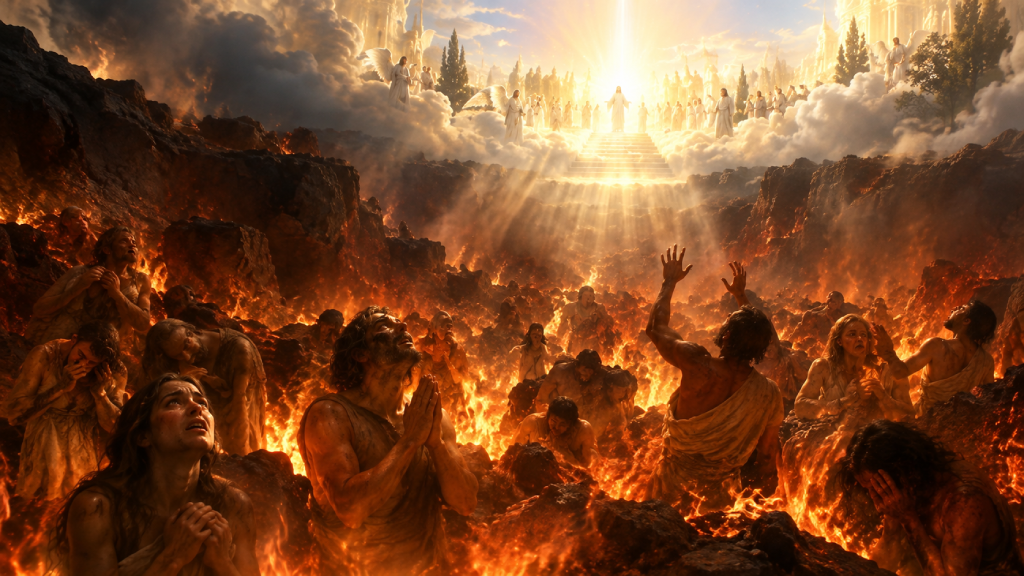
Section #1031 states, “The tradition of the Church, by reference to certain texts of Scripture, speaks of a cleansing fire: As for certain lesser faults, we must believe that, before the Final Judgment, there is a purifying fire.”
It remains unclear how unpleasant Purgatory will be for those who must endure it. However, the Catechism’s use of the phrases “purifying fire” and “cleansing fire” suggests it’s no church picnic, for however long one’s time of suffering might be. Exactly how much time will be required to make the unholy soul holy enough for heaven will be determined once the true state of their soul is finally and fully revealed upon their passing from earth. Then, once fire has completed the cleansing and pure holiness has been achieved, the now-purified soul will be drawn into the joys of Heaven.
What every Catholic must come to terms with is that the more they brush off venial sins as not worth recognizing and confessing, the more they are racking up for themselves time spent having to endure the painful fires of Purgatory. If Catholic doctrine is true, then by failing to develop a strong conscience through daily self-examination and confession, they are only making their post-life suffering last much longer than it needs to be.
The Biblical Foundation According to the Catholic Church
The primary New Testament passage the Catholic Church cites to support its teachings on Purgatory is 1 Corinthians 3:10-15. In the Catholic Church’s view, these verses provide the clearest and most direct evidence of Purgatory’s existence, what happens there, and why. In it, Paul wrote: “According to the grace of God given to me, like a skilled master builder, I laid a foundation, and someone else is building upon it. Let each one take care how he builds upon it. For no one can lay a foundation other than that which is laid, which is Jesus Christ. Now if anyone builds on the foundation with gold, silver, precious stones, wood, hay, straw – each one’s work will become manifest, for the Day will disclose it, because it will be revealed by fire, and the fire will test what sort of work each one has done. If the work that anyone has built on the foundation survives, he will receive a reward. If anyone’s work is burned up, he will suffer loss, though he himself will be saved, but only as through fire.”
The following brief commentary on this passage by Clement Harrold of the St. Paul Center shows how Catholic theologians often twist unrelated Scripture to support major doctrinal positions and beliefs for which Scripture offers no support or defense. Harrold writes:
“On the day of our judgment, the true nature of our efforts will be revealed. Did we construct a life which can withstand the blazing holiness of the God whom Scripture describes as ‘a consuming fire’ (Hebrews 12:29)? If not, then we fully expect the divine presence to burn away all our fluff, all our impurities, all our empty show. This is what we call purgatory. St. Paul warns us that through this purgation we ‘will suffer loss’ – that is to say, it will be painful. Indeed, our post-mortem purification will be ‘as through fire,’ for it is only by putting to death our old self and being formed anew in Christ that our souls will finally be ready to enter the joy of heaven.”
Contrary to Harrold’s utterly misguided interpretation, the circumstances under which this passage was written clearly show it has nothing to do with Purgatory or what supposedly takes place there. In its proper context, one can easily recognize that the Apostle Paul is not speaking of a separate place where punishment is doled out for unconfessed venial sins. Rather, he is describing how each Christian’s work done in Christ’s name will be tested directly in God’s presence. Harrold then uses another totally unrelated verse, Hebrews 12:29: “God is a consuming fire,” which speaks of God’s judgment of those who refuse to worship him, an eternity in hell, not a temporary stay in Purgatory.
This Corinthian passage actually addresses a controversy that arose in the church located there. Paul founded the church, and Apollos later served as its shepherd. Some members debated whether Paul’s work of planting the church was more effective than Apollos’s work of nurturing and caring for the flock. The disagreement grew so divisive that some openly declared allegiance to one man over the other.
In response, Paul chided the church, stating that it was not a competition: he did one thing, and Apollos did another. He wrote that God himself would test whether his work or Apollos’s work among them was of any value. He also wrote that though both he and Apollos would be saved through faith in Christ, their earthly work might not survive God’s test of genuineness. In the end, God’s testing would reveal whether they labored for the church in Corinth out of sincere devotion to Christ or for self-serving reasons, such as a desire for honor among men.
If one considers the other verses the Roman Catholic Church uses to defend the doctrine of Purgatory, one will find that each offers even less evidence for such a place existing.
Biblical Authority versus Church Authority
Since no passages or verses in the Bible even suggest the existence of Purgatory, how did the Catholic Church establish and preserve this doctrine over so many centuries, and end up profiting financially from it so successfully?
The truth is, though the Catholic Church claims tradition is equal to the Bible in authority, in practice, it treats the Bible as far subservient to the Church and its traditions. It claims a divine right to create doctrines and practices based on the philosophy that the Bible came from the Church, not the Church from the Bible.
However, if one views Church history objectively in relation to culture, one sees that much of what the Catholic Church believes and practices came from cultural beliefs that seeped into the Church, gradually became popular among the people and clergy, and eventually were affirmed as official doctrines. By this means, the Church has added many doctrines and practices over the centuries without any basis in Scripture.
The same was certainly true of the creation of Purgatory, which has its roots in the writings of a second-century theologian, Tertullian, who was greatly influenced by Greek mythology and incorporated certain aspects of it into his theological treatises on the afterlife.
So, when it came to the establishment and ongoing belief in the Catholic Church’s doctrine of Purgatory, the Bible played and continues to play no role. Literally, none at all.
Conclusion
If we go by Scripture alone, as we should, it is clear there is no such thing as Purgatory. According to the Bible, once we die, we are immediately judged and have no second chance to enter heaven by having our souls purified through fire. There is no temporary, post-mortem process provided by God to purge unconfessed sins from our souls. Our eternal destiny is determined and fixed the moment our lives on earth come to an end.
There is only one way to be purified of our sins: not by having them burned from our souls in Purgatory, but by having them covered by the shed blood of Jesus while on earth. The Bible speaks of only one way to be totally free of sin and to enter heaven. It is through faith in Christ alone during this life, not through fire in the next.
Nothing but the Blood
Robert Lowry, pub.1876
What can wash away my sin?
Nothing but the blood of Jesus;
What can make me whole again?
Nothing but the blood of Jesus.
Oh! Precious is the flow
That makes me white as snow;
No other fount I know,
Nothing but the blood of Jesus.