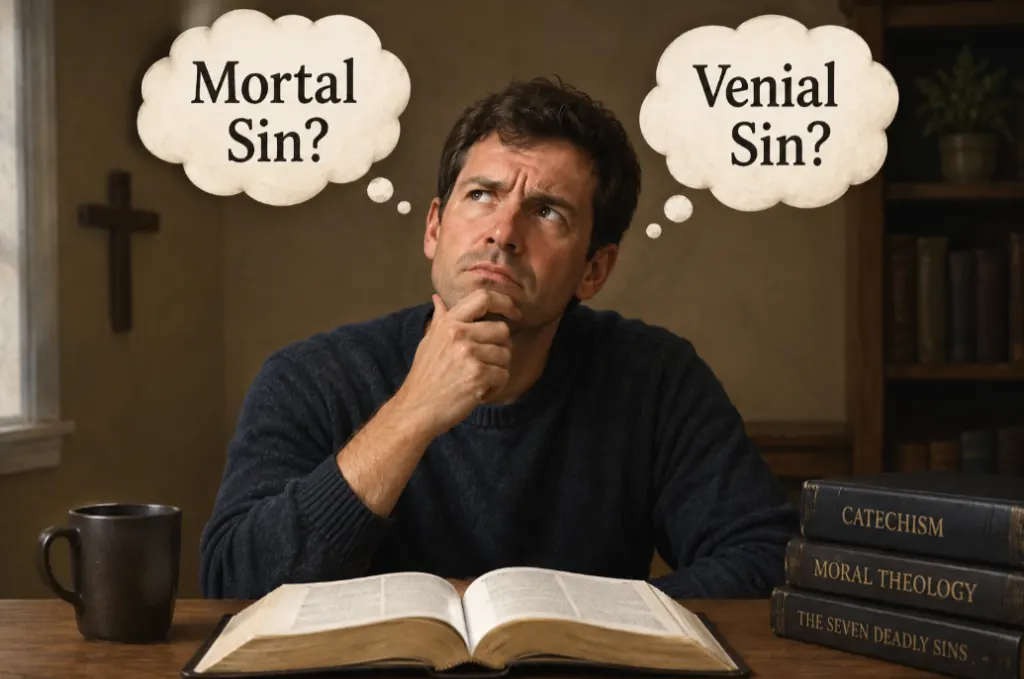
What is a mortal sin? In many cases, the Roman Catholic Church’s teachings on mortal sin and its consequences have either been forgotten from childhood or simply no longer believed. Regardless of the reasons why this doctrine might have become neglected in a Catholic’s life, Roman Catholic doctrine still holds that even a single mortal sin brings immediate, spiritual destruction within the soul and, if left unconfessed, results in eternal damnation. Therefore, whether forgotten or rejected, this teaching deserves careful review and serious reconsideration by every Catholic, especially since these severe consequences for mortal sin are unavoidable. Or are they? Catholic doctrine says it depends.
Question #67 of the Traditional Catholic Catechism asks, “Why is a mortal sin called mortal?” The answer provided is, “A mortal sin is called mortal or deadly because it deprives the sinner of sanctifying grace, the supernatural life of the soul.” Unfortunately, that is not all. Question #68 of the TCC goes on to ask, “Besides depriving the sinner of sanctifying grace, what else does mortal sin do to the soul?” to which the answer is, “Besides depriving the sinner of sanctifying grace, mortal sin makes the soul an enemy of God, takes away the merit of all its good actions, deprives it of the right to everlasting happiness in heaven, and makes it deserving of everlasting punishment in hell.” In stark terms, this amounts to a death sentence for the soul, which, unless the sin is confessed to a priest for absolution, will result in eternal damnation.
Given these devastating temporal and eternal consequences, how does a Catholic determine whether what they have done is serious enough to be considered a mortal sin? To clarify the issue, the TCC, in conjunction with the other approved Catholic catechisms, provides criteria for distinguishing between venial sins and mortal sins, or in other words, sins that are not so serious from those that are serious. Question #69 asks, “What three things are necessary to make a sin mortal?” The answer given is, “First, the thought, desire, word, action, or omission must be seriously wrong or considered seriously wrong; second, the sinner must know that it is a serious sin; and third, while knowing the sin is mortal, the sinner must fully consent to it.”
Serious, Not Serious
Upon review of these criteria, what might strike an adult Catholic as somewhat puzzling is that a sin is said to be mortal when it is either “seriously wrong or considered seriously wrong.” This criterion immediately raises a question: “considered seriously wrong” by whom? Is it the sinner who makes this determination? If so, they would likely go far too easy on themselves regarding the seriousness of their actions. That said, the local parish priest should surely be the one to determine whether a sin is venial or mortal. Because a sinner often lacks the objectivity to judge his own actions rightly, the wisest course is to enter the nearest confessional so a proper judgment may be made, a fitting penance assigned, and the much-needed absolution granted.
Unfortunately, relying on a priest to determine whether a sin is mortal or venial can also lead to uncertainty, since what one priest considers serious often differs greatly from what another priest considers serious. In fact, just as priests from two different parishes may disagree, so two priests serving the same parish may differ on what constitutes a mortal sin.
These differences of opinion among priests within the same diocese or church inevitably lead to what can best be described as “priest shopping.” With this approach, the guilty Catholic goes to another parish and confesses to a priest known to be far less severe in judgment and far more merciful in assigning penance.
Another way some go about avoiding a well-deserved chastising during confession and rather extensive penitential punishment afterward is to hunker down in the church parking lot long enough to see which parish priest enters the church to hear confessions. If the laid-back, easy-going priest enters, the sinner opens the car door and heads inside to get it over with. If it is the old curmudgeon priest, the sinner makes a sly getaway and hopefully lives to confess another day.
The Blessed State of Ignorance
The second criterion states that for a sin to be mortal, a Catholic “must have knowledge of its seriousness.” Strange as it may sound, what this reveals is that in order for a sin to be mortal, the Catholic must know that a mortal sin is a mortal sin. This clause makes determining a sin’s seriousness totally dependent on the strength or weakness of a Catholic’s conscience. Through this qualifier, the catechism leaves the door wide open for the catechistically challenged Catholic to avoid the more serious consequences of having committed a mortal sin.
The third criterion states that “the sinner must fully consent to it.” In other words, the sinner must fully recognize that the act is a mortal sin and, despite that knowledge, deliberately choose to commit it. So it is that a Catholic who is unaware that a sin is mortal cannot then purposely commit a mortal sin. Once again, the ill-informed Catholic escapes the consequences of mortal sin while the informed Catholic suffers greatly and, perhaps, eternally.
For an example in practice, an ill-informed Catholic guilty of the mortal sin of drunkenness on Saturday night could, due to his ignorance, boldly stroll up to the communion rail on Sunday morning and receive the Eucharist with the blessing of both God and the Church. Meanwhile, the Catholic with a fully developed conscience who is guilty of the same would need to remain seated lest he commit a second mortal sin called sacrilege by receiving the Eucharist outside of a state of grace.
So, once again, the clueless Catholic benefits from their ignorance in that he or she keeps whatever sanctifying grace is within their soul, remains a child of God, keeps all the merit gained from good works, and is still able to experience the joys of heaven despite their sin. Meanwhile, the Catholic who took the time to fully understand the nature and consequences of mortal sin loses every spiritual benefit in this life and burns in hell for an eternity.
Never in the history of mankind has the phrase “ignorance is bliss” been truer and more beneficial to someone than when it comes to the Catholic who avoids both temporal and eternal consequences of mortal sin simply by being and remaining doctrinally and ethically ignorant. From a purely logical standpoint, it is not at all ridiculous to believe that when it comes to avoiding hell, the best philosophy and approach for any Catholic to take is, “What I don’t know won’t hurt me,” since “not knowing” is unquestionably the next best thing to not thinking, desiring, speaking, or doing the sin in the first place.
One Catholic commentator recently used the catechism’s criteria to educate his Catholic readers on what constitutes a mortal sin. At the end, he admitted that those who had taken the time to read his article would, from that point forward, be held accountable for every mortal sin they would ever commit. By taking away their ignorance, the writer robbed his Catholic readers of their best post-mortem excuse and their protection from the consequences of unconfessed mortal sin.
If Not Mortal, Then What Is It?
The final question must be: if a serious sin is not recognized as mortal by the one committing it, then what is it? Is it not a sin at all? Roman Catholic doctrine does not let the uninformed, but “must-be-guilty-of-something” Catholic, get away totally unscathed. The answer is provided by the TCC, Question #71, which asks, “How can a sin be venial?” The answer states, “A sin can be venial in two ways: first, when the evil done is not seriously wrong; second, when the evil done is seriously wrong, but the sinner sincerely believes it is only slightly wrong or does not give full consent to it.”
According to the catechism, “when the sinner sincerely believes it is only slightly wrong,” the mortal sin is only venial. Once again, we are taken back to the surprising position of allowing ignorance to dictate whether a sin is serious enough to be mortal. Even though it is incredibly unfair to the Catholic burdened with a doctrinally cognizant mind and a well-developed conscience, the Catholic who believes a mortal sin is only venial magically turns it into exactly that.
It is beyond dispute that there are temporal and eternal advantages to being unaware of what the Church teaches regarding what constitutes a mortal sin. By these criteria, it is abundantly clear that the easiest way for a Catholic to sin mortally and yet remain in a “state of grace” is by keeping themselves in a perpetual “state of ignorance.”
The Fallback Position
It is because of the confusion caused by the Roman Catholic Doctrine of Sin and the inherent unfairness of how it is applied that most Catholics simply attend weekly Mass, conjure up a few “venials” if and when they go to confession, trust that the priest’s absolution covers the sins they either forgot to mention or were too embarrassed to mention, and then hope for the best when their time comes.
Although the local parish priest normally finds this approach acceptable enough for a parishioner to remain in good standing, it is not at all what any approved catechism reveals as acceptable. If the various Catholic catechisms are true to the Bible, then such a half-hearted approach will not save a Catholic from a prolonged time being slow roasted in the purifying fires of Purgatory or, even worse, the scorching, eternal fires of Hell.
The Only Remedy
The truth is we all sin in serious ways every day of our lives. We sin against God far more often than we realize through our thoughts and desires, even if we do not act on them. As fallen human beings, we sin not only consciously at times but also subconsciously in so many ways and on so many levels that it is objectively impossible to even recognize many of our sins, much less remember and confess each one to a priest. Therefore, no one dies without having failed to confess sins that are deeply serious and offensive to God.
Because of this spiritual reality, God had to provide another way to forgive sins, all of which are worthy of damnation, without depending on one’s own conscience, memory, or doctrinal literacy. That one other way is to have faith in the past, completed work of Jesus as one’s only means of redemption. As the apostle Paul wrote in Romans 3:23-24, “For there is no distinction: for all have sinned and fall short of the glory of God, and are justified (declared righteous) by his grace as a gift, through the redemption that is in Christ Jesus.”
God has provided only one remedy for every type of sin imaginable along with its soul-damning consequences, and it is not confession to another man who may very well be guilty of far greater sins than those seeking absolution. That sole remedy is to trust that Jesus has already paid for our sins by His suffering and death, and that the perfect and obedient life he lived, his righteousness, is credited to us by faith. Through faith in Christ alone, we can be sure the words of a famous hymn are eternally true for us: “Jesus paid it all, all to Him I owe; sin had left a crimson stain, He washed it white as snow.”